



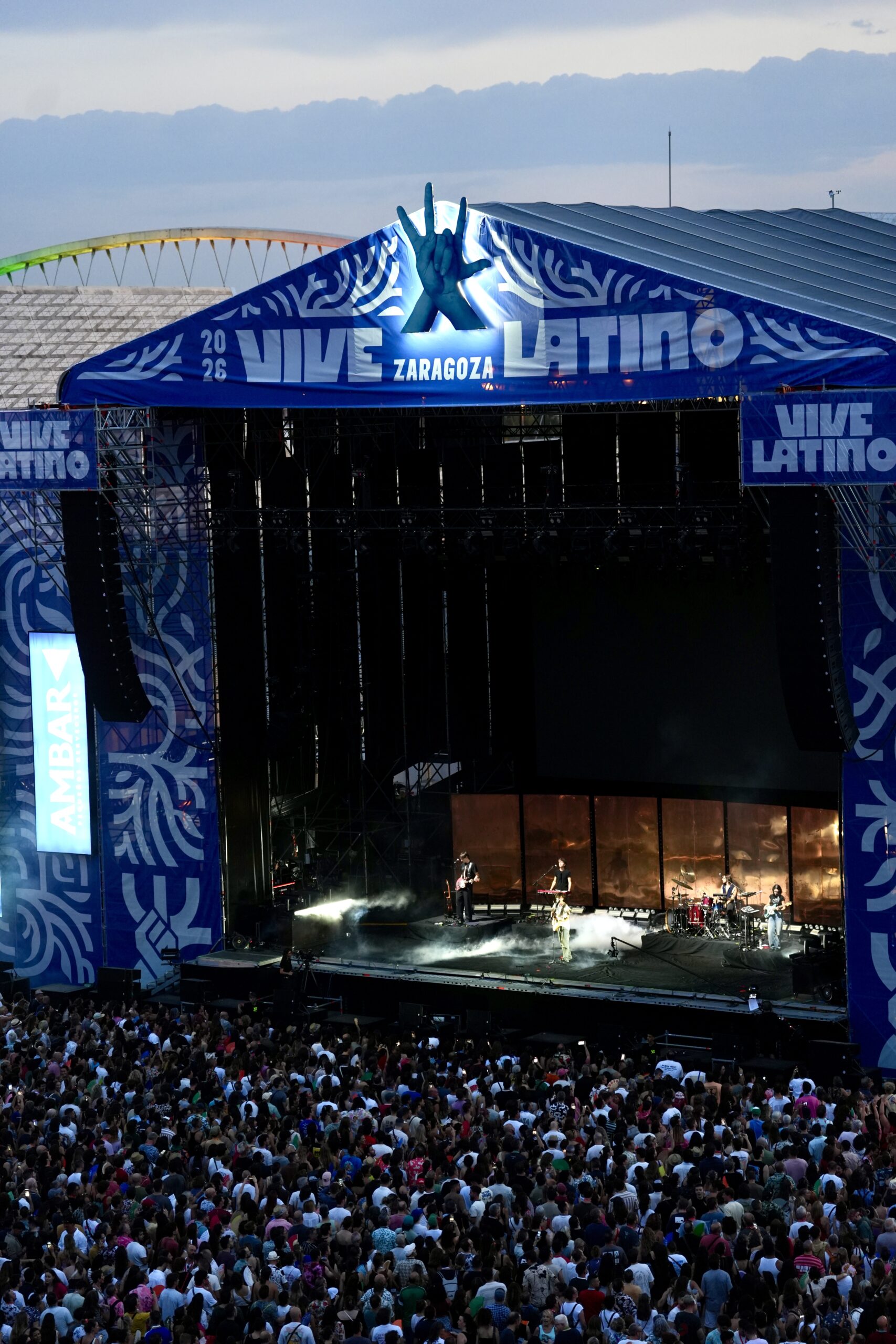
Vive Latino has wrapped up its fifth edition in Zaragoza with its strongest attendance since arriving in Spain. A total of 45,000 people passed through the Expo venue on Friday, September 4, and Saturday, September 5, selling out both days and confirming the growth of a festival that, five years after landing in the Aragonese capital, is already working on its return in 2027.
This year’s edition began with a figure that foreshadowed the public’s response. For the first time, all 15,000 festival passes went on sale sold out, followed by day tickets, bringing attendance to 22,500 people on each of the two days. The result brings Vive Latino’s cumulative attendance to about 200,000 since Zaragoza hosted the first European edition of the Mexico-born festival in 2022.
Over two days, more than 30 artists performed across the three stages set up at the Expo venue. Julieta Venegas, Amaia, Loquillo, M-Clan, Rigoberta Bandini and Rawayana were among Friday’s headliners, while Guitarricadelafuente, Siloé, Ojete Calor, Ultraligera, La M.O.D.A., Sonido Gallo Negro and La Plazuela took over on Saturday. They were joined by Aragonese bands and artists, as well as acts from several Latin American countries, sustaining the musical exchange between both sides of the Atlantic that is one of the festival’s defining features.
High temperatures were especially pronounced in the early hours of both days and affected visitors’ arrival times at the venue, although crowds grew as the afternoons progressed. The major nighttime concerts drew thousands of spectators and again highlighted a feature the organizers emphasized this year: the arrival of a younger audience alongside the fans who have followed the festival since its earliest editions.
Zaragoza Mayor Natalia Chueca said after the conclusion of Vive Latino that the fifth edition had exceeded expectations, emphasizing in particular the addition of new generations. The lineup encouraged that meeting of different audiences, with established artists such as Loquillo, M-Clan and Julieta Venegas sharing the bill with Amaia, Rigoberta Bandini, Siloé, Guitarricadelafuente, Ultraligera and La Plazuela.
The mix was not limited to age groups. Rock, pop, singer-songwriter music, punk, flamenco, electronic music, reggae, funk, cumbia and Cuban son coexisted throughout the weekend in a program that has expanded Vive Latino’s musical boundaries beyond its origins, which were primarily tied to Ibero-American rock. Over the past five years, Zaragoza has developed a version of the festival with its own identity, combining exchanges between Spanish and Latin American artists with the continued presence of Aragonese musicians.
A festival whose impact extends beyond the Expo
The outcome of this fifth edition goes beyond attendance figures inside the venue. Initial municipal estimates put the economic impact generated over the weekend at around €8 million, while hotel occupancy exceeded 80%. The figures remain provisional, but they reflect the festival’s growing influence on Zaragoza’s tourism, hospitality and retail sectors.
The growth becomes clearer when looking at its full trajectory. The first four editions had drawn about 155,000 attendees and generated, according to municipal data, a cumulative economic impact of more than €25 million. The 45,000 spectators in 2026 now bring total attendance to 200,000 people over five years, making this latest edition the largest held to date.
The Expo venue has been one of the factors underpinning that consolidation. Its size makes it possible to distribute the three stages and the various food, rest and service areas while keeping walking distances manageable—especially important for a festival built around simultaneous performances. This year, water stations and other services were also reinforced in response to temperatures that once again became one of the main challenges during the middle of the afternoon.
Vive Latino’s impact also has a dimension tied to Zaragoza’s international profile. The festival was founded in Mexico City in 1998 and chose the Aragonese capital as the site for its European edition, turning it into a meeting place for artists and audiences from Spain and Latin America for one weekend each year. After five editions, that relationship has made it possible to build an identity of its own that goes beyond simply bringing the Mexican model to Europe.
Organizers are already working on 2027
The 2026 edition also carried a particular significance. It completed the five editions originally planned for Vive Latino in Zaragoza since 2022, raising questions about the festival’s future in the city. Statements from its management, however, point to its continuation.
Vive Latino España director Nacho Royo confirmed ahead of this fifth edition that the organization is already working on the 2027 event and has artists who are virtually signed. Royo also said the aim is to continue raising the profile of the names on the lineup, a strategy that could strengthen the festival’s drawing power following this year’s record attendance.
For now, neither the dates of the next edition nor its first artists have been officially announced, and the terms of any new agreement to extend the festival for several more years have not been made public. The confirmed information supports discussion of preparations for 2027, but not yet of a new multiyear commitment between the parties.
The organization’s stated intention comes, in any case, after the best-attended of the five editions held so far. Vive Latino arrived in Zaragoza in 2022 as the first European venture of a festival with a long history in Mexico, and it has since steadily built its audience, attracted new generations and increased its impact on the city.
The 2026 results stand at 45,000 attendees, every ticket sold and about 200,000 cumulative admissions since the inaugural edition. Should the continuation now being prepared by organizers be confirmed, the 2027 edition will offer another opportunity to see how far a festival can grow after finding, in Zaragoza, a stable home for connecting the music scenes of Spain and Latin America.