


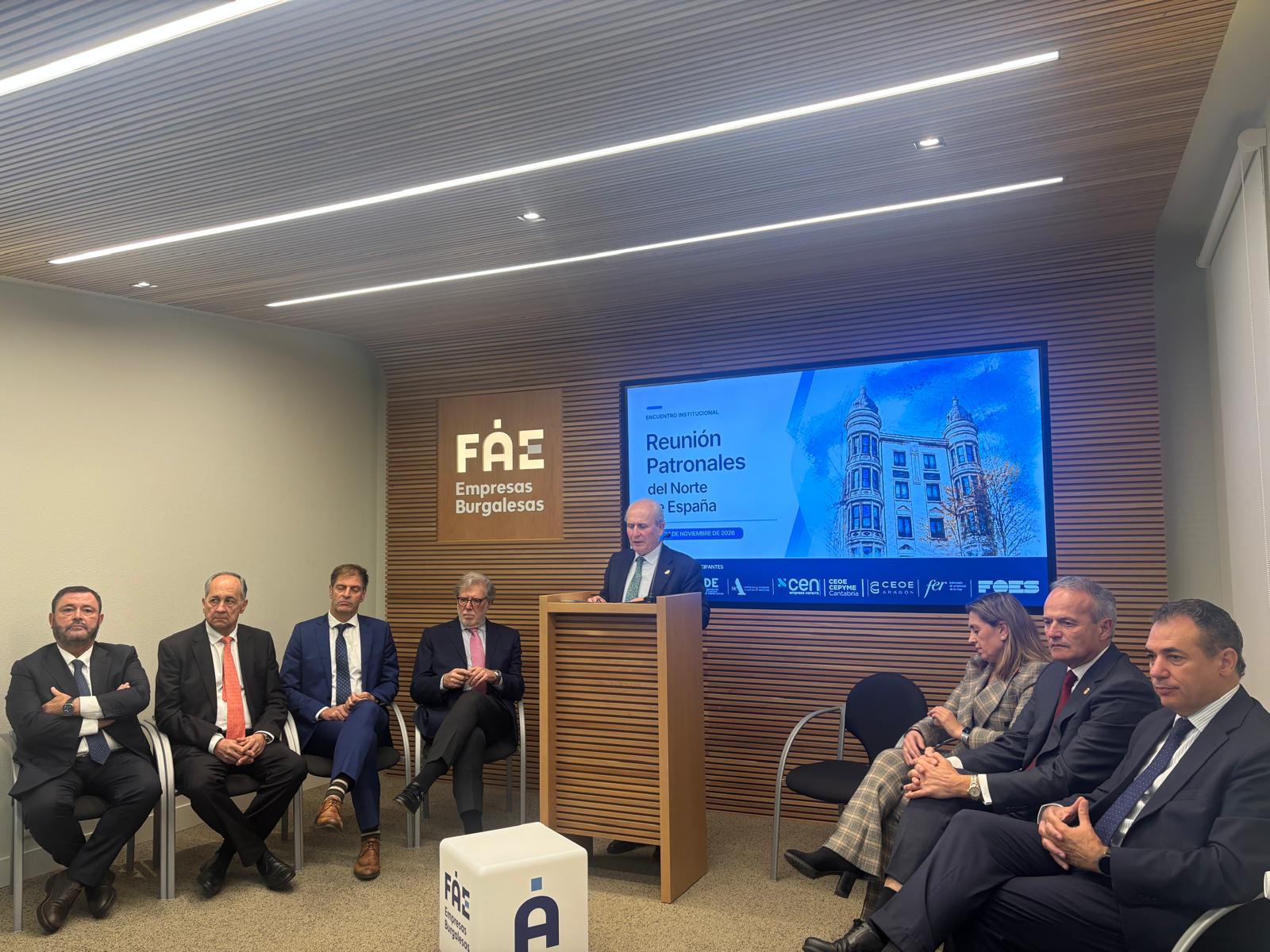
Eight business organizations from Burgos, Soria, La Rioja, Álava, Asturias, Cantabria, Navarre and Aragon met in Burgos to strengthen their joint strategy on the factors they believe are shaping economic activity. Their demands include increased electricity capacity, administrative simplification, measures to address absenteeism and a greater availability of skilled professionals.
The meeting, held at the Casa del Empresario and chaired by FAE President Nacho San Millán, was attended by Santiago Aparicio of FOES; Eduardo de Luis of FER; Juan Antonio Sánchez Corchero of SEA; María Calvo of FADE; Enrique Conde of CEOE-CEPYME Cantabria; Manuel Piquer of CEN; and Benito Tesier of CEOE Aragón.
San Millán called for continued cooperation among the organizations and for them to present a common position to public authorities. “Our regions have enormous potential, but we need the right conditions to develop it,” said the FAE president.
Power grids, bureaucracy and employment
The business associations placed energy among the priorities of their shared agenda. They are calling for greater grid capacity to accommodate new industrial projects, more investment in electrical infrastructure, planning aligned with the needs of the productive sector and competitive energy costs. The organizations believe capacity constraints could put investments and industrial projects on hold.
They also call for a simpler, more stable and proportionate regulatory framework, as well as greater involvement by business organizations in drafting regulations. In their view, the accumulation of obligations, procedures and regulatory provisions places a particularly heavy burden on small and medium-sized enterprises and the self-employed.
On labor issues, the organizations have highlighted the impact of absenteeism on productivity and business operations. They propose better coordination among health services, mutual insurance associations, the National Social Security Institute and companies.
The availability of skilled professionals and generational succession round out the pillars of the shared agenda. The organizations say some companies with the capacity and opportunities for growth are struggling to fill positions because of a shortage of qualified professionals. They therefore call for training to be better aligned with labor market needs, for vocational education and dual vocational training to be strengthened, and for talent recruitment to be facilitated.
The business associations also consider it necessary to adopt measures to address generational succession, particularly among SMEs and family businesses, arguing that the closure of a viable company due to a lack of succession results in the loss of economic activity and jobs, especially in rural areas.
The meeting follows up on the alliance launched on May 12 in Logroño, where the eight organizations signed the Business Declaration for Competitiveness. The document laid the groundwork for a shared position calling for businesses, business owners and the self-employed to play a greater role in the political and economic agenda. The organizations intend to maintain joint dialogue with public authorities on energy, regulatory simplification, absenteeism and the availability of skilled professionals.