



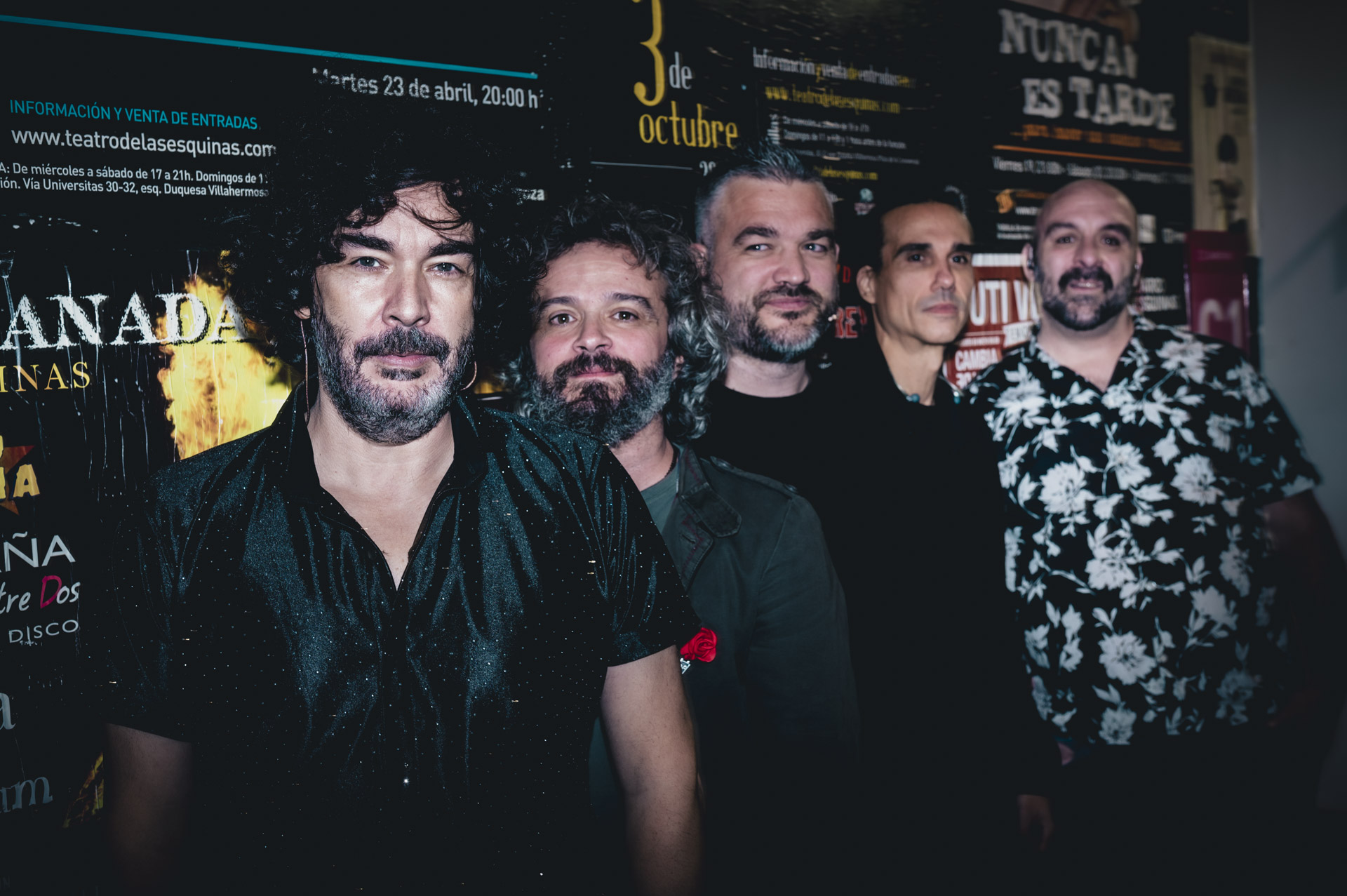
Volador has not returned to repeat itself. The Aragonese band is back on stage to reconnect with songs that have been silent for years, to see if there is still an audience willing to listen, and to confront a question that goes beyond nostalgia: what does Volador sound like in 2026?
Santiago Vicente —known as Ana Azul within the group— responds from that strange place where memory and uncertainty coexist. He recalls the first rehearsals, the tours in a van, the years when the band always seemed on the verge of making a definitive leap, and the decision to stop in 2011. But most of all, he speaks of what is still to be discovered, as Volador is already preparing new songs and wants to see if, after all these years, the essence of the band is still there.
Three songs for one
Volador was born out of three friends: Óscar, the singer; Eduardo, the guitarist; and Santiago Vicente. Over time, Miguel Mercadal joined on drums, and Sergio Rodrigo came on bass. While the lineup changed, Vicente believes those two musicians became an essential part of the band’s history: «The core has always been the three of us, but with Miguel and Sergio we experienced Volador’s golden age. They are part of the group, and much of the reason the band sounds good live is thanks to them.»
Santiago and Óscar have known each other since they were four years old. They met Eduardo when they were around 15 or 16. None came from a family professionally linked to music, and their initial steps were closer to enthusiasm than technique. «We started practically from scratch. I remember that with my first paycheck, I bought a keyboard. Óscar paid for some singing lessons, we bought a guitar… and that’s how we evolved.»
Eduardo, Vicente explains, was already an extraordinary guitarist at a very young age. The others had to learn on the fly, and those first rehearsals were filled with improvisation. In one of those early formations, they even had a drummer who didn’t know how to play the drums but liked to say he was a drummer «to pick up girls.»
The lack of experience didn’t prevent them from having a clear ambition from the start: to make songs and to make them together. All three wrote music, which could be both a blessing and a challenge. «We all had songs in our heads, and from those three, one had to emerge. That was possibly the most significant challenge for the group. It’s like a three-way marriage. For many years, I think we managed it well.»
Within that creative coexistence lay one of the keys to Volador. Eduardo brought in his influences from Anglo-Saxon pop; Óscar came from Spanish pop and less commercial propositions, while Santiago leaned more towards electronic and electronic pop. They had different tastes but also shared common ground, such as Radio Futura, the epic pop of Muse, and much of the Aragonese scene that paved the way before them.
Las Novias, Niños del Brasil, and Héroes del Silencio were part of that musical landscape. Vicente still keeps the ticket from the concert held at La Romareda where several of those bands performed together. Over time, Volador would cover songs by Bunbury and share the stage and collaborations with musicians who had been part of their youthful references.
How to define the music of Volador? Óscar found an expression for it: dream pop. Santiago accepts it, although he has another definition that he still prefers: «The best review we received was from a journalist who wrote that ‘Volador sounds like Volador.’ I think that’s the best compliment you can get. If you’ve achieved that, that’s it.»
Learning the craft
The evolution of Volador was not linear. The group started with limited musical knowledge, but soon found people capable of transforming that enthusiasm into a professional project. One of the pivotal names was Laurent Castagnet, the band’s first producer and drummer for many years for Loquillo. His work was not limited to the studio: «He taught us how to make the songs flow live, how to compose them, and how to be on stage. We learned a lot from him.»
Kike Gallego was also crucial, linked to the careers of Héroes del Silencio and Amaral and later the manager of Volador. The arrival of both made those young musicians begin to understand that a band needs more than just songs: you have to know how to play them, defend them live, record them, present them, and find the right moment for them to reach the audience.
Then came Madrid. At their first concert in the capital, Warner showed interest in the group immediately after the performance. «We had just played, and they told us they wanted to sign an editorial contract with us because they liked what we were composing. We were around twenty years old; it was our first time performing in Madrid, and a multinational was telling you they saw something in the band.»
It was not yet a recording contract, but it was an unmistakable signal that something was happening. Volador had managed to capture attention just when the traditional model of the music industry was beginning to transform, and the band experienced firsthand the transition between record labels as the primary gateway, the emergence of the internet, home studios, downloads, and streaming.
Years later, they still remember a phrase that summed up that transformation: «If you had come six years earlier, we would have put 20,000 euros on the table to record an album. I love you, but right now I can’t do anything.» For Vicente, having someone knowledgeable about the industry remains important, even though the current landscape is much broader: «There is an artistic side and a technical side: knowing how to shape the songs, how to sell them, and what to do or not do at any moment. Having someone in the industry who believes in your project and is passionate about it is still key.»
The van and weariness
Miguel Mercadal was the one who pushed Volador to leave Zaragoza. «When Miguel joined, he told us: ‘Here in Zaragoza, you’re the kings of the mambo, but you need to take the van and go out there.’ And he was right.» The band began to organize its own tours, searching for venues, scheduling interviews, and building a network of contacts outside Aragon. Galicia, Andalusia, Alicante, and other cities became part of the map for a group that advanced through persistence.
«It was grind and sweat. You played somewhere on Friday, another place on Saturday, and during the week, we all had our jobs. It was tough, but also very fun. I remember it as one of the best times of my life.» For years, Volador was a road band. That experience allowed them to grow as musicians and as a group, but it also fed a feeling that would eventually become exhausting: the feeling of being perpetually on the brink.
On the brink of making that leap, of securing the next contract, or of finally establishing themselves. In 2011, they decided to stop, although they were not experiencing a bad artistic moment. They had released new material, gone on tours, and developed ambitious projects; in the last two years, they had played dozens of concerts across Galicia, Andalusia, and other places.
«For many years, we were right there, right there,