


The ROSI Energy Iberia project to install a photovoltaic panel recycling plant in La Puebla de Híjar has passed one of its main administrative hurdles. The Aragonese Institute of Environmental Management (INAGA) has issued a favorable, but conditional, environmental report for the future installation at the Venta del Barro industrial park.
The resolution spares the project from undergoing an ordinary environmental impact assessment; however, the company must still obtain the remaining necessary permits and licenses before commencing operations.
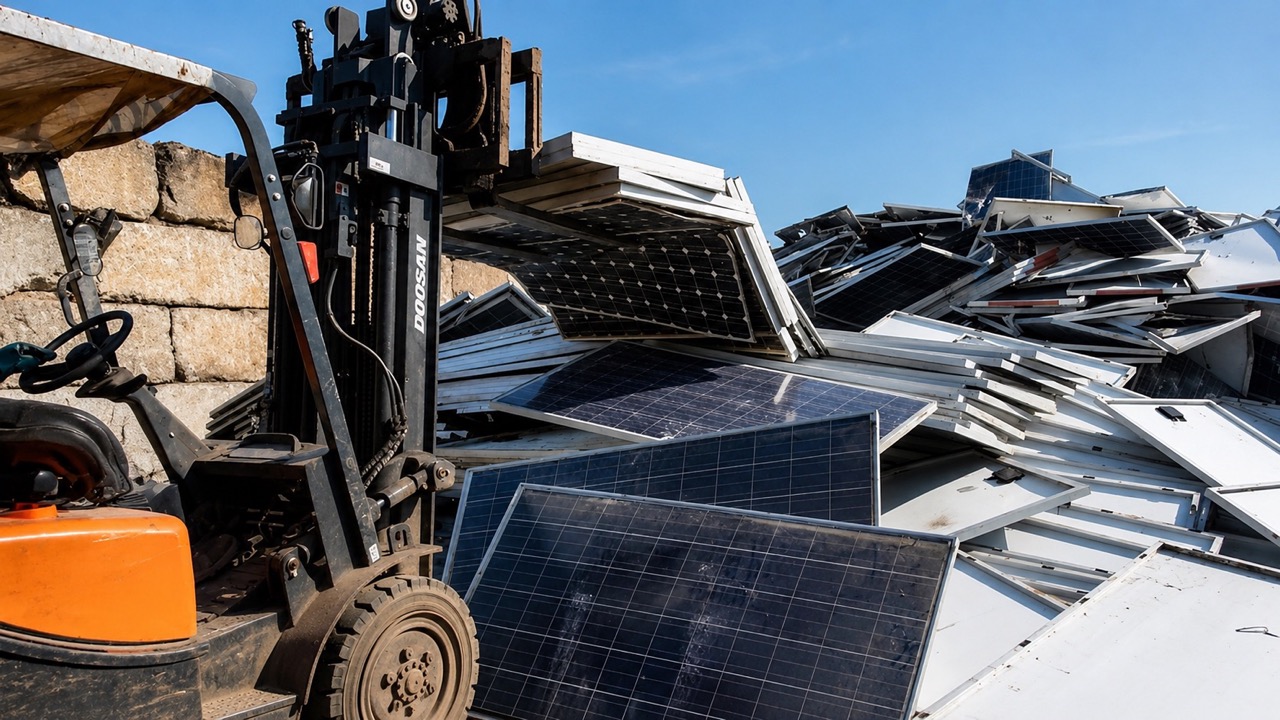
The plant will process silicon photovoltaic panels that have reached the end of their useful life. Its capacity will gradually increase: it will start with around 2,000 tons annually and is expected to reach 10,000 tons by 2030. The installation is expected to generate approximately 20 jobs and could begin operations in the first quarter of 2028, once the pending administrative procedures are completed.
Recovering materials from panels
The activity of ROSI addresses one of the challenges accompanying the growth of solar energy: what to do with panels when they become non-operational or no longer competitive.
Photovoltaic modules contain materials that still retain industrial value, such as aluminum, glass, silicon, copper, and silver. The aim of the plant will be to separate and recover these materials so they can be reused as raw materials in other processes.
The treatment will begin with the mechanical dismantling of the panels. This will be followed by thermal processes of pyrolysis, mechanical separation, and chemical treatment. The combination of these phases will allow for the removal of various components and the recovery of those that maintain sufficient quality for industrial reuse.
The facility will also be able to classify some modules for a second life. Panels that pass a technical inspection can be repurposed for new uses instead of entering directly into the recycling process.
The project’s documentation estimates that the plant will be able to recover up to 94% of the materials contained in the modules. ROSI, on the other hand, states that its INSPIRE-PV technology can achieve recovery rates exceeding 95% in certain configurations.
An already constructed building
ROSI will install its main operations in an industrial building of approximately 3,250 square meters located on a plot close to 30,000 square meters. Utilizing an existing facility will limit the need for new constructions, although the project includes plans to adapt adjacent spaces and progressively expand storage areas.
The plant will feature treatment areas, warehouses, a control room, offices, and technical facilities to manage emissions and process water.
The thermal and mechanical phases will operate continuously, 24 hours a day, in three shifts, across 330 days a year. The chemical treatment will be conducted over 253 days. Taking maintenance work into account, the facility will remain operational year-round.
The expected energy consumption is around 10 gigawatt-hours annually. The company will also install photovoltaic panels for self-consumption, although the environmental documentation does not indicate that the plant can cover all its energy needs with these panels.
A project linked to the Mudéjar Knot
ROSI’s establishment in La Puebla de Híjar is part of the industrial initiatives related to the support plan for the Mudéjar Knot of Just Transition. The program focuses on the economic transformation of the regions affected by the closure of the Andorra thermal power plant.
Endesa included among the initiatives associated with this process the creation of a plant dedicated to recovering materials from photovoltaic panels. The proposal introduces an activity complementary to the deployment of renewable energies in northern Teruel.
The plant will not produce electricity. Its role will be to work on a later phase of the solar facilities’ life cycle and recover raw materials that would otherwise become waste.
The activity will be conducted on non-hazardous waste, according to the project’s environmental documentation. Nevertheless, INAGA’s authorization establishes preventive and control conditions that the company must comply with during the construction and operation of the plant.
ROSI’s European expansion
ROSI is a French company specializing in the recycling of photovoltaic modules and the recovery of high-value materials, particularly silicon and silver. The company operates a first industrial facility in France and is expanding its capacity in Europe.
In April 2026, it announced financing of over 20 million euros, sourced from an investment round and French and European subsidies. Part of these funds will be allocated to bolster its industrial projects, including the planned plant in Teruel.
The La Puebla de Híjar installation will be one of the main projects in that expansion. Its launch will bring an industrial activity linked to the circular economy and the recovery of strategic raw materials to the region.
The project still needs to complete the administrative phase and construct the plant before beginning operations. If it adheres to the planned timeline, La Puebla de Híjar will have a facility capable of processing thousands of tons of solar panels and converting some of their components into new materials for the industry by 2028.