



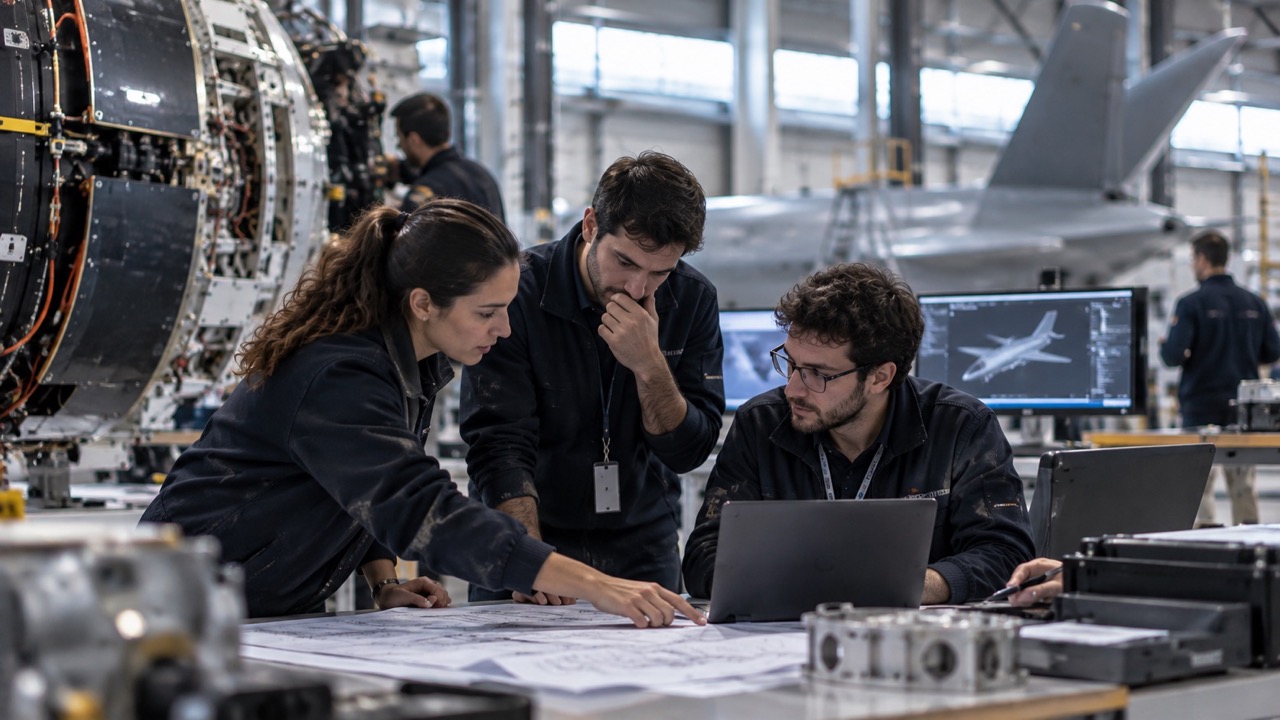
Aragon aims to gain a larger foothold in the defense industry and dual-use technologies. Companies expanding their facilities, a Hub that already brings together around 150 organizations, new investments linked to the aerospace and military sectors, and projects such as Teruel’s future Comprehensive Air Training and Mobility Center (CIEMA) point to a growth scenario. But as investments begin to take shape as concrete projects, a less visible and likely decisive question emerges: where will the professionals needed to sustain that growth come from?
The case of Up Lifting in Huesca brings the debate down to the company level. The company will invest €11.3 million to expand its PLHUS factory from 8,000 to 20,000 square meters. Its CEO, Roberto Garzo, has identified finding the workers needed for the expansion as one of the project’s major challenges. Company estimates point to between 40 and 50 professionals, with roles ranging from welders to engineers.
Demand, therefore, is not limited to highly specialized university graduates. The development of a modern defense industry requires engineers and specialists in electronics, automation and digital technologies, but also welders, electricians, assemblers, maintenance technicians and other professionals from vocational training and traditional industry.
This intersection of new technologies and existing industrial capabilities could become one of the factors determining how far the sector can grow in Aragon.
An ecosystem beginning to take shape
The Aragon Defense Hub was created with precisely this cross-cutting approach. It is not conceived solely as a grouping of military equipment manufacturers, but as an ecosystem bringing together industry, logistics, technology, research, training, entrepreneurship and infrastructure.
The Hub currently puts the number of companies and organizations involved in the project at around 150. Its own planning includes a specific training and entrepreneurship stream that proposes studying professional profile requirements and comparing them with the talent available.
The inclusion of this analysis is significant. The ability to attract investment may lose some of its impact if companies are subsequently unable to find the workers needed to carry out their projects.
Moreover, the needs are particularly broad because many of the companies that may enter this market do not work exclusively for defense. They are industrial or technology companies with products and capabilities that may have civilian and military applications. This dual-use industry considerably broadens the range of occupations linked to the sector.
Up Lifting is a good example. It manufactures heavy machinery and lifting equipment for both markets. The growth of its Huesca plant requires industrial profiles already common in other productive sectors and for which numerous companies are also competing.
Teruel: aerospace, defense and training are beginning to converge
Teruel is another of the places where the relationship between investment and talent can best be observed. Teruel Airport has established itself as an aerospace industrial hub specializing in activities such as aircraft maintenance and storage, and it continues to add new projects.
The Comprehensive Air Training and Mobility Center will join this ecosystem. The Ministry of Defense plans to invest close to €42 million to develop CIEMA at Teruel Airport. The project will be devoted to training related to air transport and deployment support, and will include capabilities involving military transport aircraft, drones and landing zones for crew training.
According to projections released by Teruel Airport itself, the full project could be associated with around 350 jobs once all infrastructure has been developed. Not all of those jobs can automatically be interpreted as new industrial positions or assigned to a single professional profile, but the scale of the project points to increased demand for skills related to the aerospace and technology sectors.
University education is beginning to respond to this transformation. In March, the University of Zaragoza began work to introduce a Bachelor’s Degree in Aerospace Engineering at the Teruel Campus. A committee comprising University members and external specialists is working on the documentation required to design and validate the future program.
The choice of Teruel is directly tied to the development of the province’s aerospace ecosystem. Documentation prepared by the University itself notes that companies based at the airport have been expressing the need for aerospace engineers to support the growth of their facilities.
The degree is still in the design and validation process and therefore cannot be regarded as an immediate response to current needs. Nevertheless, its development shows that the relationship between industrial development and education is beginning to be incorporated into Aragon’s academic decision-making.
It is not all about universities
The talent challenge cannot be addressed solely by creating university degrees. The case of Up Lifting clearly illustrates the importance of industrial trades and vocational training.
INAEM’s 2026 training offering includes, among other specialties, courses in MIG-MAG and TIG welding, industrial automation, industrial piping and drone-related training. Programs are available in Zaragoza, Huesca, Monzón and Teruel, showing that some of the skills demanded by the new industry are already part of the employment training system.
The question will be whether the number, specialization and speed at which these professionals are trained are sufficient to meet the demand that business growth may generate. That comparison still requires more detailed data from the companies themselves.
There is also training specifically linked to defense. The University of Zaragoza and the University Defense Center offer the Master’s Degree in Management and Administration of Defense Systems Procurement, aimed at training specialists in the planning, contracting, management and monitoring of procurement programs. For the 2025-2026 academic year, 25 places were offered and all 25 were filled.
Aragon therefore has training components at different levels, but industrial growth poses the challenge of connecting them more precisely with companies’ real needs.
From the Armed Forces to business
There is also another potential source of professionals. In June 2026, the Ministry of Defense and the Government of Aragon signed an agreement to develop, through INAEM, career guidance, employability enhancement and job placement measures for military personnel, with priority given to those on temporary contracts with the Armed Forces and reservists with special availability.
The initiative opens an interesting avenue for connecting military experience with the civilian labor market. Some personnel leaving the Armed Forces have technical, logistical or organizational knowledge that may be transferable to industrial, technology and service companies related to defense.
It is not in itself a solution to the talent challenge, but it adds another component to a system that will need to combine universities, vocational training