



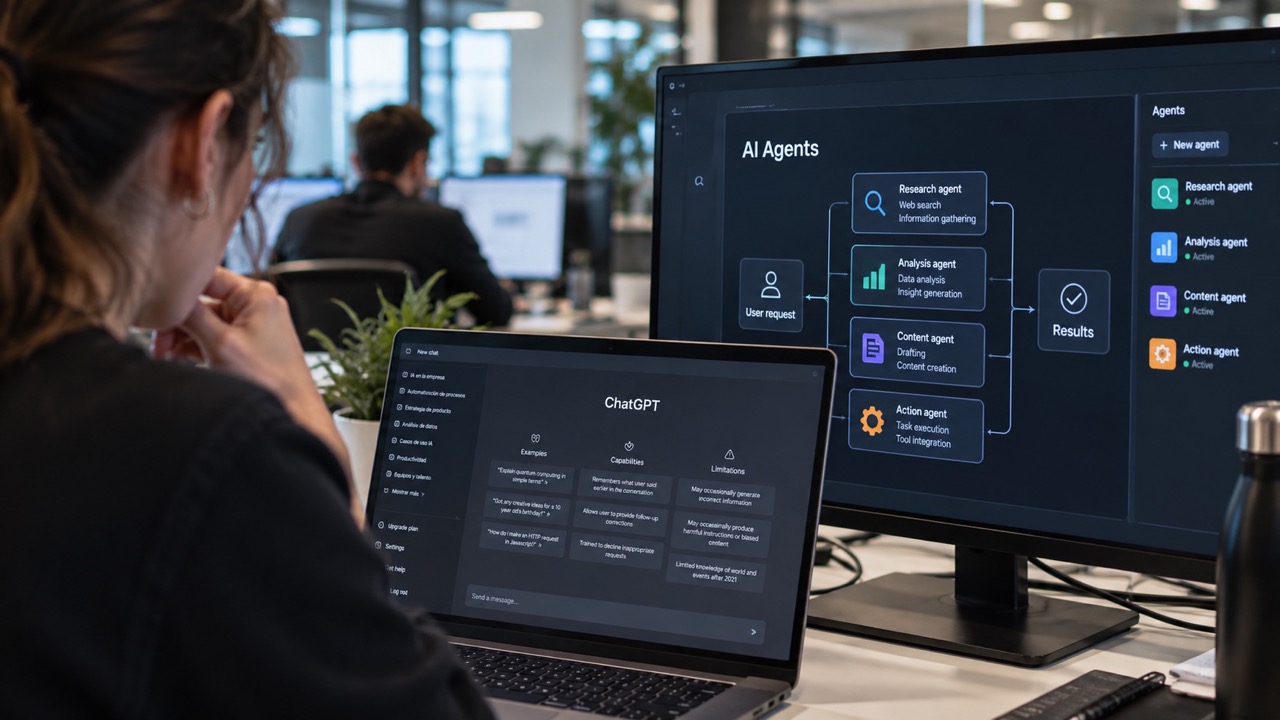
Generative artificial intelligence has rapidly become part of the day-to-day work of companies and professionals. Drafting an email, summarizing a report, translating a document, or searching for information are already relatively common uses. The technology industry, however, is working toward a far more ambitious scenario: one in which AI does not merely respond when someone asks it a question, but can receive an assignment and independently carry out part of the work needed to complete it.
So-called AI agents are at the center of that evolution. Huawei has just put numbers on what it expects to happen over the next decade, and its projections are difficult to ignore. The Chinese company estimates that by 2035, more than 90% of AI-generated token traffic will come from agents and that annual global consumption of these processing units could increase 100,000-fold.
These are Huawei estimates, not an independent forecast of market developments. Even so, they are noteworthy because they reflect where some of the largest technology companies are directing their investments and help explain why computing capacity has become one of the key areas of international competition.
When AI stops waiting for instructions
An agent can be given an objective and sequence different actions in an effort to achieve it. It can retrieve information, use applications, analyze data, or prepare documents without a person having to specify each step individually.
In a corporate setting, the possibilities are broad. One system could periodically review certain commercial data, detect deviations, and prepare a report for the head of the department. Another could classify customer inquiries, retrieve the information needed to answer them, and prepare a response. In administration, procurement, or logistics, task sequences that currently require moving from one application to another could likewise be automated.
None of this necessarily means handing over the entire process to a machine. Indeed, one of the issues companies will have to resolve is exactly how far they are willing to let that autonomy extend.
The distinction is important. It is one thing to use artificial intelligence to draft an email and quite another to allow it access to corporate email and authorize it to send messages. The same applies to a system that analyzes invoices versus one authorized to approve transactions, or one that retrieves commercial information versus one capable of modifying it.
As agents become embedded in business processes, decisions on permissions, data access, security, and oversight will be as important as the choice of technology itself.
Behind the agents lies a vast infrastructure
Huawei’s projections also have an industrial dimension. If agents work for longer periods and perform multiple operations to complete each assignment, they require far more computing capacity than an isolated query to an AI assistant.
Huawei estimates that over the next decade, the scale of large computing systems will need to increase 100-fold, while the cost of tasks performed by agents will need to fall substantially. That demand helps explain the investments major technology companies are making in processors, data centers, networks, and storage.
This week in Shanghai, the Chinese company unveiled new computing systems for artificial intelligence and an architecture designed to connect a very large number of specialized processors. Its plans include configurations of up to one million NPUs working in coordination.
Huawei is seeking to expand its capabilities in a market also shaped by U.S. restrictions on China’s access to certain advanced semiconductors. The company is developing new generations of its Ascend processors while facing domestic demand that, by its own admission, currently exceeds its production capacity for AI computing equipment.
The scenario Huawei describes for 2035 is therefore linked to its own business. The company is both the author of the forecast and one of the manufacturers seeking to supply part of the infrastructure required if that growth materializes. That context should be kept in mind when interpreting such large figures.
For companies, the change will be less spectacular and more practical
Most Spanish companies will not need to worry about building data centers or deciding which processors to use. Their challenge will be much closer to home: finding AI applications that genuinely improve their operations.
So far, much of the adoption of generative artificial intelligence has taken place through standalone tools and employees’ own use of them. Agents could take that integration a step further because they require access to companies’ internal processes.
Before assigning a task to an autonomous system, companies will need to know what information it requires, which applications it must consult, what decisions it can make, and which must remain the responsibility of a person. They will also need to determine who is accountable when the system makes a mistake and how its actions can be reconstructed.
In this area, the challenge will not be solely technological. Many companies will need to review processes built over years around habits, spreadsheets, emails, and applications that are not always connected to one another. Automating them will first require understanding them.
Training will be another part of that process. Huawei, for example, says its Spain Academy trained 10,000 people in digital skills during 2025 and remains committed to reaching 50,000 over five years. Artificial intelligence, cloud computing, connectivity, and cybersecurity are among the subjects covered by its programs.
Huawei’s initiative is one of many emerging around these technologies. For companies, particularly small and medium-sized businesses, the challenge will probably lie less in having specialists capable of developing proprietary models than in having people who know how to use the available tools, integrate them into day-to-day work, and recognize where they should not be used.
The figures Huawei projects for 2035 may prove accurate or fall far short of reality. Nine years is a long time in a sector that is changing rapidly. What matters for companies is closer at hand: agents are beginning to move beyond technology demonstrations and into products and applications for professional use.
That introduces a new question in the adoption of artificial intelligence. Until now, companies have mainly asked what they could use it for. From now on, they will also have to decide which tasks they are willing to place in its hands.