


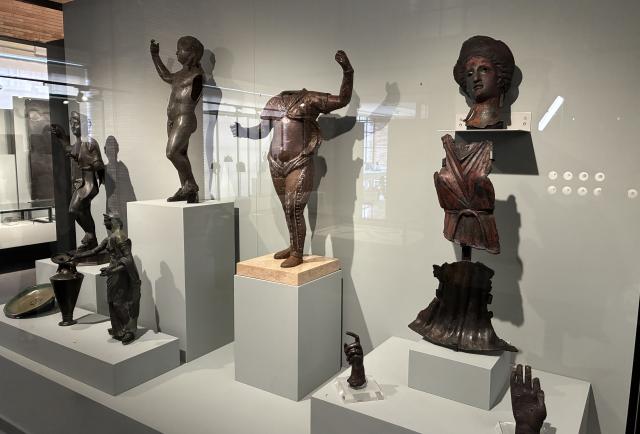
The Museo de Zaragoza has loaned nine archaeological artifacts to the exhibition In the Shadow of Vulcan: Roman Bronze in Hispania, now open at the Museo Nacional de Arte Romano in Mérida. The exhibition brings together more than 400 objects and places several Aragonese discoveries among the key evidence of bronze use on the Iberian Peninsula.
Roman bronze in Hispania brings together more than 400 pieces in Mérida
Organized by the Museo Nacional de Arte Romano, the exhibition marks the 40th anniversary of its current building and inaugurates a new temporary exhibition gallery. It also revisits the narrative of Roman Bronzes in Spain, an exhibition held in 1990 at the Palacio de Cristal in Madrid’s Retiro Park.
The works come from museums and archaeological collections in cities including Madrid, Seville, Huelva, Cádiz, Jerez de la Frontera, Córdoba, Burgos, Lugo, Ourense, Badalona, and Mérida. The exhibition examines the role of bronze in political, legal, religious, economic, military, and domestic settings.
The selection spans more than a millennium of bronze craftsmanship, from pre-Roman societies to Late Antiquity and its subsequent artistic legacy. The exhibition highlights the typological, symbolic, artistic, and functional diversity of this production in Hispania.
Pieces from the Museo de Zaragoza trace the history of the Ebro Valley
Among the Aragonese loans is a Celtiberian Hispano-Chalcidian helmet, from the area surrounding Aranda de Moncayo and dating to the 3rd century BC. The piece is included in the section devoted to the pre-Roman world.
The exhibition also includes the Dama de Fuentes, a female sculptural ensemble discovered at the La Corona site in Fuentes de Ebro. Comprising a head, bust, and tunic, along with two hands of uncertain attribution found nearby, it dates to the 1st century BC and is one of the few surviving examples of large-scale Roman bronze sculpture in the region.
The Bronce de Botorrita II, from Contrebia Belaisca and dated to 87 BC, records the legal proceedings and ruling in a dispute over the construction of an irrigation canal. It is considered one of the oldest judicial documents on the Iberian Peninsula.
Displayed alongside it is the Bronce de Agón, dating from AD 117 to 138, containing regulations for an irrigation community and rules governing water use. Both documents reflect the strategic value of water resources in the Ebro Valley during Antiquity. Zaragoza’s contribution is rounded out by, among other pieces, a Celtiberian horse muzzle from Contrebia Belaisca, dating to the first quarter of the 1st century BC and linked, through its technique and decoration, to contexts of social and military prestige.
The exhibition will remain on view in Mérida through March 2027
In the Shadow of Vulcan: Roman Bronze in Hispania will remain open at the Museo Nacional de Arte Romano in Mérida through March 31, 2027. The program includes the 23rd International Congress on Bronzes in Antiquity, a research gathering on the field that will bring together specialists from several countries.