



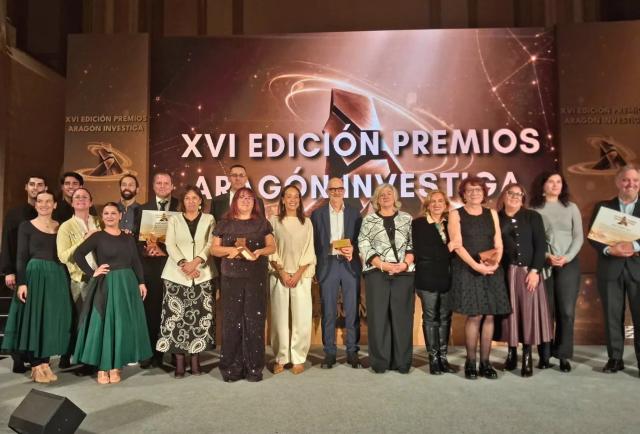
The Aragón Investiga awards held their 16th edition on Wednesday, November 25, at a gala bringing together researchers and representatives of academic, scientific, and business institutions. The jury recognized five categories, honoring Ángel Lanas Arbeloa, Carlos Anerillas Aljama, the Pyrenean Institute of Ecology, the project led by Concha Lomba Serrano, and the CONTER initiative by the University of Zaragoza and Ariño Duglass.
The regional minister for Education, Science and Universities, Carmen Susín, congratulated the award-winning individuals and organizations, noting that every research project reflects years of effort, talent, perseverance, and dedication. Also attending the event were Pilar Gayán, director-general for Science and Research, and María Luisa Feijóo, director-general for Universities.
The Aragón Investiga ‘Miguel Servet’ Award for Research Excellence went to Ángel Lanas Arbeloa for a career of more than four decades devoted to translational research into digestive diseases. The award recognizes his contributions to the prevention, diagnosis, and treatment of these conditions, including characterizing the risk of gastrointestinal bleeding associated with the use of nonsteroidal anti-inflammatory drugs and acetylsalicylic acid, developing gastroprotection strategies, and improving the management of Helicobacter pylori infection.
Carlos Anerillas Aljama received the Aragón Investiga ‘Blanca Catalán de Ocón’ Young Researchers Award for his track record and potential in the study of cellular senescence, aging, and related diseases. In September 2025, he joined the Aragon Institute of Health Sciences as an ARAID researcher and group leader, where he launched his own research line into the survival mechanisms of senescent cells and strategies to identify or selectively eliminate them when they prove harmful.
His body of work includes 35 scientific papers, eight of them as corresponding author, as well as studies published in Science Advances, Nature Communications, and Nature Aging.
Ecology, art and knowledge transfer
The Aragón Investiga ‘Fidel Pagés’ Award for Public Institutions went to the Pyrenean Institute of Ecology (IPE), part of the Spanish National Research Council. The jury recognized its contribution to understanding and conserving terrestrial and mountain ecosystems. Its work spans fields including climatology, environmental hydrology, biodiversity, plant ecology, ecological restoration, and the reconstruction of past environmental change, from the semiarid areas of the Ebro Valley to the high Pyrenees.
The project The Recovery of Women Artists in Spain and Their Relationship with Europe, 1804-1939, led by University of Zaragoza Professor of Art History Concha Lomba Serrano, received the Aragón Investiga ‘María Andresa Casamayor’ Award for Research with a Gender Perspective. The research line has been developed over two decades and has made it possible to identify and study the careers of nearly 900 women artists, deepen understanding of their training and professionalization processes, and locate works that expand the known artistic heritage.
The knowledge-transfer award, known as the Aragón Investiga ‘Ramón y Cajal’ Award, went to the project Development of Efficient Multilayer Coatings for Energy Control in Architecture and Rail Transport CONTER (RTC2019-007368-3). The initiative brings together the University of Zaragoza and Ariño Duglass, with Enrique Carretero Chamarro serving as principal investigator for the university and Leyre Tejedor Recio representing the company.
CONTER combines materials research and industrial development to design glass coatings for sectors including construction and rail transport. Its objectives include modifying glass’s optical properties through low-emissivity and solar-control coatings, improving energy efficiency, and offering new options for aesthetic finishes. The project builds on more than 25 years of collaboration between the two organizations and the ‘Francisco Villuendas’ sputtering pilot facility.
The jury comprised Pilar Gayán, Pilar Pina Iritia, M.ª Jesús Lázaro Elorri, Juan Adánez Elorza, Jesús Santamaría Ramiro, and Sergio Vicente Serrano. Susín said Aragón has a world-class scientific community and advocated support for researchers, the recruitment of young scientists, and collaboration among universities, research centers, and companies.