



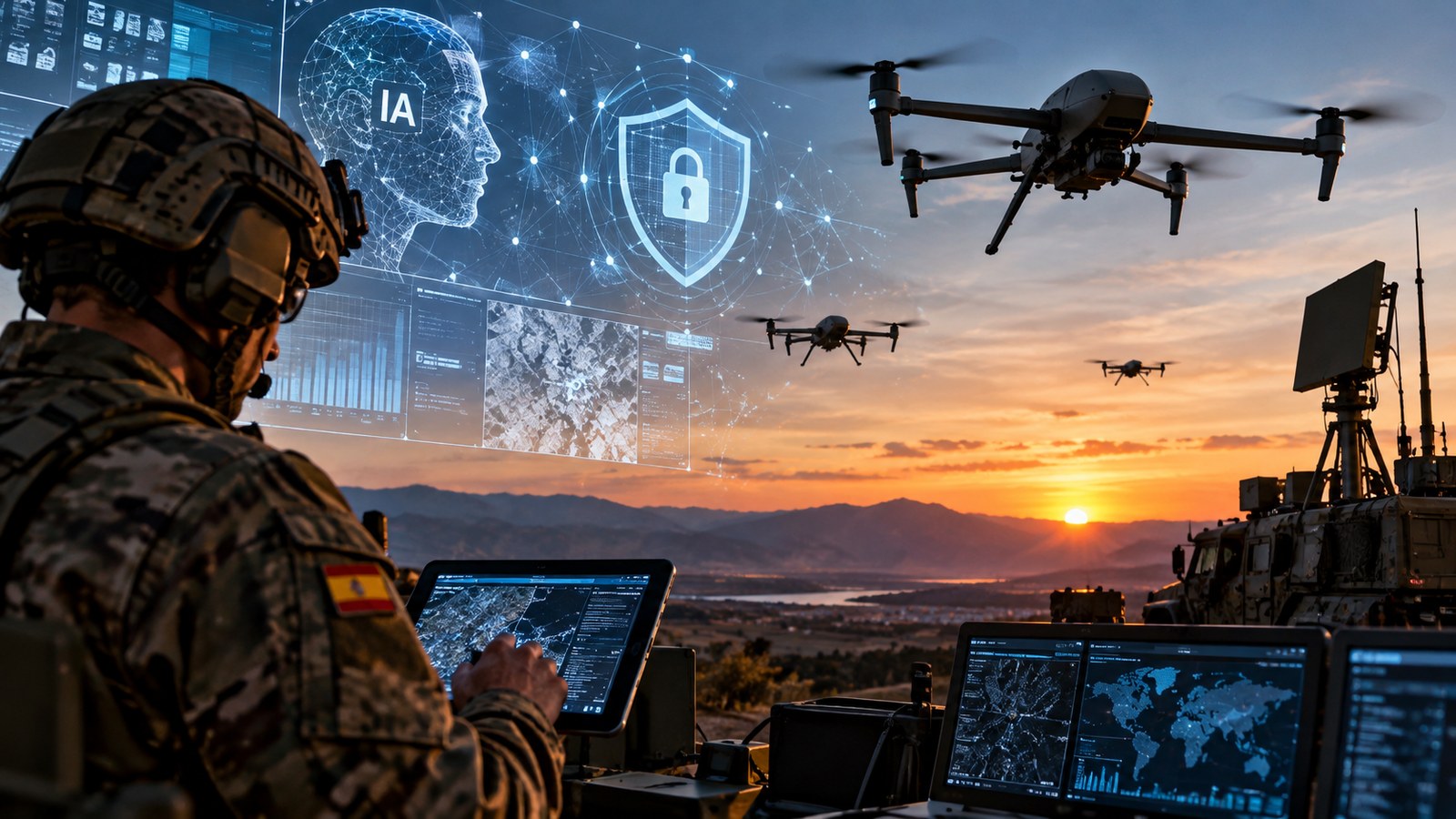
The Ministry of Defense aims to expand the Spanish technology industry’s involvement in developing new military capabilities. Artificial intelligence, cybersecurity, unmanned systems and advanced communications are among the priority areas in its 2026 Defense Technology and Innovation Strategy, a roadmap designed to leverage advances in civilian research and strengthen national and European technological autonomy.
The strategy’s main guidelines were presented on Oct. 8 during a meeting of AMETIC’s Dual Technologies for Defense Commission. AMETIC is the association representing Spain’s digital industry. The meeting included Vice Admiral Fernando José Suárez Fonseca, deputy director general for Planning, Technology and Innovation at the Ministry of Defense, who outlined the technological priorities that will guide the department’s research, development and innovation initiatives.
The strategy responds to a shift in military requirements, in which technologies also used in civilian sectors are becoming increasingly important. Artificial intelligence systems, advanced computing, secure communications networks and robotics can find applications in fields as diverse as industry, logistics, health care and defense.
From civilian research to military capabilities
One of the strategy’s objectives is to facilitate knowledge transfer between the scientific and technological system and the defense industry. The Ministry intends to leverage developments already available in the civilian market when they can be adapted to military operational needs, avoiding duplication in research and encouraging collaboration among different types of organizations.
The identified areas include artificial intelligence, cyber defense, the tactical combat cloud, electronic warfare, autonomous and unmanned systems, and space capabilities. The strategy also considers emerging technologies with potential for longer-term application, such as quantum computing, directed energy and hypersonic systems.
This approach opens up opportunities for collaboration with companies that have not traditionally worked on military programs. Companies involved in software development, electronics, sensors, industrial automation or communications may have expertise applicable to defense projects, although their participation will depend on the technical, industrial and security requirements of each program.
The Ministry’s interest in broadening its ties with the technology sector has also been reflected in regional initiatives. In early October, the Directorate General for Strategy and Innovation in the Defense Industry (DIGEID) intensified its contacts with Catalonia’s business ecosystem, in collaboration with ACCIÓ, to identify capabilities in artificial intelligence, cybersecurity, drones, semiconductors and quantum technologies.
The Catalan initiative is an example of how the Defense Ministry is seeking technological capabilities beyond traditional military suppliers. It does not, in itself, constitute the launch of a procurement call or demonstrate that new programs have been awarded to the participating companies.
Opportunities for Aragón’s technology sector
The strategy may be particularly relevant for Aragón, where business and research activity is underway in electronics, communications, engineering, robotics and digital systems. Some of these capabilities have both civilian and military applications, a feature consistent with the Ministry’s concept of dual-use technology.
The development of the Aragón Defense Hub and the participation of companies from the region in industry events reflect an interest in linking regional industrial capabilities with the needs of the Armed Forces. The Ministry’s new technological approach provides a framework for identifying potential areas of collaboration, although it does not imply the existence of contracts or funding specifically reserved for Aragonese companies.
Access to these projects will depend on factors such as technological maturity, industrial capacity, cooperation with other suppliers and compliance with program requirements. For small and medium-sized enterprises, collaboration with technology centers, universities and larger companies may provide a path to participation.
The transfer of civilian research into military applications is also reflected in public funding policies. An order published in the Official State Gazette in July 2026 established the framework for supporting research, testing and experimentation infrastructure in dual-use technologies. The areas covered include semiconductors, photonics, artificial intelligence, secure communications, cybersecurity, quantum technologies and autonomous systems.
These grants have a specific scope: eligible beneficiaries in the first call are public research entities and certain public R&D centers, rather than any private company. Their purpose is to strengthen scientific and technological infrastructure that may subsequently support the development of industrial applications.
The 2026 Defense Technology and Innovation Strategy therefore places collaboration among industry, research and the Armed Forces at the center of the Ministry’s technology policy. For the business sector, the next step will be to see how these priorities are translated into programs, cooperation mechanisms and opportunities for participation.