



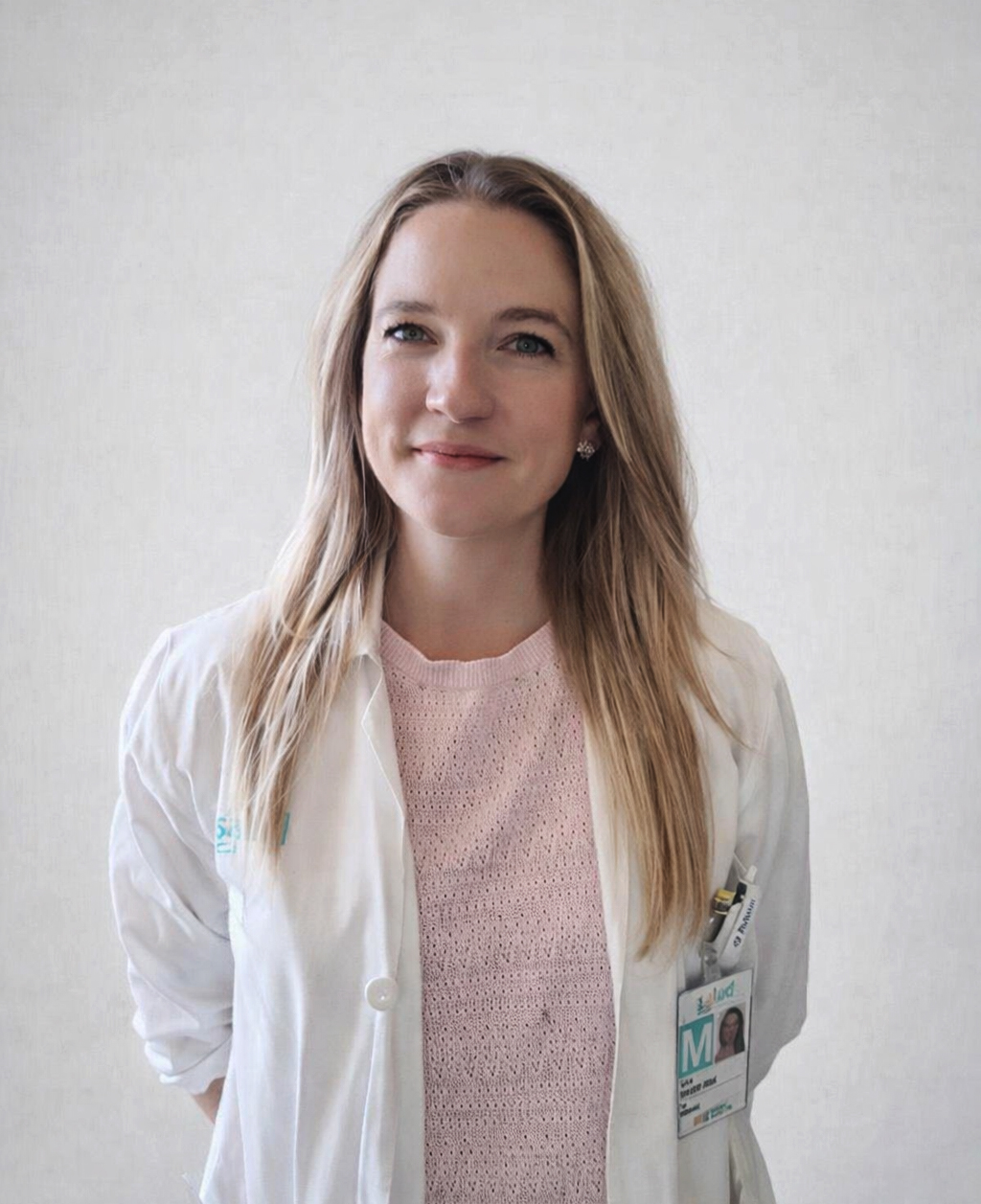
On Saturday, April 18, the Lozano Blesa University Clinical Hospital will host a national meeting to address the latest advancements in Huntington’s disease. To better understand this condition that currently affects around one hundred people in Aragón, we spoke with Dr. Elena Bellosta, a neurologist at the Zaragoza hospital and an expert in this neurodegenerative disease.
Tell us, this disease is considered rare. How many patients are diagnosed in Spain? And in Aragón?
Yes, Huntington’s disease is an uncommon condition. In Spain, it is estimated that there are between 3,000 and 4,000 diagnosed individuals, although many more are at risk due to family history. In Aragón, there are probably around one hundred diagnosed patients.
It is also a hereditary disease, isn’t it? Is it inherited maternally? Paternally? Or is gender irrelevant for passing it on or inheriting it?
Yes, it is a clearly hereditary disease. It is transmitted from parents to children in an autosomal dominant manner, which means that inheriting the altered gene from one of the parents is sufficient to develop the disease. It does not matter whether it comes from the mother or the father, and it affects men and women equally.
Tell us, what are the early symptoms of Huntington’s disease? And how do they progress?
The initial symptoms can be subtle and often go unnoticed. They typically include involuntary movements, difficulties with concentration or attention, and mood changes such as irritability, sadness, or anxiety. Over time, the disease progresses, leading to more evident movements, balance and speech disturbances, and progressive cognitive decline.
Can it manifest at any age?
It most commonly appears between the ages of 30 and 50, but it can occur earlier or later. There are juvenile forms, which are rarer and appear in childhood or adolescence, often with a different progression.
What should we do if we notice any signs in ourselves or in family members? Or if we suspect that perhaps our parents may have suffered from it?
The most important thing is to consult a doctor, preferably a neurologist. If there is a family history, genetic counseling can be considered, which helps to understand the risk and the available options. It is essential not to panic, but to study the symptoms appropriately.
Is it in any way comparable to Parkinson’s disease?
Both are neurodegenerative diseases, meaning they progressively affect the brain, but they are distinct. In Parkinson’s disease, rigidity and slowness predominate, while in Huntington’s disease, involuntary movements and behavioral changes are more prominent. They are different diseases in cause, progression, and treatment, but they affect the same brain area.
With those symptoms, one could say that Huntington’s chorea affects both physically and mentally. What mental effects does it provoke?
In addition to physical symptoms, it affects the brain in areas related to behavior and thought. It can lead to depression, anxiety, irritability, impulsiveness, apathy, and, in more advanced stages, cognitive decline that affects memory and decision-making abilities.
From the onset of the disease (and its recognition) until death, what time estimates are typically considered?
The progression is variable, but it usually lasts between 15 and 20 years from the onset of symptoms. It is a progressive disease, although the pace may differ for each individual.
Currently, there is no cure. But what treatments are carried out to improve the lives of patients?
As of today, we do not have a curative treatment, but we do have treatments that help control symptoms, such as medications for involuntary movements or mood disorders. Furthermore, a multidisciplinary approach is key: neurologists, psychiatrists, rehabilitation specialists, social workers, nutritionists—all work together with a common goal: to improve the quality of life for the patient and the caregiver.
As a neurologist familiar with other degenerative diseases, what do you consider to be the most defining characteristics of Huntington’s disease?
The most characteristic aspects are the combination of three factors: involuntary movements, changes in behavior, and progressive cognitive decline. All of this occurs within the context of a hereditary disease, which significantly impacts the family.
What are the goals that inspire a day like the one you will be holding next Saturday, April 18?
This meeting aims to raise awareness about the disease, but, above all, it was born from the idea of supporting patients and families, with the goal of answering doubts, questions, or concerns and discussing Huntington’s disease in a clear and approachable manner. It is important to highlight the impact it has not only on the patient but on the entire family. Emotional, social, and healthcare support is fundamental. Moreover, research is advancing, which gives us hope that new therapies could alter the course of the disease in the future.