



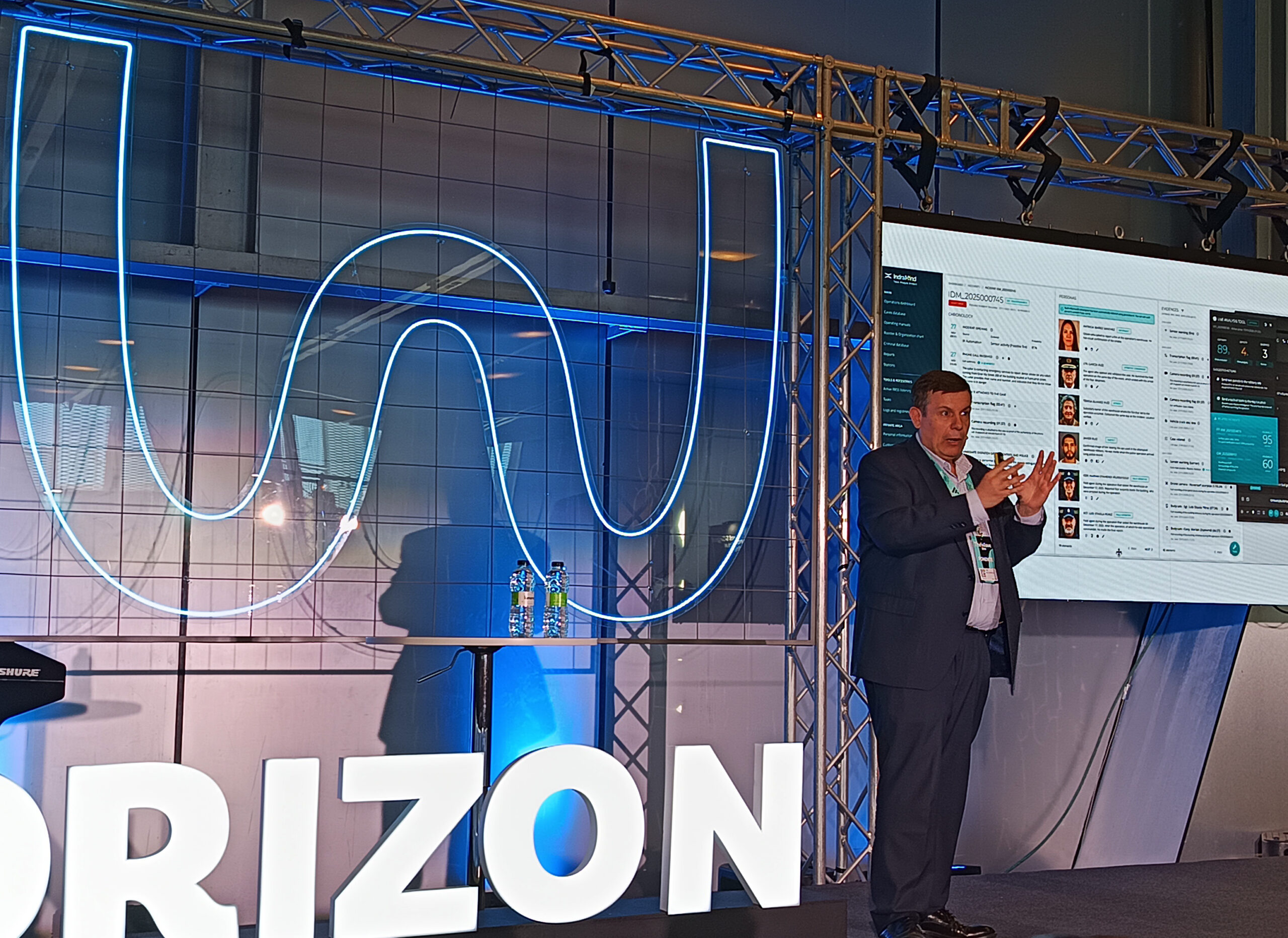
The telecommunications engineer José Ruiz Cristina, current Business Development Director of IndraMind Security, has been one of the speakers on the first day of The Wave. After finishing his presentation titled “Application of Next-Generation AI to Command and Control of Mission-Critical Operations,” he takes a few minutes to share details about Indra Group’s commitment to its own technological platform in the fields of security and cybersecurity. This is particularly interesting in the times we live in.
Tell us about the IndraMind platform.
At Indra, we recognized years ago that the industry offers numerous solutions and systems to address security threats or problems. These are solutions already used by police, firefighters, and various agencies, including systems that process cameras, drones, and many others. However, none of them provide a complete overview of what is happening that allows for anticipating certain threats or optimizing decisions. In fact, each of these systems has its own blind spots, and therefore, that is where they are vulnerable. To solve this issue, and leveraging Indra’s extensive experience, we devised the IndraMind platform. It is a natively distributed platform, born from artificial intelligence and sovereignty.
Sovereign? Please elaborate.
Yes, it may seem paradoxical in this highly interconnected world. But the reality is that the field of defense and security is moving in the opposite direction. Exceedingly so. While in other matters one might think, why not rely on OpenAI, Google, or Amazon? In this world, unfortunately, we need to protect ourselves against geopolitical decisions that can cut off our access to technology overnight. But it is not just about not having technology. It also involves protecting what we put into it, that is, our context, our strengths, and our weaknesses. Because large language models that generate the information we receive rely on the context and the questions of all others.
So how does the platform generate that context?
Essentially with four key components. First, ontologies that provide the system with a complete and transversal understanding of entities and their relationships. Next, knowledge graphs that enable inference, correlation, and detection of hidden patterns. Additionally, there is the memory bank that facilitates continuous learning through operations and results. And finally, there is the agents’ mesh that reasons and executes specific actions. This is how the platform achieves the context it understands and acts upon. This represents the cognitive leap that IndraMind achieves. It moves beyond specific models that have been used for 20 or 30 years and are very efficient for a specific task, whether it is analyzing videos or transcribing a conversation, but which do not extend beyond that. However, we have surpassed this to reach a cognitive model that is only possible with current cognitive technology, which is based on understanding the world, comprehending how it functions, and making deductions.
Like a human, but the difference is that this understanding and these deductions are made very quickly and take multiple factors into account simultaneously.
Correct, the technology allows us to analyze a vast spectrum of information, and cognitive technology reasons, retains memory, correlates, and provides those insights that may not be extraordinary or excessively brilliant deductions, but are nonetheless rapid. It is not a matter of complexity of reasoning, but rather the breadth of reasoning. A reasoning that must be exposed and validated by humans. The power of our platform lies not in the models or in the algorithms, but in the cognitive architecture, in memory, in context, and in combining all of this to achieve a correct configuration. This is the future of security and defense.
When we talk about defense and security, do we understand that the optimal development of the IndraMind platform can be achieved at a national level?
The natural target for IndraMind is a country target, I would say. Country target, city target, that is, large organizations that currently have a problem that the industry does not solve. They have too much unconnected information. So instead of information, it becomes noise, and their adversaries can take advantage of the blind spots between different realms of information. The broader the ecosystem you address, the more you need a solution of this kind. However, it should also be noted that private organizations, such as energy companies or telecommunications firms that already have many infrastructures or very sensitive environments, also require these types of tools. Yet the ambition, the natural target is a country, city, or organization that inherently has this problem.
Applying it at a national level necessarily implies coordination among institutions and agencies.
First and foremost, it is crucial to gather all the information. For example, in Spain, one must consider the central government, autonomous communities, and municipalities. That is three levels that must coordinate, share information, and act together during emergencies. What IndraMind does is build a layer of situational awareness, which serves as a command and control layer that supports all of them and manages the flow of information. And certainly, it is done much better and more efficiently than at the human level. This is especially true given Indra’s long-standing connection with the defense sector. Consequently, IndraMind understands how far information can be shared and compartmentalizes it according to legality and data protection.
Finally, the big question that always hovers over everything related to AI. Implementing a platform like yours, what positive or negative effects would it have on the jobs of people currently working in these areas?
Simply put, work will transform. Every organization will need to readjust its positions. Ultimately, work needs to be reinvented to better harness human capabilities. This is nothing new. It has been happening since the Industrial Revolution.