



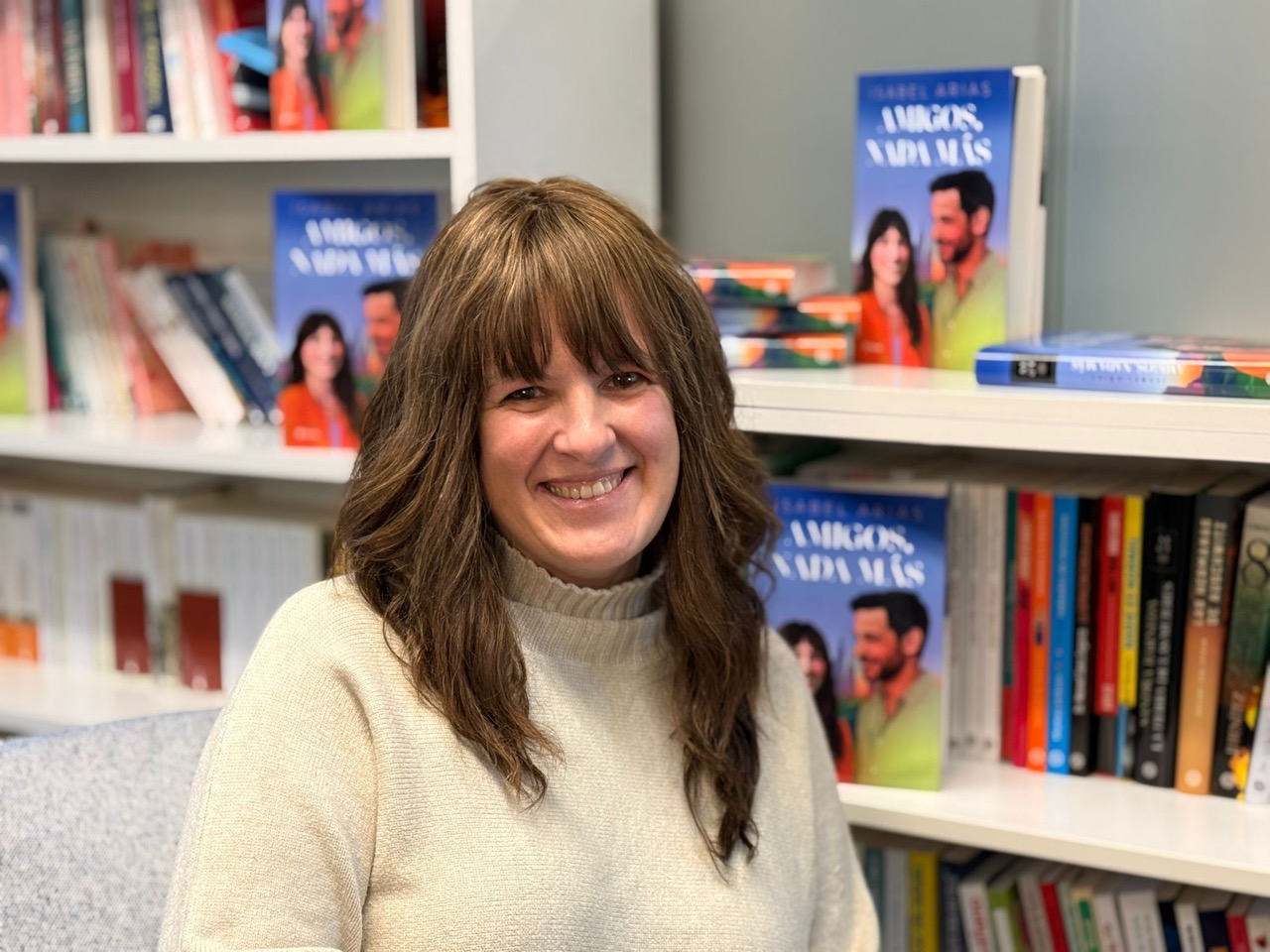
Q. You are in Zaragoza in the middle of your promotional tour. How are you experiencing these days of interviews? A. I’m on a press route, so it’s been intense days, with interviews practically all day. At first, I was very nervous — the first one I did in my life was live — but now I enjoy them a lot. I have a great time.
Q. Writing has been with you since childhood. Was there a specific moment when you decided that this was serious?
A. I have always liked writing. Since I was little, I wrote stories for school, and I used to correspond with my friends through letters of fifteen pages… The truth is that life leads you down other paths, and I ended up professionally pursuing law, which I also enjoy very much. But I have never stopped writing. I wrote my first novel for fun, without really knowing where it was going, and in the end, it ended up in bookstores.
«I learned to read by myself when I was three years old, and I haven’t stopped since. I have a library at home with over four thousand books.»
Q. Before writing, we are all readers. What type of literature has had an impact on you? A. I have always been a great reader; I learned to read by myself when I was three and I haven’t stopped. I like almost everything: historical novels, thrillers, crime, romance… And especially French literature, those novels in which apparently «nothing happens,» but which leave a lasting impression. I also enjoy Spanish authors like Marta Rivera de la Cruz or Máximo Huerta. I enjoy reading without the need for big shocks.
Q. Have those readings influenced your way of narrating? A. I’m sure they have, albeit unconsciously. I read as a reader, not analyzing style, but everything sinks in over time. In the end, we write with everything we have read.
Q. Friends, nothing more is your second novel, and in it, you address the friendship between men and women. Why did you choose this theme? A. It’s a reality that has interested me for years. I have always had male friends, and I firmly believe in it. I think friendship has no gender, although it still generates a lot of debate and there are many prejudices in society.
Q. Where does this second novel come from? How did the story come about?
A. I was clear that at some point I was going to write about it, but I didn’t have the story. The trigger was a work trip to Chicago almost two years ago, with two male colleagues and a woman. On the return from that trip, I suddenly said: «I have the story.» I returned, started writing, and didn’t stop until I finished it. The novel is fiction, of course, but that trip was the starting point.
“Friendship has no gender. It’s a topic that generates a lot of debate. It is always assumed that there must be something more.»
Q. The million-dollar question: Can a genuine and pure friendship exist between a man and a woman?
A. I believe so, absolutely yes, it is possible and real. I practice it as well. But it is true that sometimes the environment questions it more than the people involved. I have very good male friends; I have had them all my life. In college, my group was almost all boys, and I was the only girl. To me, they are friends, regardless of their gender or whether they have partners. What is true is that it’s complicated, not because of oneself, but because of others. In our society, if a man and a woman are friends and one of them has a partner, it is always assumed that there has to be something more. New generations normalize it more, but ours and the older ones, let’s not even talk about it. It’s a topic that generates a lot of debate, and in theory, people accept it, but when it comes to practice, they no longer see it so clearly.
Q. Friendship is a recurring and central theme in your work. What does it represent for you? A. Friendship is one of the greatest treasures we have. You can live without a partner or even without a relationship with part of your family, but it’s very difficult to imagine life without friends. And yet, many times we do not care for them enough. Friendship, moreover, is not usually selfish. It’s an act of generosity.
Q. Your first novel reached bookstores in quite a unique way. How did it happen?
A. I was very lucky, to be honest. I wrote the story because I suddenly said: «Here is a story!» Not knowing where it would go. I let people close to me read it, and one of those people was Máximo Huerta, who read it, loved it, and posted on his networks something like «Editors of the world, rush for the rights, it’s a very good novel.» I was traveling to London at that moment, and when I landed, I had calls from several publishers. I spent four days glued to the phone, not believing it. In the end, I signed with Planeta with the same editor as Máximo.
Q. You are also passionate about travel. In fact, another of your passions is writing travel guides that are authentic treasures. How does «the journey» influence your novels?
A. A lot. For me, the setting is fundamental. I like to place stories in real places that the reader can recognize or even visit. I am passionate about traveling, and journeys are part of my understanding of writing.
«Traveling is another one of my passions. Setting and locating stories in real places fascinates me. Traveling is part of my understanding of writing.»
Q. What is your creative process like? Do you have any writing rituals?
A. None special. The computer goes with me everywhere, and I write wherever I can and whenever I can. I wrote my first novel entirely on planes, at airports, and in Starbucks around the world. The second one also has many hours of flight. That said, I do notice that when I reach the last third, I can’t stop; I write at night, and suddenly it’s three in the morning without me realizing it. I am more of a night owl than a daytime person.
Q. How would you define your literary universe?
A. Stories without big shocks, with very human characters, short chapters, and that leave a good taste in the mouth. I am interested in the reader identifying and traveling through the story.
Q. What would you like the reader to feel when closing the book? What do you seek to provoke in the reader? A. I would like them to close the book with a smile, feeling good, and with a beautiful perspective on life. If it also moves them in some way, like reconnecting with a friendship, then that’s wonderful. At the beginning of the tour, a reader wrote to me and told me that she read the novel, and upon finishing it, she picked up her mobile phone and wrote to a friend she had lost contact with to reconnect that friendship. It’s exciting. I found it the most beautiful thing someone could say to me. Just for that, writing the novel was worth it.
«A reader told me that when she finished the book, she picked up…