



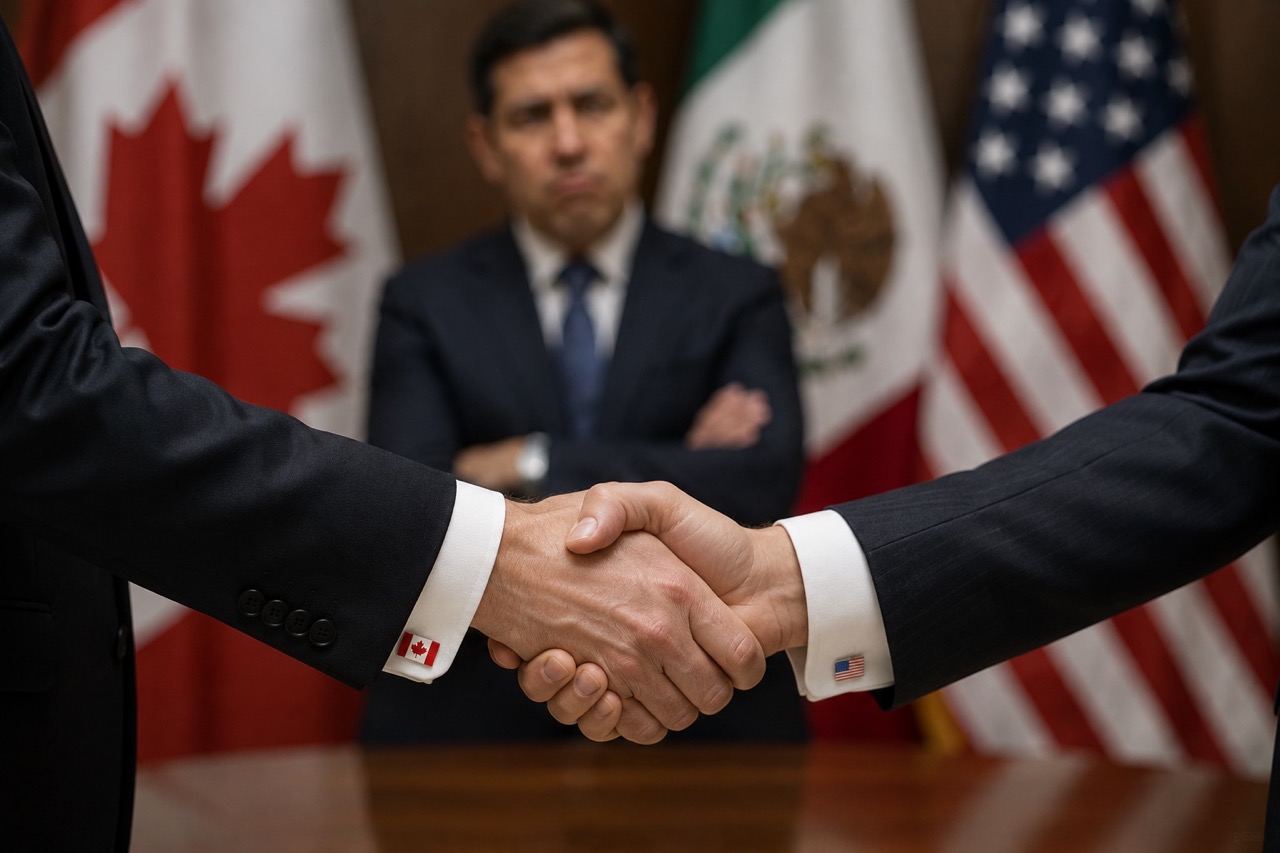
The trade negotiations of the United States with its two major North American partners have taken a turn that puts Mexico in an uncomfortable position. Canada and Washington have moved toward a preliminary agreement that would lower some of the tariff barriers imposed during Donald Trump’s new trade offensive, particularly in sectors where the Mexican government has been demanding more favorable treatment for months.
According to information published by Bloomberg, the provisional understanding includes reducing tariffs on certain Canadian steel and aluminum products to 25% and on automobiles to 15%. The agreement is not yet finalized, but the progress has been sufficient to raise pressure on Mexican negotiators.
The issue for Mexico is not solely that Canada might achieve better conditions. Both countries, together with the United States, form the USMCA, one of the largest integrated trade areas in the world, and they compete simultaneously for industrial investments aimed at supplying the massive U.S. market.
Automobiles, steel, and aluminum at the heart of negotiations
The automotive industry is particularly important. Over the past few decades, Mexico has built a powerful manufacturing platform integrated with the United States and Canada. Production chains cross borders multiple times before a finished vehicle reaches the market, meaning any tariff modification alters costs and investment decisions.
Mexico holds a considerable advantage due to the USMCA itself. Economy Secretary Marcelo Ebrard has noted that approximately 85% of Mexican exports to the United States continue to enter tariff-free by complying with the treaty’s rules of origin. However, automobiles, steel, and aluminum remain subject to U.S. sectoral measures.
These same sectors are also involved in Canadian negotiations. If Ottawa ultimately secures better conditions, Mexico will have an immediate precedent to demand similar treatment from Washington, but it will also lose part of the argument used by Claudia Sheinbaum’s government so far: that its negotiating strategy has placed the country in a particularly favorable position compared to Canada.
Two different strategies toward Trump
The comparison is particularly interesting because Mexico and Canada have followed different strategies in response to U.S. trade policy.
The Canadian government under Mark Carney maintained a more confrontational position for months, while Claudia Sheinbaum opted to avoid retaliation and keep negotiations open with Washington. The U.S. and Mexico held three bilateral rounds between May and July, addressing automotive, steel, and aluminum, agriculture, labor issues, economic security, and payment services.
Thus far, Mexican authorities had presented this strategy as an advantage. The Canadian progress forces a reconsideration of the outcome: Ottawa may end up achieving specific tariff reductions before Mexico.
This does not mean that the Mexican strategy has failed. Most of its exports maintain tariff-free access to the U.S. market, and negotiations continue. However, it does introduce a reference against which businesses and the government can compare the outcomes obtained by both countries.
China is also behind the negotiations
There is also another issue that deserves attention because it connects this news with several topics we are following: China.
Washington is attempting to have Mexico align more closely with its trade policy toward the Asian giant. The Trump Administration has suggested that Mexico consider measures similar to those of the U.S. on certain steel and aluminum imports from outside North America. Mexico has already increased some tariffs on steel from Asia.
The review of the USMCA thus begins to transcend a purely tariff negotiation. The United States seeks to strengthen a North American industrial chain less dependent on supplies from China, particularly in sectors deemed strategic.
For Mexico, the balance is complex. The United States is its main market, and the preferential access provided by the USMCA constitutes one of the country’s greatest competitive advantages in attracting foreign investment. At the same time, Chinese companies and products have increased their presence in the Mexican economy.
The industrial future of Mexico is also being negotiated
What is at stake goes beyond the specific percentage applied to steel or automobiles. Mexico has built a significant part of its industrial model over decades on proximity to the U.S. market and the integration of North American production chains.
Nearshoring further emphasized that expectation: international companies could produce from Mexico to access the United States while benefiting from lower costs and the trade advantages of the USMCA.
The new U.S. trade policy introduces uncertainty into that model. If Washington begins to negotiate different conditions with Canada and Mexico, or ties preferential access to issues such as trade relations with China, the review of the treaty could end up modifying much more than a few tariffs.
Canada has just secured an important, albeit still provisional, negotiating advantage. Mexico now has a precedent to demand equivalent conditions and, at the same time, a warning.
The great North American negotiation is no longer solely about preserving the USMCA. It is deciding which industries will produce within North America, where new investments will be located, and to what extent Mexico and Canada will need to align with the U.S. economic strategy toward China.