



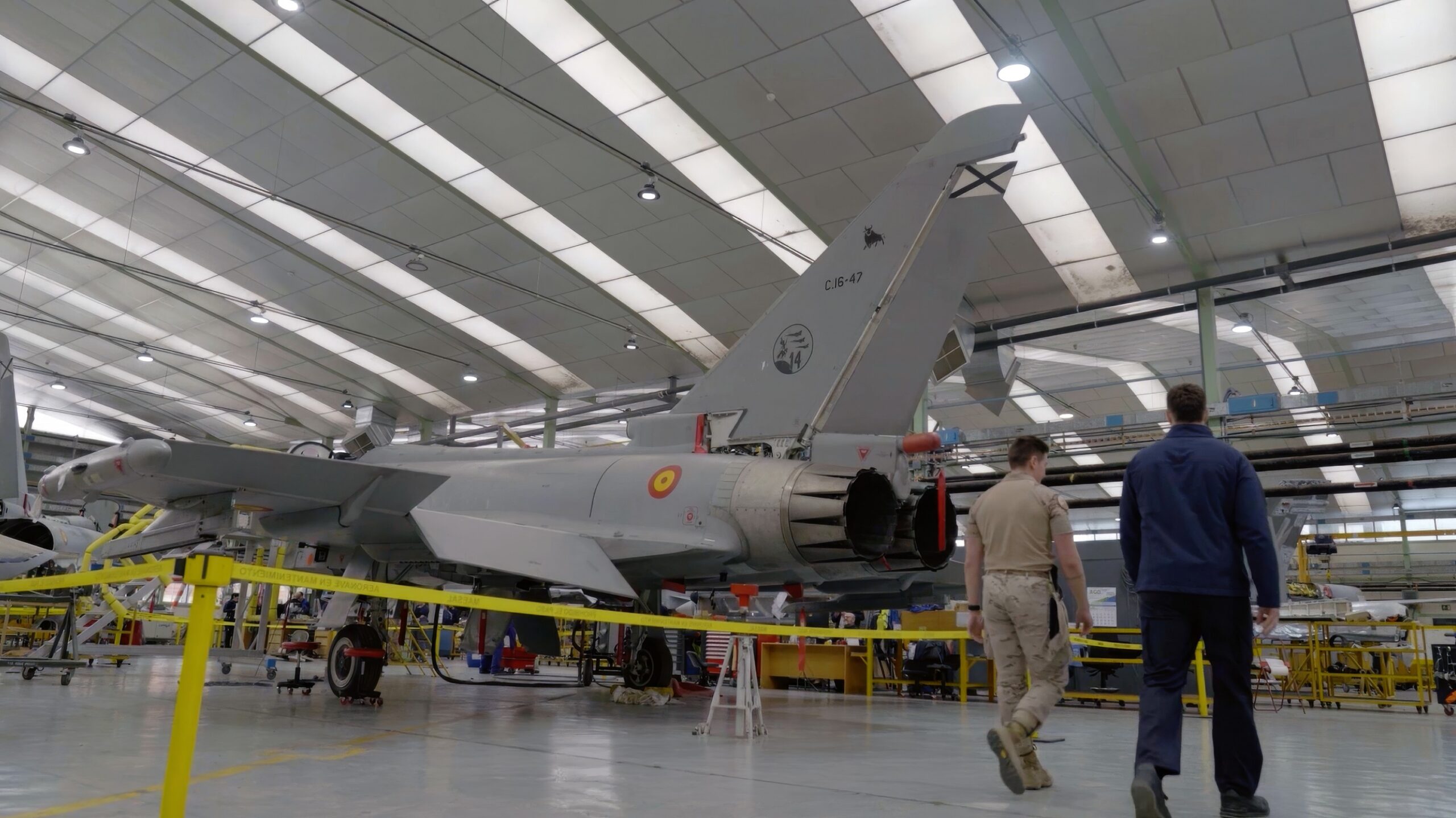
European combat aircraft increasingly need to exchange information with other aircraft, command centers, and various platforms deployed during operations. The ability to do so rapidly, securely, and compatibly among militaries from different countries has become one of the technological elements that will accompany the evolution of fighters in the coming years.
Spain, along with France, Germany, and Italy, is participating in the development of a new European terminal specifically aimed at meeting this need. The system, called F-EMIDS (Fighter European Multifunctional Information Distribution System), is part of the EMIDS 2 program managed by the Organization for Joint Armament Cooperation (OCCAR).
The main contractor is the EuroMIDS consortium, which includes European companies Hensoldt Sensors, Indra Group, Leonardo, and Thales SIX GTS France. The contract to initiate this second phase was signed on July 6, and the program held its kickoff meeting at the end of the same month.
The goal is to develop a common European terminal capable of providing secure and interoperable tactical communications for both currently deployed aircraft and future sixth-generation combat platforms.
From Link 16 to a New Generation of Communications
Modern military aircraft do not operate in isolation. During a mission, they exchange information about positions, threats, targets, or tactical situations with other platforms. One of the fundamental standards for this exchange is Link 16, which is widely used by NATO countries and their allies.
Current MIDS LVT terminals allow access to that network and are present on platforms such as the Eurofighter, Rafale, and Tornado IDS/ECR, as well as the A400M transport aircraft and certain early warning AWACS aircraft.
F-EMIDS is designed to progressively replace that generation of terminals and expand their capabilities. OCCAR states that the new system should enable faster data exchange, improve network functionality, and facilitate future updates, while simultaneously maintaining interoperability among European armed forces and their allies.
The technology is based on a software-defined radio architecture. In contrast to equipment whose capabilities depend more on the installed hardware, this approach allows new frequencies, modulations, or standards to be introduced via software updates, reducing the need to physically replace terminals each time communication requirements evolve.
Simultaneous Networks and Increased Data Reception Capacity
Among the anticipated capabilities is a new dual cryptographic architecture designed to protect communications and the possibility of operating simultaneously on different networks.
One of the technologies, called Concurrent Multi-Netting, will allow aircraft to participate in multiple communication networks at once. Another, Concurrent Contention Receive, is aimed at increasing the capacity to receive information in scenarios where there is a high volume of transmissions.
The terminal will also incorporate a broadband waveform developed under the European ESSOR program. This project aims for different countries to use their own radio equipment while maintaining common standards that enable communication between them.
Interoperability is particularly relevant in Europe, where air operations often involve aircraft, systems, and armed forces from several countries. Having shared standards allows different platforms to exchange information without needing to use exactly the same equipment.
The Role of Indra
Within EMIDS 2, Indra will participate in the development of two initial versions of the terminal. The model F-EMIDS A.0 will serve to validate the software and new communication capabilities, while F-EMIDS B.0 will be the first physical prototype.
This second demonstrator will feature segregated processing to handle classified information, separating areas where sensitive data circulates from those designated for unclassified information.
This participation allows Indra to acquire and develop knowledge related to a technology that will play an increasingly important role in future European combat networks. The Spanish company is also working in other areas linked to the digitization of military operations, including command and control systems, sensors, electronic warfare, and technologies related to the future combat cloud.
The latter aims to connect different platforms and sensors to share information during an operation. In this context, the ability to communicate between aircraft, drones, and other systems becomes as crucial as the individual sensors installed on each platform.
A Four-Country Project
The program also has an industrial and political dimension. Germany, Spain, France, and Italy are jointly developing a capability that previously relied on an earlier generation of terminals and technologies.
OCCAR presents the project as a contribution to European technological autonomy in tactical communications. The objective does not involve developing systems that are incompatible with allies: precisely one of the fundamental functions of F-EMIDS will be to maintain Link 16 and interoperability with NATO forces.
The difference lies in having greater European capacity to develop, modify, and evolve a technology considered critical for military operations.
EMIDS 2 builds on an initial phase in which a complete family of terminals was defined. In addition to F-EMIDS for combat aircraft, there are plans for H-EMIDS for helicopters, M-EMIDS for naval platforms, and S-EMIDS for ground systems.
Two Years to Develop the First Demonstrators
The project is still in the development phase. OCCAR has set a two-year timeframe for EMIDS 2, during which the first demonstrators of F-EMIDS should be produced and the technological foundations necessary for its potential later deployment established.
A third phase would advance toward terminal production and its incorporation into current and future European fleets. Therefore, there is still no comprehensive implementation timeline that can confirm when different fighters will begin to use it operationally.
The development coincides with a moment when Europe is increasing its investment in defense and working to strengthen certain domestic industrial capabilities. Secure communications are part of this process because the evolution of military systems increasingly depends on the ability to connect sensors, platforms, and decision centers.
F-EMIDS represents one of those technologies that is not readily visible from outside an aircraft but is fundamental to its operation within a joint operation. The project will allow verification over the next two years as to whether the industry from Germany, Spain, France, and Italy can collaboratively develop a new European generation of tactical communications prepared for both current fighters and the airborne platforms that will arrive in the coming decades.