



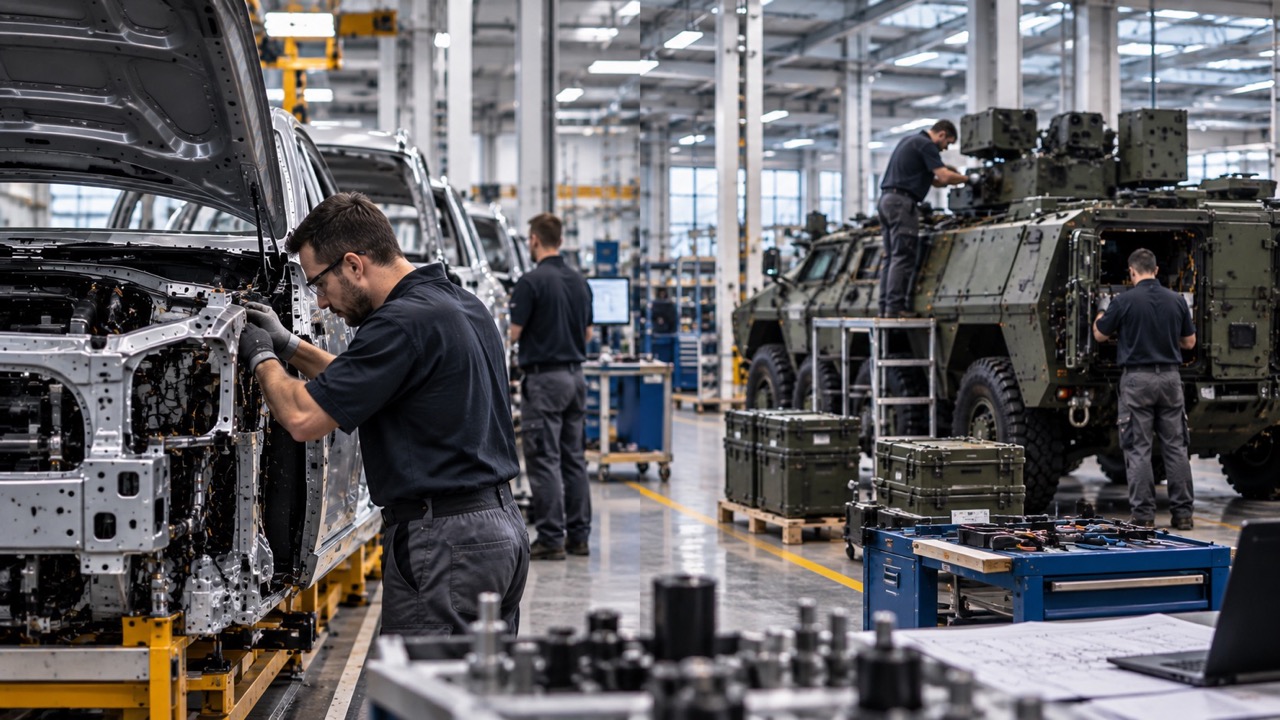
The line between the automotive and defense industries is beginning to blur in Germany. Europe’s need to expand its military production capacity comes at a time of profound change for vehicle manufacturers and their suppliers, which face lower production volumes, high costs and mounting competition from China.
This environment is fostering closer ties between two industries that share capabilities in areas such as engineering, advanced manufacturing, electronics, materials, mass production and supply-chain management. For defense companies, the automotive sector offers facilities, skilled workers and established industrial processes; for vehicle and component manufacturers, rising military spending opens a new avenue for diversification.
Germany is one of the European countries where this trend is most visible. Manufacturers, suppliers and major defense companies are examining different forms of collaboration to make use of factories and industrial capabilities that could otherwise be underutilized as a result of automotive restructuring.
Volkswagen is one of the most significant examples. Its plant in Osnabrück, Lower Saxony, has been at the center of various proposals to introduce defense-related activity. Rheinmetall proposed using part of the facility to produce armored vehicles such as the Boxer and the Fuchs, while Israel’s Rafael Advanced Defense Systems has held discussions on the potential manufacture of components for air-defense systems.
Volkswagen itself has explored these possibilities. The Osnabrück plant has developed vehicle prototypes and displayed them at the Enforce Tac trade fair in Nuremberg to assess opportunities in this market.
From manufacturing cars to producing for defense
The automotive industry’s appeal for defense companies lies not only in the availability of factories. Production processes, the expertise accumulated by workforces and the existence of an extensive supplier network make it possible to expand industrial capacity more quickly than by building new facilities.
The Osnabrück plant also has a feature particularly well suited to this process. Its workers have experience with short production runs and complex assembly, a production model closer to that used for certain military vehicles and systems than to mass-market car manufacturing.
The relationship between Volkswagen and the military industry is not starting from scratch. MAN, part of Volkswagen’s Traton Group, works with Rheinmetall through Rheinmetall MAN Military Vehicles, a joint venture dedicated to developing and manufacturing military and logistics vehicles.
The trend extends to other German manufacturers and suppliers. Companies from the automotive ecosystem are exploring opportunities in drones, military vehicles, engines and other systems, while the defense industry seeks to increase output in response to growing European orders.
A trend spreading across Europe
Germany is the most visible case, but the convergence between the two industries is also taking place in other countries. France, Italy, Sweden and Spain all have projects in which capabilities originally developed for the automotive sector are finding military applications.
Renault, for example, is working with French company Turgis et Gaillard on drone-related projects, drawing on industrial capabilities from its factories. Italy has also advanced in integrating vehicle manufacturers with major defense groups, while Sweden has a long tradition of links between the two sectors.
Spain is beginning to follow a similar path. Indra has held talks with Seat to explore potential forms of collaboration in the manufacture of light military vehicles in Martorell. The Spanish technology company has also strengthened its land-vehicle operations and maintains agreements with international companies such as Rheinmetall and Hanwha.
The supplier industry could also play a significant role. Capabilities developed over decades in electronics, cameras, sensors, software, communications, engines and components may find new applications in military vehicles and systems.
Defense as a route to industrial diversification
Growth in the defense sector is unlikely to replace the economic and manufacturing weight of Europe’s automotive industry. The scales are vastly different: a car factory can produce hundreds of thousands of vehicles a year, while military programs typically involve much smaller production runs and products of greater complexity and longer development cycles.
Nevertheless, defense could become a complementary avenue for making use of facilities, skilled workers and industrial expertise that may become available during the transformation of Europe’s automotive sector.
The process also raises an industrial-policy question. Europe needs to expand its defense production capacity while trying to preserve an automotive industry facing intense international competition. Connecting the two sectors makes it possible to repurpose part of the existing infrastructure and reduce the time required to develop new production capabilities.
The evolution of factories such as Volkswagen’s Osnabrück plant will test how far this convergence can go. What began as a search for alternatives for facilities threatened by automotive restructuring is becoming part of a broader debate about Europe’s industrial future.