



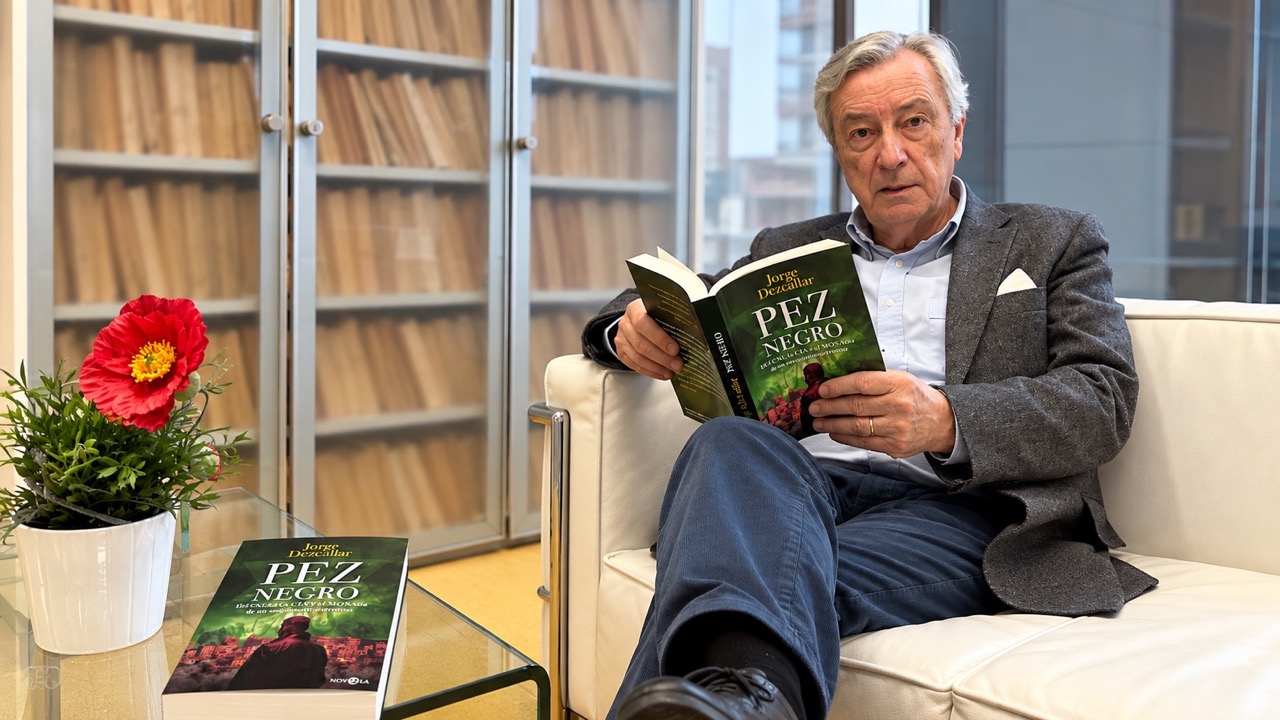
Jorge Dezcallar, former director of the CNI and a career diplomat, has published Pez Negro, a spy thriller in which the characters “disobey” their creator. In this interview, we reflect with the author on the vertigo of the blank page, the ethical burden of writing about real figures such as Benjamin Netanyahu, and the freedom he has found in fiction.
After more than forty years on the front lines of Spanish diplomacy and having served as the first civilian director of the National Intelligence Center (CNI), Jorge Dezcallar has found in the novel the ideal space to give free rein to what he could previously only hint at. With his new work, Pez Negro, he cements his reputation in the suspense thriller genre, inviting us to peek into that “world of shadows” he knows so well. We hear his reflections on the creative process, the secrets, and the fine line between realism and pure invention.
For decades, your job consisted of accessing information that the rest of us didn’t have and distinguishing what was true, what was probable, and what was just noise. Now you sit down at a computer to do exactly the opposite: invent something that never happened and make us believe it could have happened. How did that transition come about?
It was precisely that past—that knowledge of how things work—that helps me lend credibility to my fictional stories. The advantage is that now I’m freer and can mix reality and noise however I see fit—something I couldn’t do before. Knowing where the boundaries lie at any given moment is very important.
You began Pez Negro with just a single scene in mind, without a clear idea of where the characters and the story would take you. Is there something liberating about sitting down to write and allowing yourself not to know what’s going to happen?
It’s a terrifying challenge. You have an image—in my case, that of a guy throwing a cell phone overboard after just taking a photo with it. You have nothing more than that, but you know something is going to come of it… and you don’t know what it’s going to be. So you start writing, and to your own surprise, a story unfolds as you write it. It’s fascinating. Others start writing and already know how their story is going to end, but that’s not the case for me.
Do you always write this way—letting the novel find its own path—or was Pez Negro particularly unpredictable?

That’s right. I wasn’t sure how it was going to end until I finished it. Because the characters gain or lose strength as you write, and I like that. That’s why I let them take the lead—they’re the ones who set the course. When I started writing, I didn’t know that Nusseibah was going to become so important. And other characters fade into the background… That’s why Pez Negro ended up giving the book its title.
In fact, I understand that you wanted one of the novel’s central themes to be the relationship between an Israeli woman and a Palestinian man, and yet you’ve said that the character from Pez Negro grew until “the terrorist ended up devouring her.” At what point do you realize that your characters have started to defy you?
The story’s own development makes it clear to me, as I realize that today, given the terrible polarization in Israeli society, my well-intentioned love story between a Jewish Israeli woman and a Palestinian Israeli man couldn’t have a future. And that’s when the terrorist steps in. It’s Nusseibah who makes me realize I’m wrong.
Asís García has been by your side for three novels now, and in this one he’s retired, seemingly far removed from his old life. However, all it takes is a photograph, a strange gesture—something any of us would probably overlook—for him to be back in action. You can stop working as a spy, but can you stop seeing things like a spy?
I don’t think so. But in my novel, Asís hasn’t internalized it quite so deeply; the one who decides that what happened seems strange is Figo, the professional agent, the CNI member who decides to retrieve the phone from the bottom of the harbor and investigate. Figo is the professional. From there, the story unfolds in which, by a twist of fate, Asís and Amal find themselves involved once again. And it’s only from that moment on that they act like professionals, despite themselves.
Being a spy is more than just a job; it’s something so intense that it gets under your skin, permeates your entire being, and affects your behavior.
In fact, I wonder if something similar happens to you. When you walk into a restaurant, an airport, or a reception area, do you still see things that others don’t? Is that way of looking at things something you learn, or does it eventually become a permanent way of being in the world?
Being a spy is more than just a job; it’s something so intense that it gets under your skin, permeates your entire being, and shapes your behavior. That’s what happens when your life is on the line and the slightest slip-up can betray you. You never forget that. It’s been many years since I stepped down as head of the CNI, and back then I was under threat from ETA, but when I go to a restaurant, I sit far from the window, facing the entrance and with a wall behind me. Am I still in danger? No… but I can’t help it. Still, I lack the keen eye for detail that characterizes a good spy.
One of the peculiarities of your novels is that the reader knows who writes them, and that inevitably changes how we read them. When you describe certain procedures, we think you probably know them firsthand. Do you like to play with that reader’s uncertainty between what’s lived experience and what’s invented?
A person is defined by themselves and their circumstances. I couldn’t write spy novels without having first directed the CNI and knowing how an intelligence service thinks and acts. I also served as Director General for the Middle East and North Africa at the Ministry of Foreign Affairs for eight years, and that brought me into contact with all the kings, presidents, sultans, and prime ministers of every country in the region. I know their palaces. But I’ve also been to prisons and Palestinian refugee camps where people have lost everything. I believe it’s that knowledge that lends credibility to the things I make up. Because what I make up could be true—I’ve lived through similar situations.
I often use my characters to say what I think but can’t say myself.
Has it ever happened to you that something completely made up was interpreted as a revelation of something real?
Of course it has. And I often use my characters to say what I think but can’t say myself. Like the idea that there won’t be security for Israel without justice for the Palestinians. And some people realize that. But my work is fiction, based on a real plot—in this case, the Israeli-Palestinian conflict—and with the authenticity that comes from my knowledge of that world… but it’s fiction, pure fiction. My characters have never existed… but they could exist.
One of the issues I find particularly sensitive is the inclusion of real-life figures who are part of current events; a clear example is the “character” of Benjamin Netanyahu. How does it feel to put words in the mouth of someone who actually exists?

I try to be respectful toward him and ask for his forgiveness in advance. But I believe I know him well enough to be convinced that if he were in the situation I place him in, he would say something very similar to what I have him say. That said, I consider him a disastrous politician for Israel and for the region.
To what extent can you rely on what you know about how a real person thinks or behaves, and at what point do you have to set that person aside and simply turn them into a character?
When I take a real person and use them in my fiction, I never forget that I can’t make them say or do something they would never say or do. I think I owe that to them. It’s one thing to use them in a work of fiction and quite another to distort them—something I would never do out of respect. Just as I use the Western Sahara issue in Operation False Flagor the conflict between Israel and Iran in Accidental Spy. In all my novels, I’ve used a real-world backdrop that I also respect and don’t distort, and it is within that backdrop that the characters I imagine then live out a plot that is also solely a product of my imagination.
Is there a different kind of responsibility there than the one you feel when writing a completely fictional character, especially when you’re also recounting events as recent and dramatic as the music festival that kicks off the novel?
What happened at that festival is very real; I simply place my fictional character in that very authentic and tragic setting and try to make her behave as she would have if she were flesh and blood. It was horrific—a group of young people who were having fun without harming anyone and who were brutally murdered and kidnapped. I think that scene captures very well the interplay between the reality of the attack and the fiction of my invented character, Leah, who experiences it firsthand. And it also serves as a way for me to condemn the savagery and senselessness of an unjustifiable terrorist attack that still traumatizes Israeli society today.
The conflict between Palestinians and Israelis is neither religious nor ethnic. It is a struggle over land. As primitive and basic as that.
You’ve said that to write Pez Negro, you drew heavily on your own experience and memories. Have you ever doubted whether a scene you remember happened exactly that way, or whether time has already turned it into a little story of its own?
I haven’t experienced any of what I write about. What I have experienced is the backdrop to Pez Negro—the conflict between Palestinians and Israelis, which is neither religious nor ethnic. It is a struggle over land. As primitive and fundamental as that. And it is based on that experience—very real and gained through many trips to Israel and the Israeli-Occupied Palestinian Territories, as well as many conversations with Palestinians and Israelis—that I was then able to write my fiction. It is pure fiction; I never tire of repeating that. But it would be less believable without that prior experience on the ground.
For many years you were professionally bound to keep secrets, and now you write fiction. Does fiction allow you to approach truths you couldn’t express directly, or are there boundaries that remain exactly the same?
Of course there are boundaries that I cannot, must not, and do not want to cross. And in that regard, I am and will remain a grave. But I’d be lying if I didn’t admit that sometimes I have my characters say things I think and want to say but cannot or must not say myself. I’ll leave it at that.
It must be peculiar to have lived through extraordinary situations and to know that some of them will probably never be told. Does one eventually get used to living with that silence?
When you head an intelligence service as prestigious as the CNI, the least you can do is be discreet. No, it doesn’t come hard to me—discretion has become second nature, first as a diplomat, which was my profession, and later as director of the CNI. Don’t forget that it’s always been said that diplomats speak to hide what they’re thinking.
And after a life dedicated to diplomacy, intelligence, and later to analysis and essay writing, what does fiction offer you that all those other ways of understanding and describing the world hadn’t already provided?
Writing about geopolitics—which is supposedly my area of expertise as a career diplomat—seems much easier to me than writing a novel, which is a very solitary exercise where the characters, in every situation you place them in, can choose to act in many different ways. And once they choose one—because they, the characters, and not you, that influences the rest of the plot, and only you can help them work it out while you wander through the mountains with Maktub, my precious Rhodesian Ridgeback, who pays no attention to me as I ask him questions and he chases—without ever catching them—the bocs, those wild goats that abound in the Serra de Tramuntana of my native Mallorca.
——
As this interview draws to a close, it becomes clear to me that for Jorge Dezcallar, literature is not merely a creative endeavor, but an open wilderness where he lets his characters run free and defiant. In the labyrinth of geopolitics and espionage, where truths must be jealously guarded under lock and key or camouflaged in diplomatic language, the blank page stands as a refuge where characters can rebel and be masters of their own destinies. Between the “world of shadows” of the CNI and the landscapes of the Serra de Tramuntana, Dezcallar’s pen demonstrates that fiction is another way—a freer and more human one—of telling the truth.