



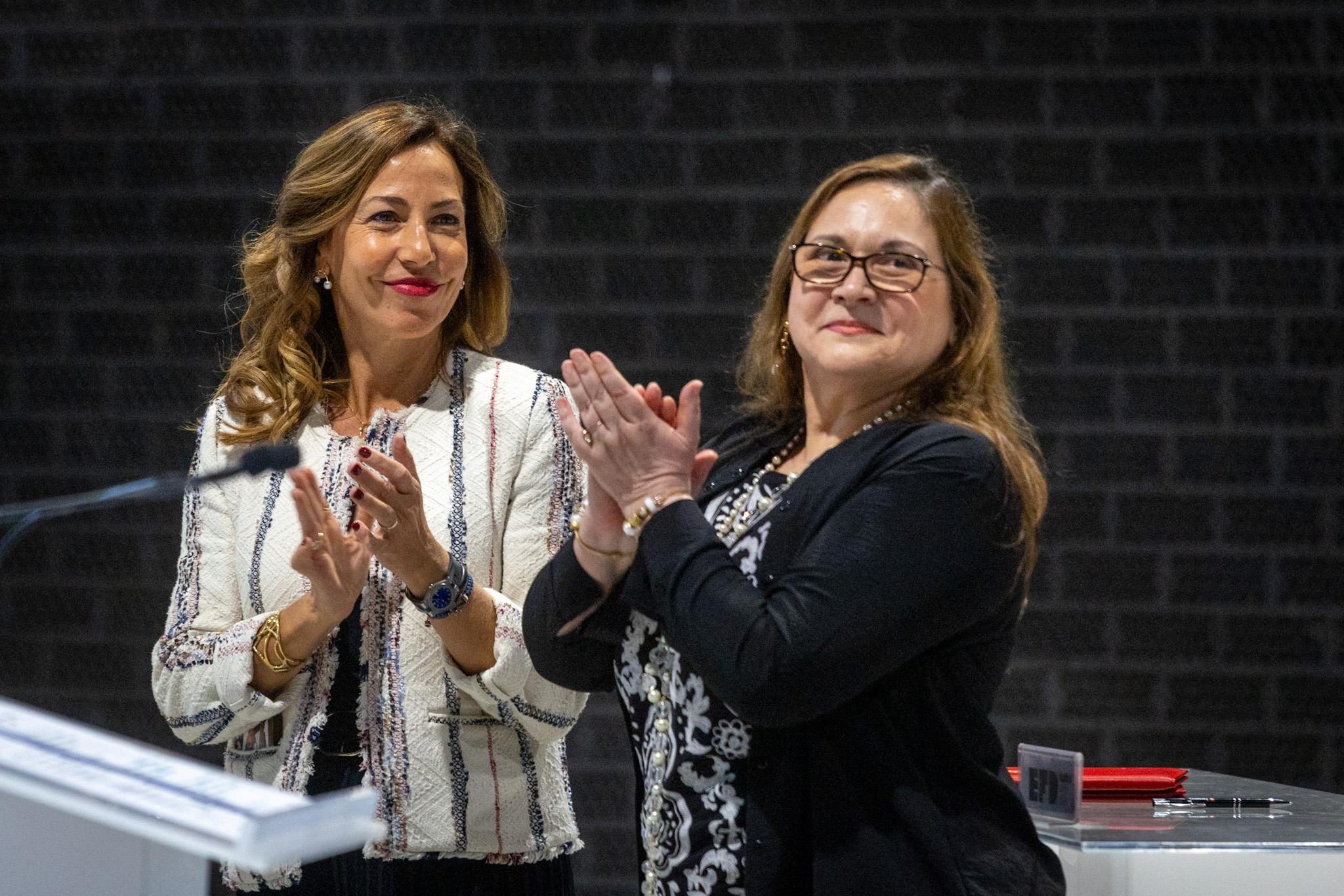
Founder and CEO of EFD Studios, Georgina Terán went from working in audiovisual production in Mexico to building an international technical-services company for film and television. She now faces one of her most significant projects in Spain: managing the soundstages at Distrito 7, Zaragoza’s Film City.
Georgina Terán’s career began on film and television production teams in Mexico. Over time, she decided to take on a different role in the audiovisual value chain: creating a company able to provide producers and filmmakers with the technical resources she herself had lacked during shoots.
The project began modestly, with seven employees, seven lenses, lighting equipment and two vehicles. From that initial operation emerged EFD, short for Equipment & Film Design, a company that has expanded over the years and now operates in several international markets under the EFD Studios brand.
Her full name is Blanca Georgina Terán Gilmore, although she uses Georgina Terán professionally. She was born in Mexico City and studied Communications at Universidad Iberoamericana, where she focused her education on filmmaking. She began working before completing her degree and spent her early years in various areas of Mexico’s audiovisual production industry.
She took part in projects linked to the Educational and Cultural Television Unit and the Mexican Film Institute, IMCINE. She also founded Diseño Fílmico, worked for Televisa Cine and served as director of Production Services at TV Azteca. That experience on set and in production management would go on to shape her subsequent business career.
Terán identified a gap in Mexico’s industry: the limited availability of technical equipment and infrastructure. Increasing local production and attracting international projects required more than skilled professionals, stories or locations; it also required companies capable of meeting the material needs of a shoot.
EFD was born out of that idea. The company added services as it grew: cameras, lenses, lighting, grip, generators, soundstages, postproduction and, more recently, virtual production. Its goal is to bring together under a single provider a significant share of the technical and logistical resources required for an audiovisual production.
Terán remains at the helm of the company as president and CEO. At the same time, she has maintained ties to her professional roots, participating as a producer or co-producer on feature films, documentaries and short films.
From Mexico to Zaragoza
EFD’s expansion took the company beyond Mexico, and Spain became one of its European markets. The company strengthened its presence in the country in 2024, at a time when Terán emphasized Spain’s ability to attract international productions through its combination of professionals, locations, infrastructure and technology.
Two years later, that strategy has arrived in Zaragoza.
Zaragoza City Council and EFD Studios formalized their contract on September 17 to manage the soundstages at Distrito 7, the audiovisual complex located in the former Giesa factory. Terán signed the agreement alongside Mayor Natalia Chueca and will play a central role in launching the project.
Her connection with Zaragoza goes beyond the relationship between the City Council and the Mexican parent company. Since June 2026, Blanca Georgina Terán Gilmore has been listed as the sole director of EFD Studios Zaragoza SL, the company established to develop EFD’s operations in the Aragonese capital.
EFD has committed to invest €1 million in the soundstages. The announced plan calls for operations to begin in January 2027, although commercial efforts are already underway. Terán has said the company is currently assessing four audiovisual projects for Distrito 7 and that several U.S. producers have expressed interest in visiting the facilities.
Aragon’s advantages
The challenge will be to compete with other Spanish regions that have spent years promoting their respective audiovisual industries. Terán points to several advantages for Zaragoza: its location between Madrid and Barcelona, its transport links, and the ability to combine studio use with a broad range of nearby locations.
For a production, the ability to concentrate services and reduce travel has a direct impact on costs, scheduling and logistics. Aragon offers access, within a short distance, to urban settings, semidesert landscapes, mountain areas, historic heritage and small rural towns. That diversity could become one of Distrito 7’s distinguishing assets.
EFD’s proposal for Zaragoza is not limited to soundstage rentals. Terán has cited areas including virtual production, artificial intelligence, new audiovisual formats and sustainability—fields that are reshaping work processes and expanding the range of professional roles required in the industry.
If Distrito 7 succeeds in attracting productions on a sustained basis, its impact will not depend solely on directors, actors or producers. The activity will require camera, lighting and sound technicians; virtual-production specialists; set-construction professionals; and workers in postproduction, visual effects, logistics, wardrobe and makeup, among other audiovisual trades.
That network of professionals and suppliers is precisely the field Terán has known since the beginning of her career. Her company was created to address the needs that arise behind the camera. The challenge now will be to bring that model to Zaragoza and determine, from 2027 onward, whether Distrito 7 can establish a stable audiovisual industry around its soundstages.








