



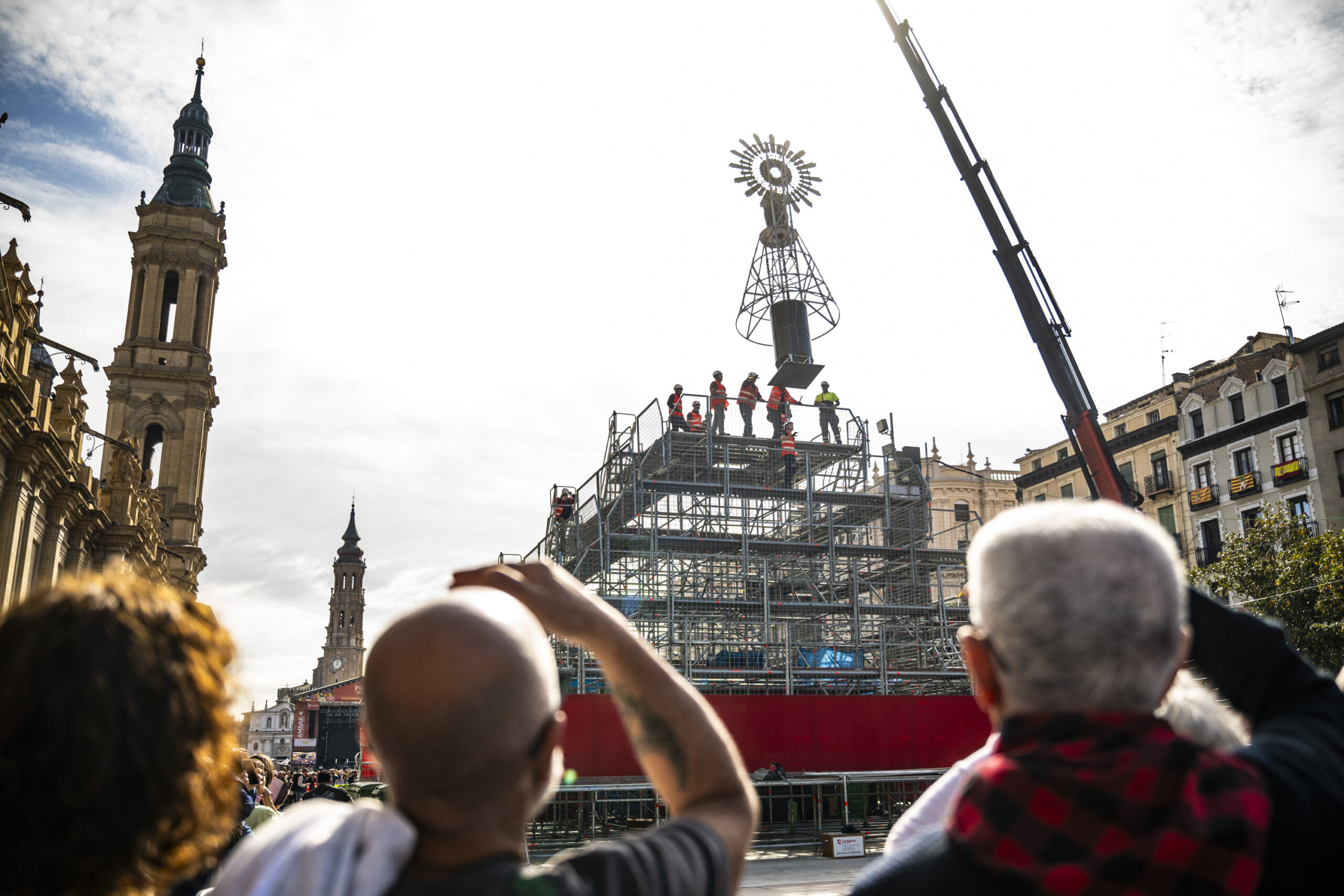
In 2024, Zaragoza City Council decided to turn the necessary task of lifting the statue of Our Lady of the Pillar to the top of the structure used for the Flower Offering into a formal ceremony. Since its debut, the event—now known as the Raising of Our Lady of the Pillar—has been warmly received. In 2025, as many as 15,000 people attended the emotionally charged occasion, which was accompanied by a musical recital created especially for it.
The Raising of Our Lady of the Pillar has therefore been scheduled for noon on October 11 as a featured event in the Pilar Festival program. Music will once again accompany the ceremony, performed by Aragonese soprano Eugenia Boix, the Chapel of the Pillar and the Children’s Choir of the Pillar, with organist Luis Antonio González.
Given the event’s evolution over such a short period, it has unquestionably become an eagerly anticipated gathering that draws large crowds. Even before it was incorporated into the festival program, however, many Zaragoza residents would come to Plaza del Pilar to watch the image of the Virgin being installed at the summit of the future floral pyramid.
A link to tradition
The Raising of Our Lady of the Pillar is the final task carried out on the vast metal structure. With the figure of the Pilarica high above the square and the strains of the Angelus ringing out, construction is deemed complete on this framework, which stands 15 meters high, measures 16 meters across and weighs 40 tons. It is an ephemeral structure built by Zaragoza City Council staff. In all, up to 30 professionals—including metalworkers, electricians, installers and gardeners—work on it from October 10 through noon on October 11.
Beyond the ceremony’s visual appeal, however, the modern Raising of Our Lady of the Pillar is rooted in popular tradition. According to religious devotion, the Virgin appeared in mortal form in Roman Zaragoza on January 2, 40 AD. At the time, the Apostle James the Greater was preaching in Caesaraugusta, but he was finding little acceptance among the population. His spirits were beginning to flag—until the Virgin Mary appeared to him that January day.
Although Mary was still living in distant Jerusalem, she appeared to the Apostle in mortal form, surrounded by angels. She did so to give him a jasper column, now known as the Pillar. This was evidently enough encouragement for James to continue his mission, while the foundations were laid for a small chapel around the Pillar. That was the distant origin of the future Basilica.
Given the dates associated with the tradition, one might assume that the Day of the Pillar would be celebrated early in the year. However, Zaragoza’s harsh winter led to the celebration being set for October 12 as early as 1613. The date coincided with the first Mass held in the chapel built around the Pillar.
Moreover, by early October, most people in that era—largely agricultural workers—had already completed much of their work, especially the grain and grape harvests. It was therefore a less demanding period, allowing them to celebrate more fully. The holiday, incidentally, became compulsory in 1807.
History of the Flower Offering
The festivities have changed considerably since then, including what is now the most emblematic event of the Pilar Festival: the Flower Offering.
Its origins date back to the 1940s. At the time, only the Virgin’s shrine was adorned with roses, carnations and tuberoses, which brought color and fragrance to the Holy Chapel. But at some point, Mayor Luis Gómez Laguna and City Councilor Manuel Rodeles decided to bring that floral splendor outdoors and involve the city’s residents.
They drew inspiration from flower offerings that had long been held in Valencia and other towns along Spain’s eastern Mediterranean coast. They brought the idea to Zaragoza and adapted it to devotion to Our Lady of the Pillar for the first Flower Offering, held in 1958. On that occasion, around 2,000 people paraded before a replica of the Virgin placed on the main façade, offering several thousand carnations, nearly all of them purchased by the City Council.
It may be considered an intimate event compared with today’s Flower Offering. Over the years, the celebration has grown into a massive event, especially since filmmaker Bigas Luna redesigned it in 1998, placing the Virgin and her flower mantle in their current location.
Once again in 2026, the Virgin’s pedestal will be made up of between 7 million and 8 million flowers. Hundreds of thousands of people will pass through the square over the course of several hours. Yet in a way, this symbolic ceremony begins the previous day, when the Raising of Our Lady of the Pillar takes place in the heart of the square that bears her name. It is the most recent formal ceremony to be added to the festivities, but its visual splendor and deep roots have already made it another hallmark of the festival.