



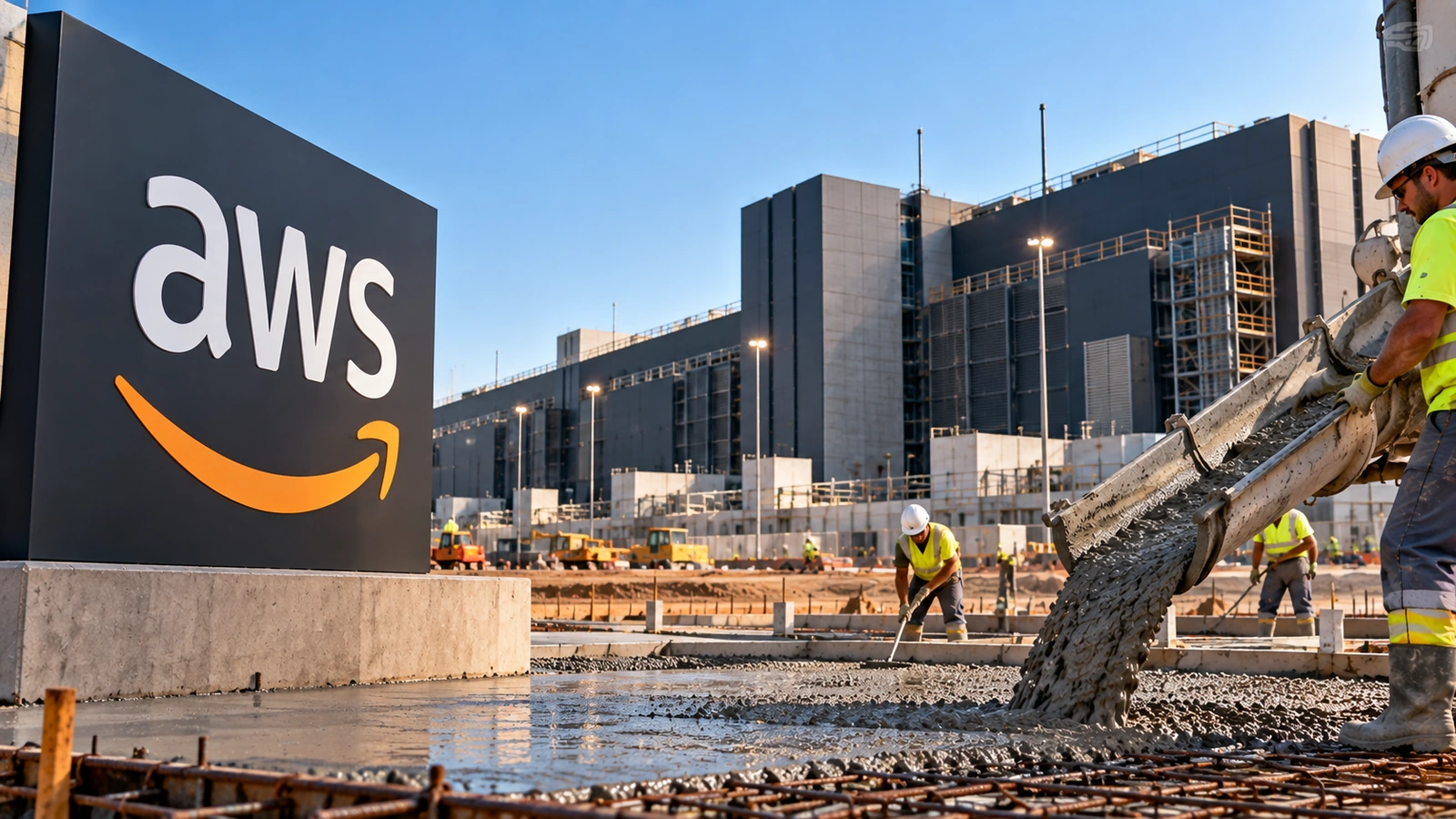
An Amazon Web Services (AWS) data center in Aragon has become a testing ground for a new generation of construction materials capable of permanently storing carbon dioxide. The initiative brings together Swedish-Dutch startup Paebbl and Aragon-based company Consolis Tecnyconta, opening the door for the solution to be incorporated into future Amazon construction projects.
The trial involved four precast concrete sandwich panels manufactured by Tecnyconta, in which Paebbl’s material accounted for 24% of the mix. According to data provided by the company, the application enables the permanent storage of about 200 kilograms of CO₂.
The technology is based on a process that also occurs naturally: certain minerals react with carbon dioxide and chemically bind it. Paebbl has developed an accelerated mineralization system that reduces this process to less than one hour, converting captured CO₂ into a mineral powder that can subsequently be incorporated into concrete production.
The product, called Rebond 300, serves as a supplementary cementitious material. Paebbl says it can replace up to 30% of the cement used in certain concrete mixes without compromising structural performance. Its environmental product declaration puts its net balance at -149 kilograms of CO₂ equivalent per metric ton of material produced.
The reduction stems from two sources. First, the captured carbon is mineralized and stored within the material; second, the partial replacement of conventional cement avoids some of the emissions associated with its production, one of the industrial processes with the greatest climate impact.
From Aragon to large-scale construction
Tecnyconta’s involvement has made it possible to move the technology from the laboratory to real construction components. The company, which specializes in precast concrete and belongs to the European Consolis group, develops data center-specific solutions from Aragon, a segment that has become an increasingly important part of its business.
The collaboration emerged through AWS. According to Ana Luisa Vaz, Paebbl’s vice president of Product, Amazon connected the startup with Tecnyconta because of the latter’s precast expertise and interest in testing new materials. The two companies jointly designed the testing program and validated the solution in their respective laboratories before using it in the building.
The Aragon pilot is significant because of the project’s next proposed step: bringing such materials to industrial scale. Paebbl is currently operating a demonstration plant at the Port of Rotterdam and plans to begin large-scale production in 2028, with an initial facility capable of producing between 60,000 and 100,000 metric tons annually.
The location of that future plant has yet to be decided. Company executives say Spain is among the options because of existing demand, the availability of renewable energy and raw materials, and a potential market for these types of solutions.
Paebbl also counts Tecnyconta as an industrial partner in a European project aimed at developing a new generation of carbon-storing cementitious materials. Other participants in the initiative include institutions such as Delft University of Technology, the Karlsruhe Institute of Technology, KU Leuven, the CSIC and Holcim.
Data centers as industrial laboratories
The trial comes amid rapid growth in digital infrastructure in Aragon. Since 2022, AWS has operated its Spanish cloud-services region from the autonomous community, with three availability zones spread across the provinces of Zaragoza and Huesca. In March 2026, Amazon announced that it would increase its planned investment in Spain to €33.7 billion to expand its data center infrastructure and services related to artificial intelligence and cloud computing.
The development of these facilities also raises the challenge of reducing the environmental impact associated with their construction. The use of materials that can reduce cement consumption and store carbon offers a new way to address the embodied emissions of the buildings themselves, alongside measures related to energy consumption during operation.
The trial conducted in Aragon remains limited in scale—four panels and about 200 kilograms of stored CO₂—but it makes it possible to assess the material’s performance outside the laboratory and within a real-world infrastructure project. The next challenge will be to demonstrate that the technology can be manufactured and deployed at scale while maintaining its technical performance and environmental balance.