



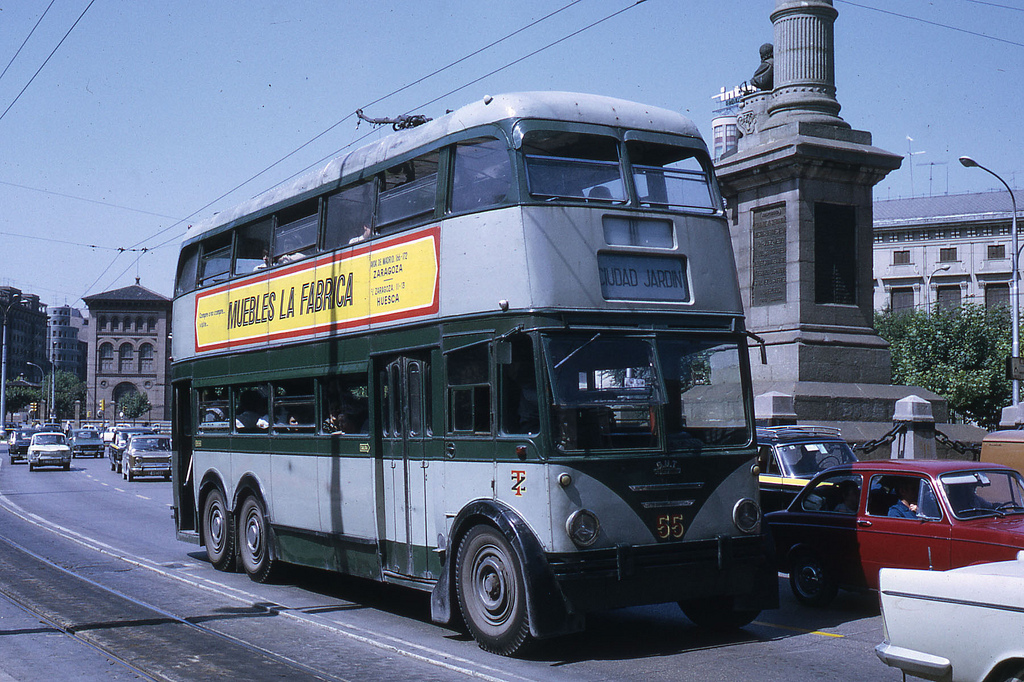
It all began in 1885, the same year Los Tranvías de Zaragoza was established—the company from which today’s Avanza descends. In October of that year, a pair of draft animals pulled a new vehicle through Zaragoza that seemed something of an oddity. The first horse-drawn tram departed from Plaza de la Constitución, bringing with it an idea that would not stop: connecting the city center with the neighborhoods beginning to grow. As Zaragoza expanded, so did the network, with new links to Torrero, Arrabal and Delicias. Transport was beginning to play an important role in connecting the center with the growing neighborhoods.
Technological innovation soon followed. In 1902, the Torrero line was electrified, a development that drove the tram’s evolution and cemented its prominence for much of the 20th century. Electricity changed how the service was delivered and foreshadowed a constant in the history of urban mobility: the search for solutions capable of responding to a changing city.
In 1923, another player was introduced that would prove essential: the bus. The first bus line was not yet making much noise, but it had something the rail could not match: flexibility. Buses could alter their routes as the city changed shape, making it possible to adapt services to new urban needs and gradually expand travel options.
A growing city in need of more connections
In the 1950s and 1960s, Zaragoza’s public transportation system enjoyed its heyday. For the first time, specifically in 1965, more than 100 million tickets were sold in a single year. Route 5, linking Venecia and Delicias, became one of the most heavily used lines in Spain.
During those years, trams, trolleybuses and buses shared the roads until the final tram line of that era ceased operations in January 1976. It was a time when private cars were gaining ground, while buses came to assume virtually exclusive responsibility for urban public transportation.
The network adapted to a growing Zaragoza through new service models: circular routes, articulated vehicles and special services emerged. Alongside the evolution of the vehicles came another, less visible but equally fundamental development: the introduction of technology to improve fleet organization and management.
When technology began to transform the journey
The implementation of the Operations Support System (SAE) marked progress in the network’s digitalization. These systems made it easier to track buses and provide information on waiting times at stops, bringing service management closer to today’s technological capabilities.
Modernizing transportation is not only about vehicles. It also lies in the tools that make it possible to manage services and provide passengers with information. With the arrival of the new century, other changes became widespread, including the gradual introduction of electronic cards to replace traditional paper tickets and the consolidation of night services. Expo Zaragoza 2008 also brought particular visibility to mobility in a city preparing to host a major international event.
The return of the tram and a new phase for mobility
Then, in 2011, something few had expected happened: the tram returned to Zaragoza. Thirty-five years had passed since its disappearance, and its return reincorporated this mode of transport into the urban network, offering high capacity and low emissions while in operation.
Meanwhile, buses continued to evolve. The introduction of hybrid and electric vehicles, along with trials of technologies linked to autonomous driving, reflects the search for new solutions for more efficient mobility.
Since 2022, the fleet operated by Avanza in Zaragoza has incorporated next-generation electric buses, as part of the city’s electrification drive, reducing environmental impact and positioning Zaragoza as a pioneering city. The change has also been operational: electrifying a transportation network means adapting not only the vehicles, but also the systems required for them to operate.
The future is plugged in
The current scale of the service helps illustrate the importance of public transportation in Zaragoza. The company that began as Los Tranvías de Zaragoza is part of Avanza, within the Mobility ADO group since 2013. More than 1,300 professionals and around 360 buses travel roughly 19 million kilometers each year. The latest data—covering 2025—show that the network recorded more than 98 million trips, averaging approximately 330,000 fare validations a day.
These are substantial figures, illustrating how Zaragoza’s public transportation system is part of the daily lives of thousands of people. Behind every data point is the story of someone traveling to work, class, an appointment or to visit a family member.
From that horse-drawn tram of 1885 to the electrification of buses—140 years after that first tram— Zaragoza’s public transportation system has changed in technology, capacity and management. Avanza’s story remains that of a city, Zaragoza, on the move—a city that has also changed, grown and taken on new connectivity needs.
Avanza’s anniversary offers an opportunity to trace that journey and look toward the next stage. The history of mobility does not stop at the milestones of the past: it continues every day, on every route, at every stop and on every journey connecting the capital of Aragon.