



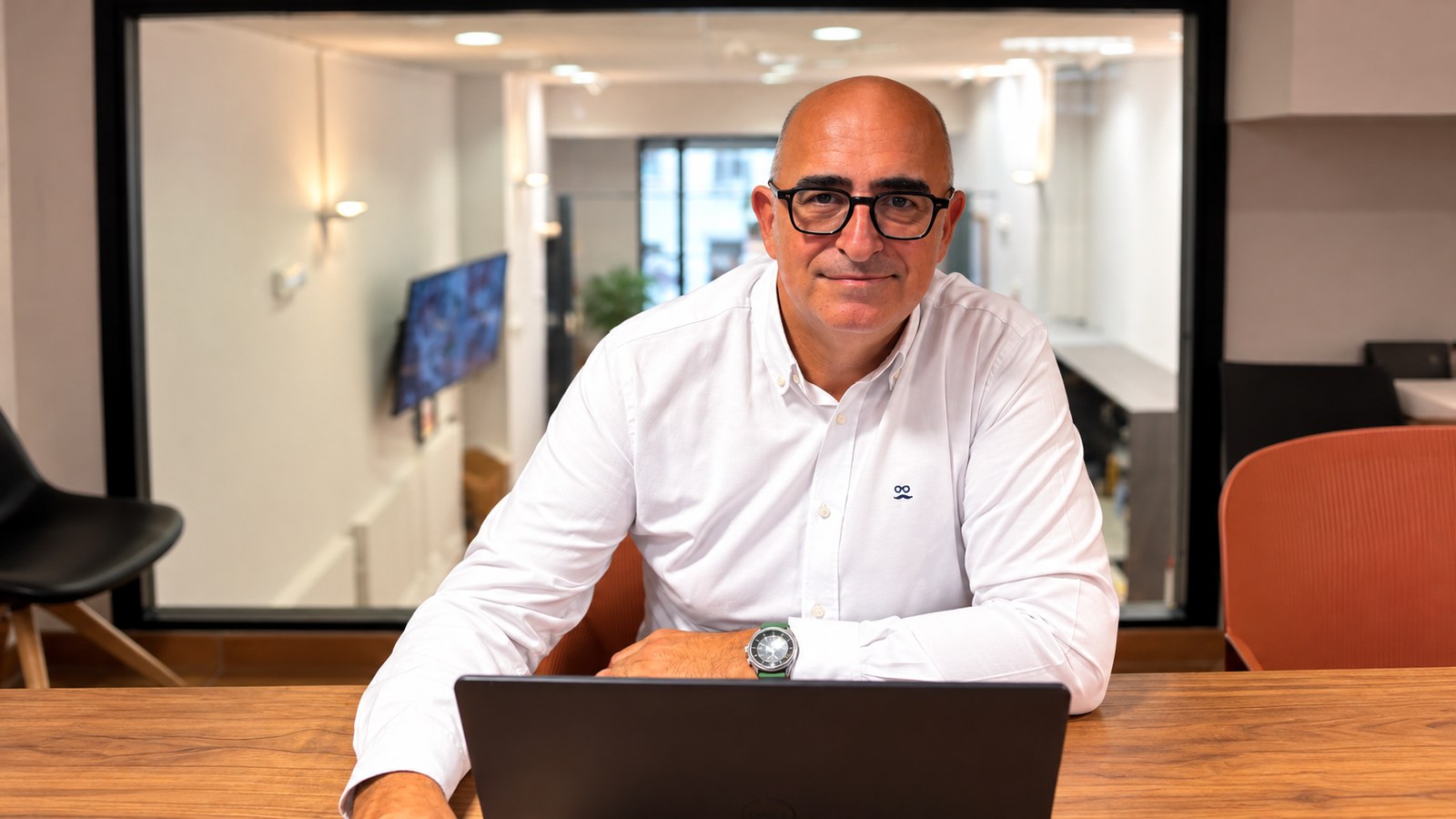
Flor de Lis still has its shutters only halfway up when we arrive. We step behind the scenes of what feels like a theater, just as the actors begin to take their places, the final details of the set are being refined, and everything is readied for a performance in which everyone knows their role and must execute their movements with the precision of a well-rehearsed choreography. The comparison is no coincidence: Luis Vaquer sees hospitality as a staging in which customers see only what happens in front of the curtain, without always being aware of the complex machinery working behind it to ensure everything runs smoothly.
On your LinkedIn profile, you describe yourself very succinctly: “Hello, I’m a restaurant entrepreneur.” Who is Luis Vaquer, and what do you believe defines you?
I’m a guy from a hospitality family in Los Monegros. We started out there, on the highway, and it has been my passion all my life. I launched a cocktail bar venture, then joined the family business, and we have developed different projects, always within the family, first with my parents and later with my siblings. I love management, I love helping my colleagues, pulling together with my family and our employees, and improving our industry.
Your business story did not begin with you. I have read you say that you “grew up behind a bar.” What memories do you have of those days?
I remember El Español, a roadside bar that was also the town’s social hub, because bars are our social centers. We have always had many customers from Bujaraloz, La Almolda, Peñalba and across the Los Monegros region. Back then, it was perfectly normal to go there and help out in the summer. I remember that, at 12 or 14, you did not have a formal shift, but one day you would wash the coffee dishes, another you would learn how to make coffee, then you would learn to use the cash register, and little by little we became part of the hospitality world.
How did you experience the decision to continue in the family business?
In a family business, you are often already headed in that direction and eager to join as soon as possible. I studied hospitality in Barcelona and completed internships at different establishments, but I always advise my children, whatever path they choose, even if they pursue their own ventures, to work at different companies when they are young so they can see how large businesses operate. Small, family-run companies have our traditions and resilience, which are strengths, but sometimes it works against us because we only see how we do things ourselves. I think it is very positive to go to large organizations, see how they work and then apply it.
More specifically, what was your professional path before launching your own projects?
I joined my parents’ restaurant and worked there for years. I studied hospitality at the Autonomous University of Barcelona, which at the time was one of the few universities offering those programs. It was a combined restaurant and hotel management course. Then, with my parents’ help, we decided to launch a business in Zaragoza. My sister Teresa and I started out and, in 2000, took over Las Palomas restaurant, which was a major bet for us. We were there for 20 years, with great success in terms of operations, clientele and management.
Was it then, with Las Palomas, that you felt it was still a family venture but was also becoming your own company?
Of course. I think that the moment you are responsible for making sure there is money at the end of the month to pay salaries—or, unfortunately, when you have to lay someone off—you become the person ultimately responsible. That is when it starts to weigh on you a little, and you have skin in the game. But I also have to say that my parents were very generous in that respect, in letting go and allowing us to make mistakes.
Of all the family legacy you have inherited, which aspects would you never change, and what have you come to understand through experience needed to be modified?
We are in hospitality, and customer service is fundamental. One of the things our parents instilled in us is that the customer comes first. We always say the customer is always right. I would add an asterisk there (laughs): the customer is almost always right, and when they are not, we make them right. As my mother says, customers bring us nothing but joy, because they bring in the money and are the fuel that drives our business, allowing us to make a living, pay our suppliers, pay our employees and continue with our project.
There is another phrase of yours that strikes me as particularly revealing. You talk about years of learning and evolution needed to turn a bar or restaurant into a proper business. What exactly does that mean?
As margins have narrowed, restaurants have to be managed better and better. Hospitality operators are highly intuitive people who give everything for their customers and love to sell. Naturally, all we think about is selling, but we have to remember that while customer satisfaction is the foundation—because if customers are not satisfied, they will not return—the restaurant also needs to be profitable in order to endure over time.
Now that we are a group, we have our strategy, human resources and finance functions fully covered. When you are small, you can do that with the help of outside professionals, and when you are a little bigger, you can do it yourself. But it is not enough to focus on service, although it is also good to supervise it. You need a comprehensive view of the business, professionalism and an organized company, because that also provides some peace of mind.
And what is the lesson that has been hardest for you to learn during that process?
I think you have to trust people. You cannot expect to be everywhere. Above all, when, as in our case, you already have five establishments, you cannot be constantly present at each one, so you need teams. You also have to work under sustainable working conditions, so people can live their lives and are not under constant stress—both the owner and the employees.
Grupo Vaquer has grown and developed very different concepts, from El Español, where it all began, to Flor de Lis, where we are now, and Rústicco. How would you define the Vaquer hallmark?
Although we strive for sound, professional management, and are now a highly digitalized company, we always put the customer at the center. We have very different formats: quick-service outlets where people have a sandwich, such as Cafetería Santiago; El Español, an all-you-can-eat buffet whose service model has nothing to do with Flor de Lis or Rústicco, the group’s most gastronomic establishment. But always, within the average check and the offering at each venue, we try to take great care of the customer.
Another hallmark is that we are clear about our roots. We keep our feet on the ground and say: look, we are from Bujaraloz; we are Aragonese. At El Español, we still make macaroni the way it has always been made, and we still prepare the roast lamb we made 50 years ago. We offer modern, updated concepts, but we always have our iconic dishes to hold on to, to keep us grounded. And that is very important to us.