



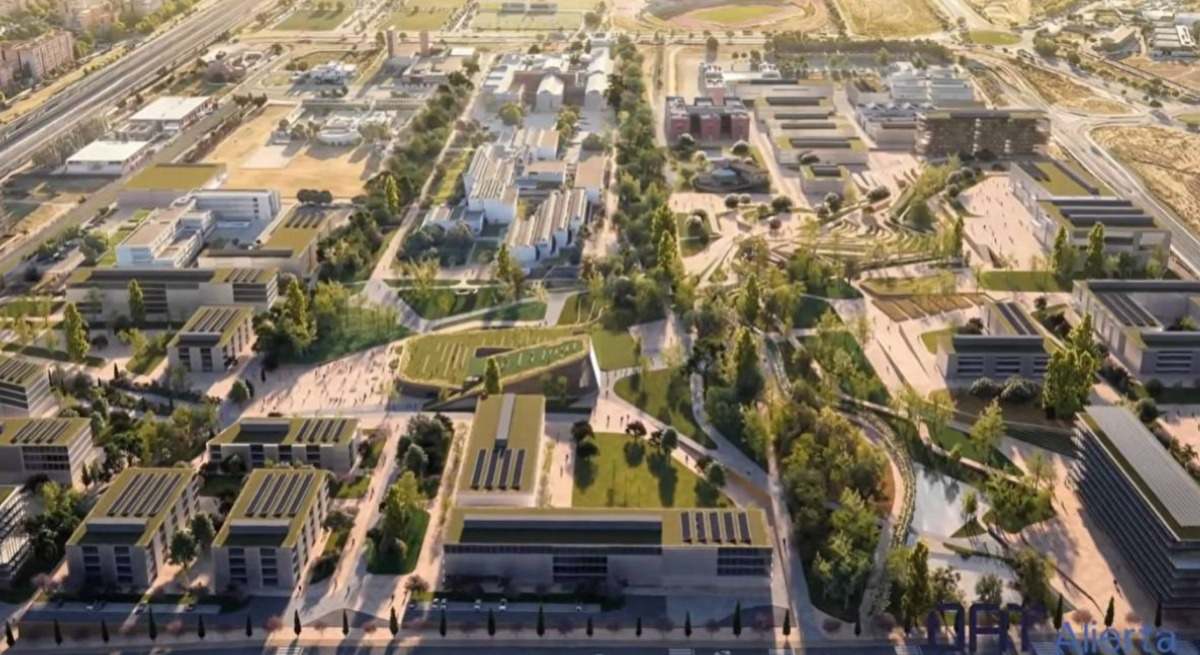
Aragón’s Department of Economy, Competitiveness and Employment will focus its 2027 budget on strengthening business competitiveness, digitalization, employment and innovation. Regional Minister Eva Valle presented the accounts on November 9, 2026, identifying the Alierta Aragón Technology District, the SME Digitalization Plan and the Defense Strategy among its cross-cutting initiatives.
Alierta DAT, digitalization and defense drive new technology investments
The development of the Alierta Aragón Technology District (Alierta DAT) will have a total budget of €17.5 million. The allocation includes €5.5 million for the expansion of the Aragón Institute of Technology, where construction is already underway, and provides for the future rollout of CIRCE, business facilities, training infrastructure and project-related urban development.
CEEI Aragón will strengthen its role as the main driver of Alierta DAT. The project is part of a strategy aimed at positioning Aragón for technological transformation, with a focus on the digital economy, artificial intelligence, advanced industry and innovation.
The SME Digitalization Plan will have more than €2.5 million and will be implemented alongside several regional directorates, the IAF, the ITA and SODIAR. The initiative seeks to expand the use of digital and artificial intelligence tools among SMEs, retailers, and industrial and service companies, with the aim of boosting productivity, competitiveness and added value.
The Defense Strategy, an evolution of Aragón’s Defense Hub, will receive at least €2.5 million in 2027. The plan aims to help SMEs access high-value markets and supply chains through innovation, certifications, financing, training and business collaboration.
A €10 million startup fund and additional resources for investment and internationalization
The department will launch a €10 million technology startup fund to support the creation, growth and scaling of technology companies linked to Aragón. Public funding will target the stages at which these companies face the greatest difficulty in attracting private capital.
The capital of Sodiar will increase to €1.5 million. According to the projections presented, the increase will initially enable more than €4 million in direct investment in Aragón-based companies and more than €19 million in induced investment, in addition to the reinvestment of funds. Of the total, €500,000 will be earmarked for the innovation fund.
Business internationalization will receive more than €4 million, coordinated with entities such as chambers of commerce. The budget also maintains work on investment attraction and regulatory simplification, with the aim of streamlining procedures and providing a stable framework for business activity.
Employment, industry, trade and energy complete Aragón’s economic roadmap
INAEM will maintain its training, employment promotion and career guidance policies with a combined budget of nearly €120 million. The department plans to continue collaborating with business and labor organizations on social dialogue, occupational risk prevention and collective bargaining, alongside awareness campaigns, oversight and monitoring of the most serious violations.
Industrial policy will be underpinned by the Comprehensive Plan for Attracting and Boosting Industrial Activity in Aragón, which is currently being finalized. The document will serve as a roadmap for the coming years and will include measures on industrial land, the modernization of industrial areas and support for productive investment, with an allocation of nearly €16 million.
The Directorate General for Industry will allocate nearly €4 million to business innovation initiatives. In retail, the budget will strengthen programs such as Volveremos and the General Plan for Commercial Facilities in Aragón, as well as measures targeting business succession and self-employed workers.
The electricity distribution grid will remain a strategic priority. The Government of Aragón is drawing up an Energy Needs Plan with other departments to align grid planning with the region’s future industrial, logistics and business demand.