



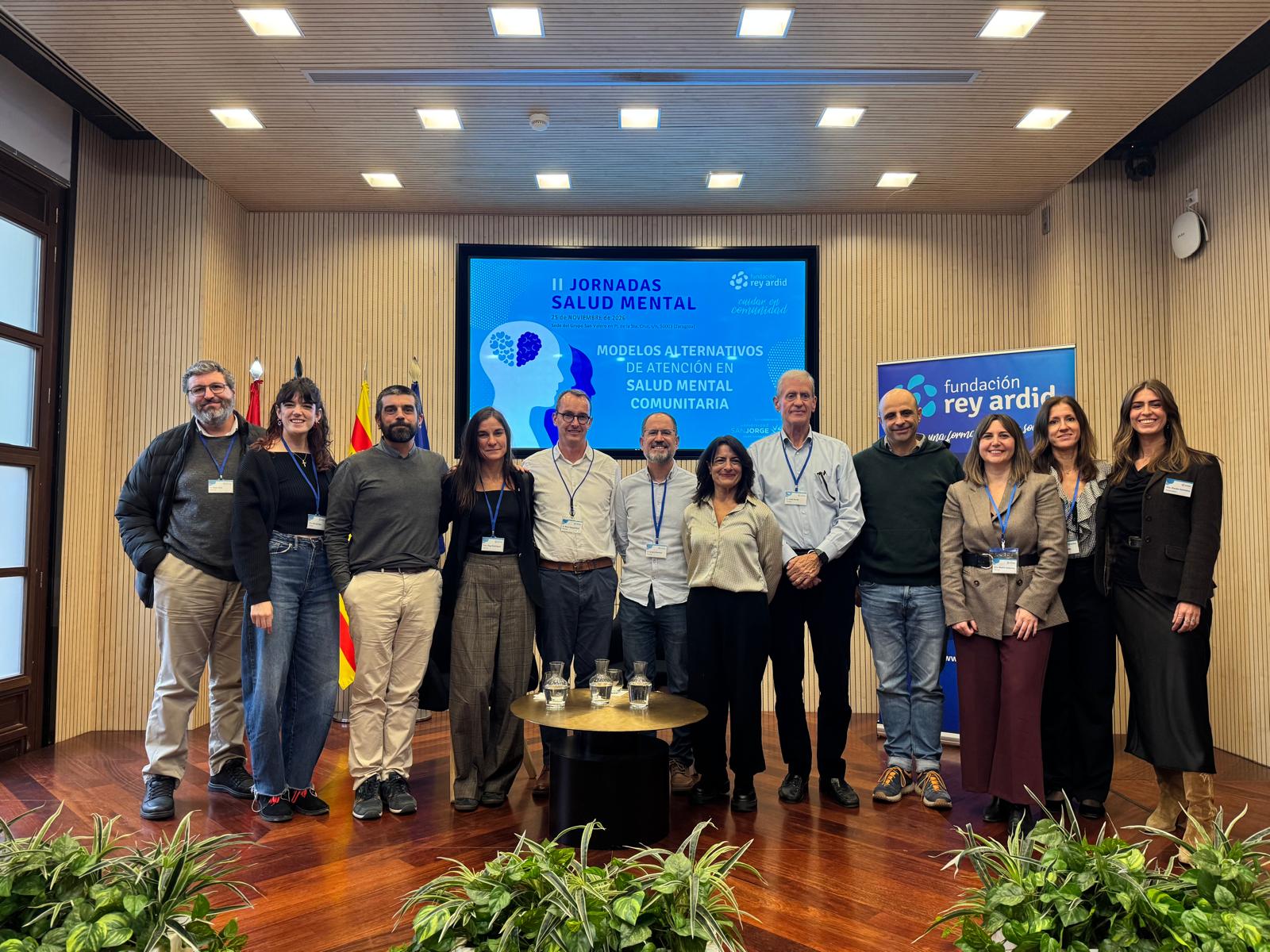
A total of 140 professionals from mental health, social services, and protection services filled capacity at the Second Mental Health Conference: Alternative Models of Community Mental Health Care, held on November 25 at Grupo San Valero’s headquarters in Zaragoza. The event, organized by Fundación Rey Ardid together with Universidad San Jorge, explored approaches including Open Dialogue, street outreach teams, mentalization in severe mental illness, and care for professionals.
Manuel Corbera, director of Mental Health for the Government of Aragon, opened the conference and cited regional inequalities and access to resources among the challenges. In his address, he said mental health “can no longer be understood solely from a clinical perspective,” adding: “A person’s recovery is not only about reducing symptoms, but about restoring connections. People do not live in services; they live in their communities, in their homes, with their families and support networks.”
Open Dialogue and care from the first crisis
Psychiatrist Jordi Marfà, one of the pioneers of Open Dialogue in Spain, advocated a recovery model understood as a meaningful life project defined by the individual. Clinical psychologist Silvia Parrabera and family therapist Sergio Sánchez explained that this approach brings together the person and their network from the first crisis.
Parrabera highlighted the importance of the language used in care: “If you say someone has a mental illness, you see a sick person. If you say they are in crisis, you see someone who is suffering and who has resources, because we all do.”
The conference also featured the experience of El Encuentro en Calle, a Fundación La Caridad program presented by Marina Aisa. The team works with homeless people in Zaragoza with the aim of breaking the “revolving door” cycle of admission, discharge, and return to the streets.
Olga Rodríguez presented the Beinke Program of the Provincial Council of Bizkaia, aimed at young people aged 18 to 25, and said that “not getting worse at these ages can be a major goal.” Meanwhile, Mark Dangerfield, director of the Vidal i Barraquer University Institute of Mental Health, questioned services that require the most vulnerable young people to show up and ask for help as a condition for beginning care: “It would be like saying that in traumatology, we will treat you only if you walk in.”
Dangerfield advocated transforming the system “from within” through research that demonstrates results, and stressed the need to care for care teams: “We do not want superheroes.” The issue was also the focus of remarks by Noelia Calderera, director of Rey Ardid’s Rehabilitation and Psychosocial Support Center in Calatayud, who asked: “Who cares for the caregiver?”
Raúl Gutiérrez, deputy director of Mental Health Technical Management at Fundación Rey Ardid, closed the event by calling for “a shift toward humanism, toward humane treatment,” grounded in connection, empathy, trust, and hope.
Fundación Rey Ardid promotes these conferences to share evidence-based knowledge and bring into everyday practice models that, according to the organization, are transforming care in other regions. The foundation, which says it has 35 years of experience in mental health in Aragon and has operated since 1991, supports 9,941 people in Aragon and La Rioja through a team of 1,874 professionals. It also says it has implemented 123 social innovation projects with more than 50 partner organizations.