



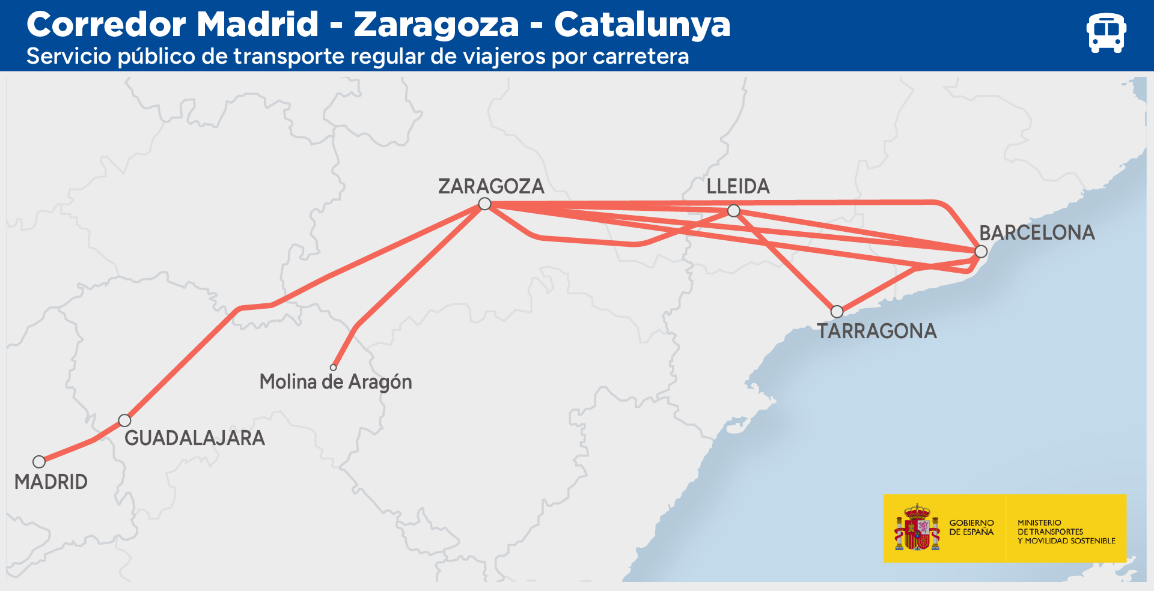
The Government has given the green light to the bus corridor that will connect Madrid, Zaragoza, and Catalonia, a key initiative in modernizing road transport in Spain. This project, approved by the Council of Ministers, aims to optimize the state bus concession map and improve interregional mobility.
A strategic corridor with 13 routes and 95 stops
The new bus corridor is structured into 13 routes covering a total of 6,030 kilometers, distributing 95 stops across 47 municipalities. Among these, Zaragoza stands out with 26 stops, followed by Barcelona with 7, and other locations in Guadalajara, Huesca, Lleida, Madrid, Soria, and Tarragona. This service will benefit over 7.3 million citizens according to the 2024 census, with projected growth of 8.6% by 2030 and 12.1% by 2035.
The estimated mobility for this corridor ranges from 786,362 passengers in 2025 to 818,893 in 2034, underscoring its importance in the national transport system. Additionally, the corridor will unify the VAC-099 and VAC-263 concessions, introducing significant improvements in the service.
Innovations and service improvements
The corridor introduces new strategic stops such as Val de San Martín in Zaragoza, Terrassa in Barcelona as an intermodal hub, and Barcelona Airport, thus enhancing multimodal connections. Furthermore, new direct connections will be established between cities such as Alcalá de Henares and Lleida, Calatayud and Guadalajara, and several others, facilitating access and mobility between regions.
One of the most notable improvements is the 22.7% reduction in fares, making the service more accessible for users. The concessionaire will be required to implement an operational support system based on satellite technology and advanced data communications, providing real-time information about the fleet.
Future of road transport in Spain
The draft project for the corridor was submitted for public consultation between November 2025 and January 2026, and after analyzing the feedback, the Ministry presented the final project. The next step in this ambitious modernization plan will be the bidding for the new contract.
At the same time, the Ministry is progressing in the development of the Madrid-Valencia corridor, which will connect 130 municipalities across 8 provinces, benefiting over 6.2 million residents. These initiatives are part of a broader effort to reorganize the concession map, which has served nearly 2,000 municipalities since the 1940s, ensuring continuity of service while promoting fleet renewal and sustainability through intelligent transport systems.