



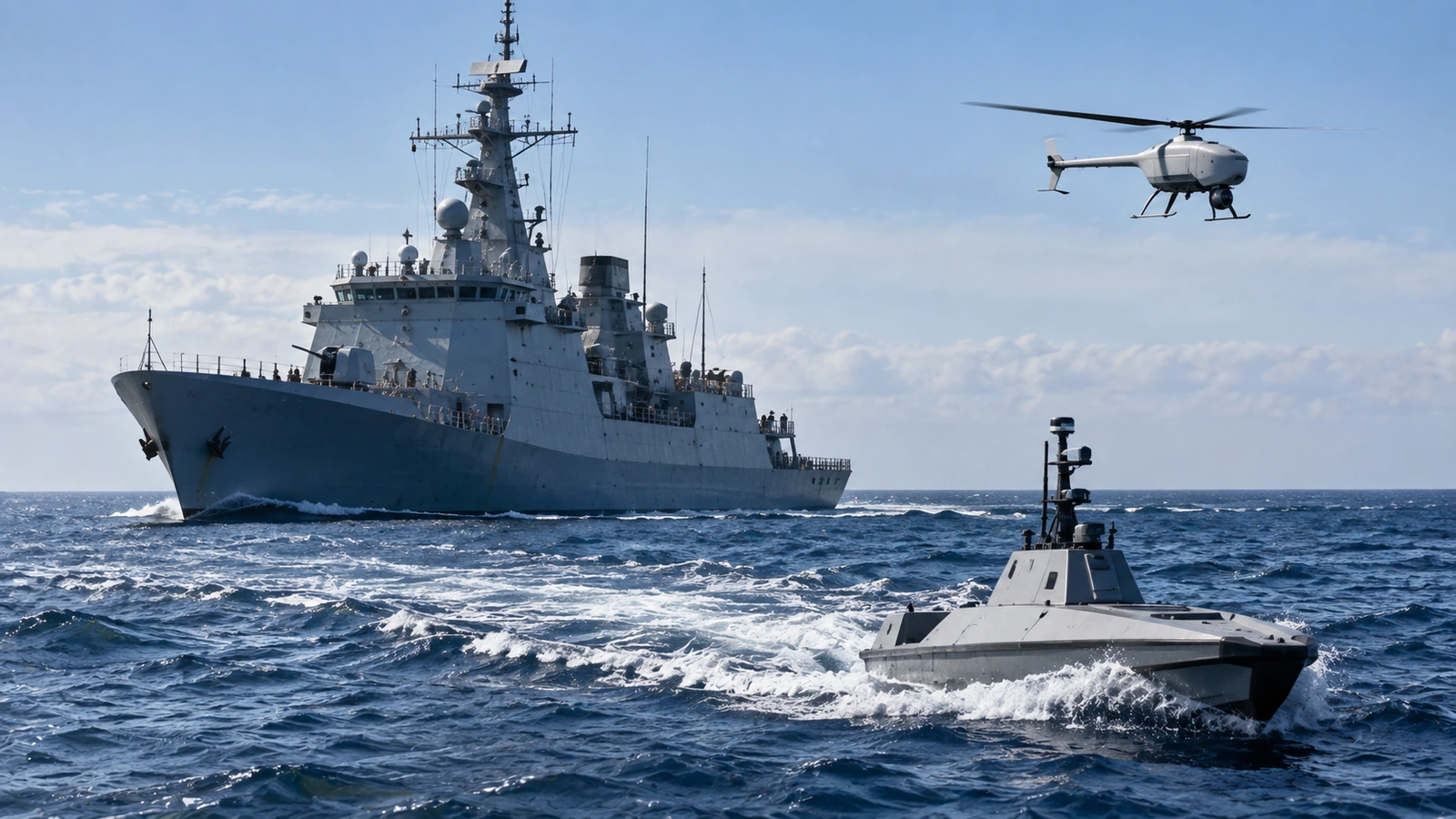
The Spanish Navy is moving forward with the integration of uncrewed systems into its naval operations through a trial that goes beyond the standalone use of drones. During the international REPMUS 2026 exercise in Portugal, the multipurpose vessel Carnota operated for two weeks with the Sead 23 uncrewed surface vehicle integrated as though it were an organic asset of the ship.
The deployment took place from September 8 to 24 and made it possible to test, under operational conditions, the integration of a crewed platform and an uncrewed system that was not originally designed to operate from a ship. The Sead 23 is operated by the Navy’s Center for Experimentation and Uncrewed Vehicles (Ceventa), which is responsible for testing and evaluating these technologies and their potential applications.
The experience is significant because of the operational model it proposes. It is not simply a matter of launching a drone from a ship, but of incorporating it into the vessel’s capabilities and using the information and services it provides as part of the naval unit’s own operations. During REPMUS, the Carnota was also the only participating vessel with an organic uncrewed asset, while the other autonomous naval systems used in the exercise operated from port.
A drone to expand the ship’s capabilities
The Sead 23 took part in a range of scenarios, from force-protection missions to maritime interdiction operations. Its tasks included enhancing the Carnota’s security when departing port and operating from anchorages, as well as gathering intelligence through imagery and data from the electromagnetic spectrum.
The Navy also tested its use as a platform for deploying loitering munitions. The trials therefore made it possible to assess not only the vehicle’s navigation and control from the ship, but also its integration into operations conducted by a naval force.
The selection of the Carnota reflects the versatility of this multipurpose vessel, which entered service with the Navy in late 2023. At 66.8 meters long and with a full-load displacement of 2,284 tons, the vessel belongs to the Maritime Action Force Units Group and is based at La Graña Naval Station in Ferrol.
Its configuration allows it to carry containers with different equipment, enabling its capabilities to be adapted to each mission. In Portugal, modules containing command-and-control systems were embarked, adding functions the vessel does not permanently possess. This modularity makes it possible to use the same platform for widely differing tasks, from maritime surveillance and logistical support to operations involving uncrewed vehicles.
More than 300 uncrewed systems in Portugal
The Spanish trial was conducted as part of REPMUS 2026, one of the leading international settings for testing robotics and autonomous systems in the maritime environment. Organized by the Portuguese Navy with the participation of NATO, the European Defence Agency, and various research organizations, the exercise was held from August 31 to September 25 in the maritime areas of Tróia and Sesimbra.
The scale of this year’s edition illustrates the growing importance of these technologies for naval forces. REPMUS brought together more than 1,500 participants from 36 navies, along with more than 60 companies and research and development organizations, 13 universities, and five NATO-affiliated entities. More than 300 uncrewed systems and 14 vessels took part in the trials.
The tests covered surface, underwater, aerial, and ground vehicles, and made it possible to assess their performance in shared operational scenarios. In parallel, the European Defence Agency used REPMUS to demonstrate its MARSUR maritime-surveillance network’s ability to exchange information in real time with national systems and NATO sources.
Spanish industry joins the experimentation
Spain’s participation was not limited to the Carnota and the Sead 23. Fleet personnel took part in command-and-control activities, while a team from the Mine Countermeasures Force worked with different uncrewed underwater systems.
The exercise also served as a meeting point with industry. According to the head of Ceventa, as cited by Infodefensa, the Navy worked with more than 20 Spanish companies during REPMUS in areas including uncrewed systems, communications, command and control, artificial intelligence, electronics, and counter-drone technologies.
The experimentation carried out in Portugal thus reflects a broader transformation of naval operations. Uncrewed systems are gradually moving beyond their role as isolated equipment to integrate with ships, information networks, and command centers. The trial involving the Carnota and the Sead 23 gives the Navy experience in organizing this coexistence between crewed and autonomous platforms before defining its future capabilities.