



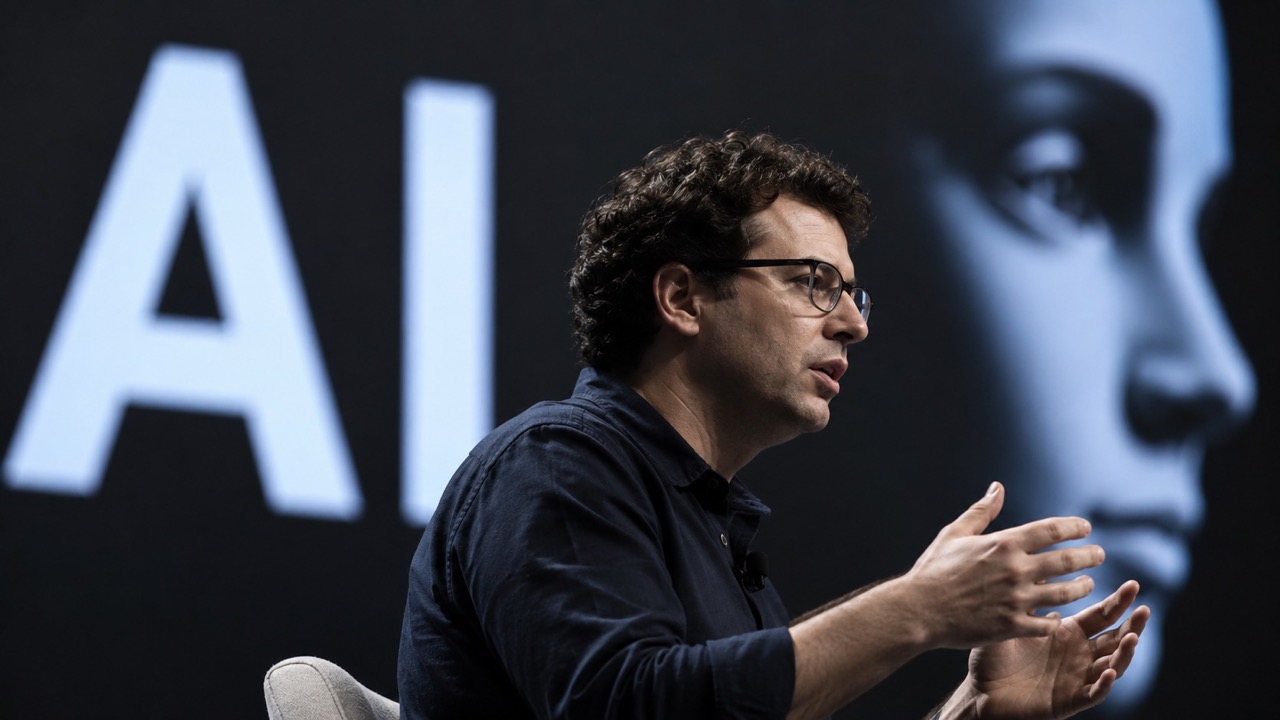
The warning is no longer coming solely from researchers, regulators, or critics of artificial intelligence. Dario Amodei, co-founder and chief executive of Anthropic, one of the companies competing to develop the most advanced models, has accused the industry itself of concealing the risks associated with the technology for too long.
“For too long, the industry lied to people about the fact that this technology had risks,” Amodei said in an interview. The executive said there are “real dangers” and argued that the rapid growth in the capabilities of artificial intelligence systems is a warning sign that requires the sector to reconsider the pace at which it is advancing.
His remarks come amid intense competition among major technology labs to develop increasingly capable models. Anthropic, the creator of Claude, is among the companies at the center of that race, alongside firms such as OpenAI and Google DeepMind. That position makes Amodei’s intervention more than an outside warning: it raises from within the industry the possibility that safety and oversight mechanisms are not progressing at the same pace as the technology itself.
A proposal to slow the pace
Amodei set out his position in an essay titled We Must Pace the Frontier, in which he argues that the development of frontier systems should proceed more cautiously. His concern centers particularly on the possibility that model capabilities could grow faster than humanity’s ability to understand, evaluate, and control them.
Among other measures, the Anthropic chief proposes giving external evaluators ongoing access to systems to verify compliance with safety measures, analyze incidents, and study model behavior during training.
The proposal goes beyond decisions any single company can make. Amodei sees a need for coordination among leading artificial intelligence developers and, at a later stage, for international agreements capable of establishing certain limits and safety standards.
The challenge is that unilaterally slowing development presents an obvious difficulty in an industry subject to intense corporate and geopolitical competition. If one company chooses to move more slowly while its rivals maintain their pace, it could lose ground in a technology regarded as strategic. The same tension is evident internationally, particularly in the technology competition between the United States and China.
A debate dividing the industry
Amodei’s warnings have found support among some of the sector’s most prominent figures. Executives including OpenAI’s Sam Altman, Google DeepMind’s Demis Hassabis, and Elon Musk have also expressed concern about the pace of development of the most advanced systems, although their specific positions and proposals differ.
At the same time, calls to slow the pace have drawn criticism. Opponents question both the feasibility of coordinating competing companies and countries and the wisdom of imposing restrictions that could curb innovation or benefit companies already holding dominant positions.
The debate also has a political dimension. Proposals for greater control over advanced systems clash with those who believe the United States must move as quickly as possible to preserve its technological advantage over China. Chinese state media have criticized Amodei’s position and interpreted his views on technological control as part of the rivalry between the two countries.
Anthropic has warned of the risks for years
Amodei’s stance does not represent a complete break from his previous message. Anthropic was founded with a strong emphasis on the safety of artificial intelligence systems, and its chief executive has spent years warning about the potential negative effects of increasingly powerful models.
At the same time, Amodei has publicly championed the technology’s enormous potential. In 2024, he published the essay Machines of Loving Grace, in which he described a scenario in which sufficiently advanced artificial intelligence could accelerate progress in fields such as biology, medicine, neuroscience, and economic development.
That combination of expectations and risks helps explain his current position. Amodei is not calling for artificial intelligence development to be abandoned, but rather for time to be gained so that control mechanisms can advance before systems emerge whose capabilities are far more difficult to oversee.
The discussion is particularly significant because it comes from those with the direct power to decide how far, and how quickly, the technology continues to advance. The question is no longer solely what artificial intelligence can do, but what limits the companies competing to build it are willing to accept.