



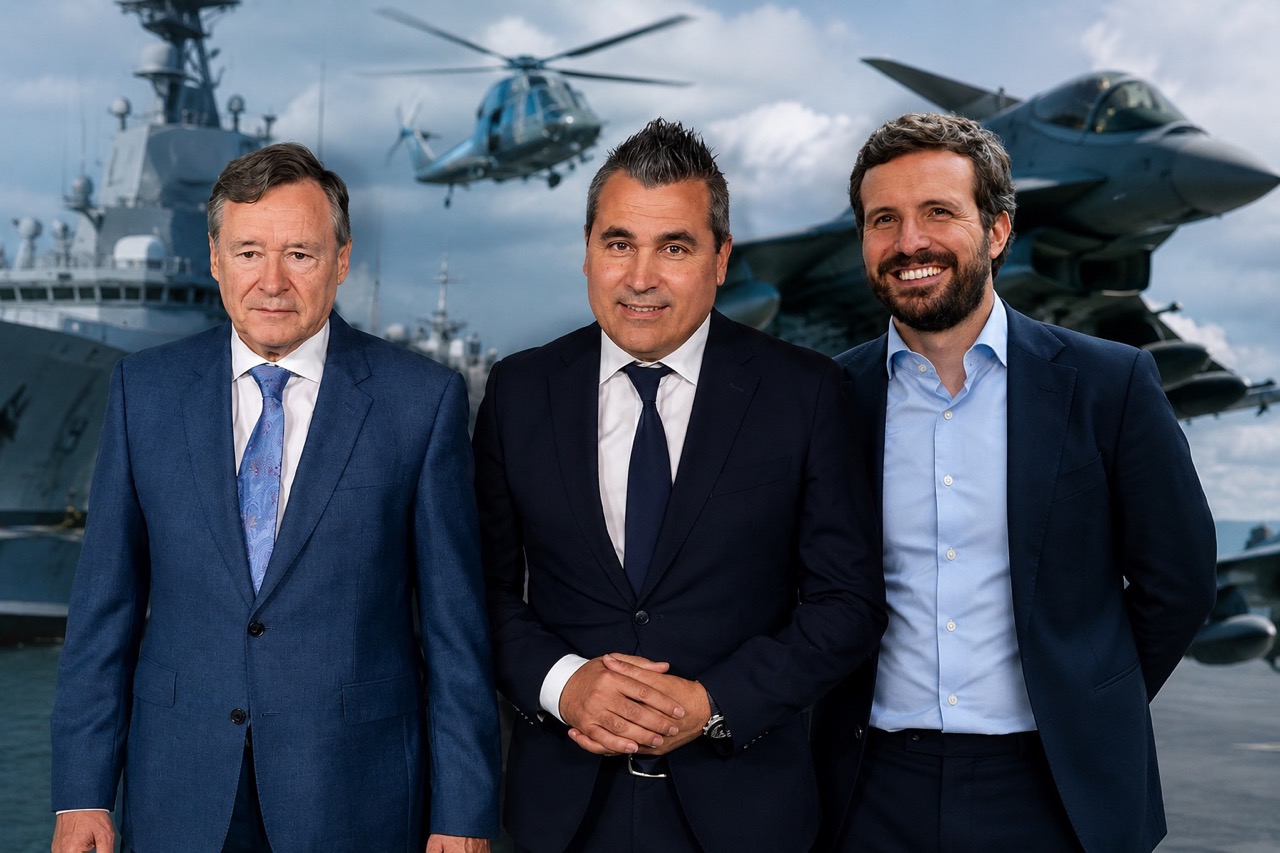
The Spanish defense industry is moving away from being a territory reserved for a relatively stable group of large manufacturers and specialized companies. The increase in military budgets in Spain and Europe is attracting private capital, new investors, and executives from sectors that have had a limited relationship with this activity until recently.
This phenomenon coincides with a technological transformation of defense itself. The Ukraine war has highlighted the importance of drones, communications, electronic warfare, artificial intelligence, space systems, and low-cost munitions. Alongside traditional large programs for aircraft, ships, or armored vehicles, opportunities are emerging for smaller companies capable of developing highly specialized technologies.
The business movements of recent months demonstrate this transformation. From funds specifically created to invest in defense and aerospace to industrial companies acquired by new investors, as well as startups aiming to fill still undeveloped technological niches in Spain.
Pablo Casado and the Entrance of Private Capital
One of the most well-known examples is that of former Popular Party president Pablo Casado, currently a managing partner at Hyperion Fund. The firm describes itself as a European fund specialized in industrial companies related to defense, aerospace, cybersecurity, and artificial intelligence.
Its portfolio reveals what types of assets are attracting private capital. Among its investments are companies linked to satellite communications, space propulsion, unmanned aircraft, and various industrial capabilities.
Hyperion has invested, among others, in Sateliot, specialized in connectivity through nanosatellites; Pangea Aerospace, focused on space propulsion systems; Orbital Critical Systems, which works on critical aerospace systems; and Gutmar, an industrial company specialized in precision machining.
The fund also participates, alongside Azuaga, in Boost Air. This company integrates aerospace maintenance capabilities from Gestair MRO, Brok-air Aviation Group, and ATS Aviation and aims to compete, among other markets, for contracts related to the maintenance of military aircraft.
The entry of specialized funds introduces a funding avenue that could be significant for mid-sized Spanish companies. One of the traditional challenges of the defense sector is that developing and certifying new technologies requires substantial investments and lengthy periods before securing major contracts. The growth of public investment is now increasing the interest of investors willing to undertake that process.
From Consulting to Industry
Another recent movement has been led by Grupo Redondo, headed by Iván Redondo, former chief of staff to Pedro Sánchez. The group acquired 51% of Norclamp, an industrial company based in Irún specializing in high-precision machining, at the end of July.
The operation has a significant characteristic: it incorporates its own industrial capacity into the group. Norclamp manufactures repetitive parts, equipment goods, and components for various sectors, including energy, security, and defense. The company has production facilities in Gipuzkoa and Zamora and exports part of its output.
The acquisition also demonstrates that the expansion of the military industry is not limited to manufacturers that directly produce weapons or complete platforms. A large part of the sector consists of supply chains that manufacture components, electronic systems, machined parts, software, or services necessary for major programs.
In this context, industrial companies that previously had limited exposure to defense may find opportunities to increase their activity as suppliers.
New Profiles to Lead Major Companies
The transformation also extends to established companies. Indra, poised to play a central role in the reorganization of the Spanish defense industry, has refreshed its top management in 2026 with two profiles whose professional backgrounds have primarily been developed outside the military sector.
Ángel Simón was ratified last June as non-executive chairman. His career has been primarily linked to Agbar and the management of water and infrastructure, along with his subsequent role at CriteriaCaixa.
The new CEO, Josep Maria Recasens, comes directly from the automotive industry.