



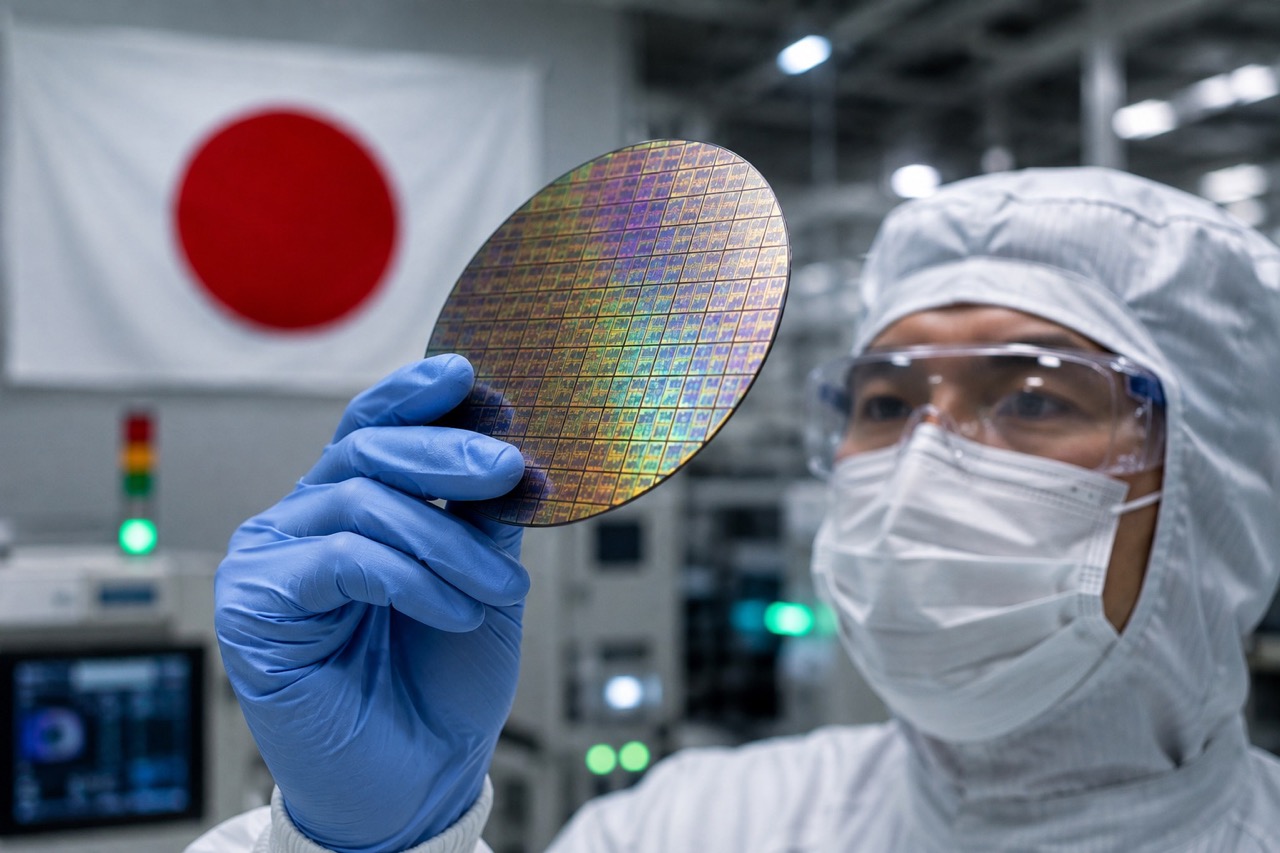
Japan is prepared to continue investing public funds behind one of its most ambitious industrial projects. The Ministry of Economy, Trade and Industry is preparing a request for an additional 150 billion yen, approximately $944 million, to finance Rapidus within the budgets for the 2027 fiscal year.
The initiative, first reported by Nikkei and later picked up by Bloomberg, would involve a new injection of public resources into a company established in 2022 with an unusually ambitious goal: to regain for Japan a significant position in the manufacture of the most advanced semiconductors.
Rapidus is working on the development of 2-nanometer chips and plans to begin mass production in the second half of 2027. If it is able to meet its plans, Japan would once again have its own capacity in one of the most demanding segments of an industry currently dominated by companies such as Taiwan’s TSMC and South Korea’s Samsung.
The project has significance that transcends the company itself. Advanced semiconductors are necessary for the development of artificial intelligence, data centers, robotics, autonomous vehicles, and high-performance computing. The Japanese government considers that having a national base capable of producing them is an economic, industrial, and technological security issue. The public agency IPA expressly notes the need to develop that capability in Japan in light of the rapid increase in computing power that will be required by the expansion of artificial intelligence.
A company backed by the state and the Japanese industry
Rapidus was established in August 2022 with the backing of some of the country’s leading companies. Its shareholders and private financing have brought together firms such as Toyota, Sony, NTT, SoftBank, NEC, Denso, Kioxia, Canon, and Fujitsu, in addition to the Development Bank of Japan.
Public participation has increased significantly since then. In February of this year, the Information-Technology Promotion Agency (IPA), a body under the Ministry of Economy, made an investment of 100 billion yen. An additional 167.6 billion was contributed by 32 private companies and institutions. In June, the state added another 150 billion yen, raising the investment made up to that point by the IPA to 250 billion yen.
The new allocation announced now would differ from those contributions and correspond to the 2027 fiscal year. If approved, it would demonstrate the government’s willingness to maintain financial support during the project’s most delicate phase: the transition from technological development and testing to commercial manufacturing capable of competing in the international market.
Rapidus has built its IIM-1 plant in Chitose, on the island of Hokkaido, designed to produce the new semiconductors. The company is also collaborating with IBM on the development of 2-nanometer technology and aims to differentiate itself through faster and more flexible manufacturing processes than those traditionally employed by major chip foundries.
Japan aims to regain ground in semiconductors
The Rapidus project should be understood within a much larger industrial effort. Japan was a global powerhouse in semiconductors during the 1980s when its manufacturers held dominant positions in the international market. That presence diminished in the following decades as more advanced manufacturing moved to Taiwan and South Korea.
The importance of chips in recent years has shifted priorities. Supply chain difficulties experienced during the pandemic, tensions between the United States and China, and more recently, the growth of artificial intelligence have made semiconductor manufacturing capacity a strategic asset for major economies.
Japan has responded by combining two strategies. On one hand, it has provided significant incentives to attract foreign production, including the factories that TSMC is developing in the country. On the other, it has decided to support the creation of a national manufacturer capable of directly competing in the race for the most advanced chips.
Rapidus represents this second path and also the riskier one. Entering the production of next-generation semiconductors requires multimillion-dollar investments, high technological capability, and enough customers to keep extremely costly plants operational. The company will also have to compete with firms that have years of industrial experience and large production volumes.
The Japanese government appears willing to assume a considerable portion of that risk. The new funding planned for 2027 confirms that Tokyo views semiconductors as strategic infrastructure and is prepared to use public resources to rebuild an industrial capacity lost over the past decades.
The outcome of Rapidus will also serve to test the extent to which a country can regain ground in an industry where scale, technology, and the necessary investments have significantly raised the barriers to entry. Japan does not start from scratch: it retains significant manufacturers of materials, machinery, and components for semiconductors. What it is now trying to reclaim is a position in the most advanced segment of its manufacturing.