



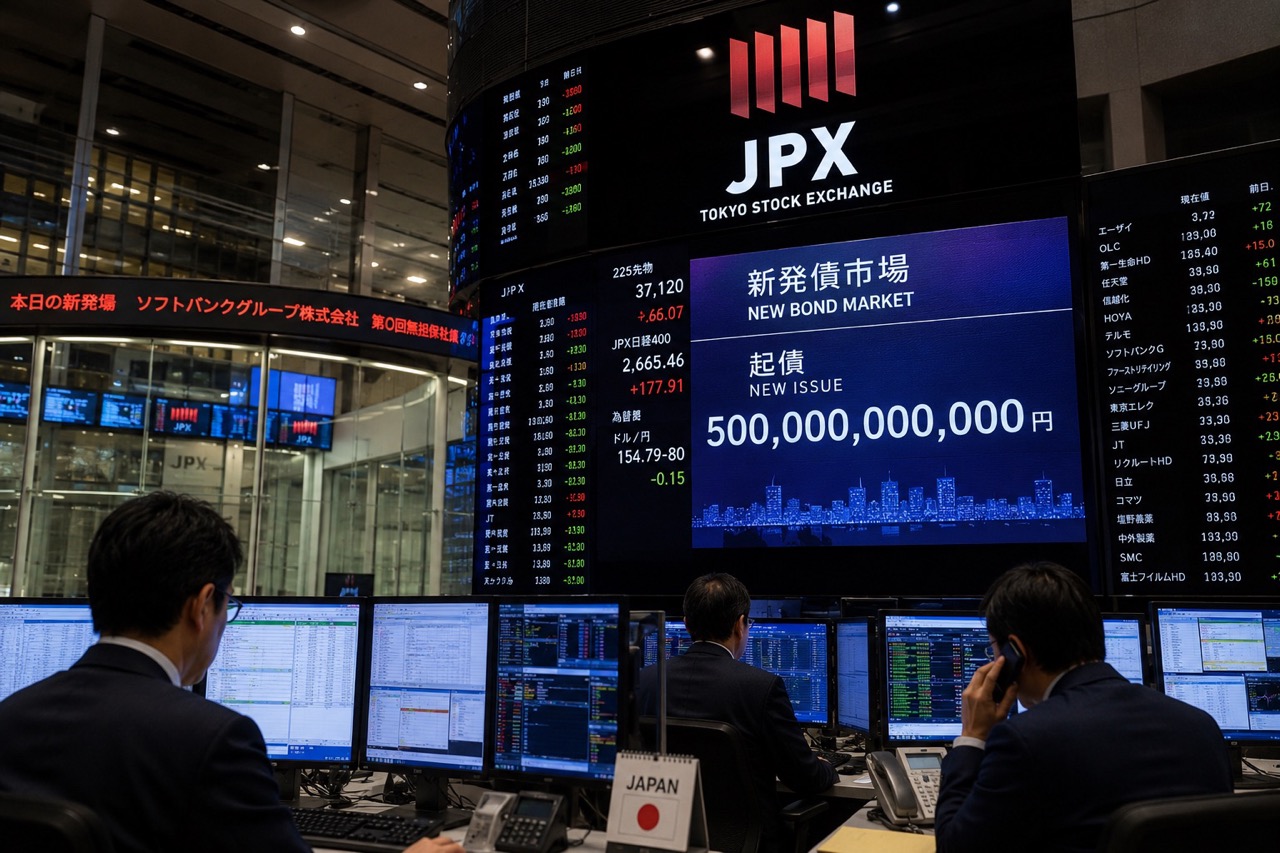
The decision by a Japanese company to issue $6.3 billion in bonds to small investors may initially seem like news strictly relevant to Asian financial markets. However, the operation announced by SoftBank has far broader implications. The funds will bolster the financial capacity of a group that has committed more than $60 billion to OpenAI and related artificial intelligence projects.
This amount sheds light on how drastically the nature of technological competition has evolved. Over the past few years, much attention has centered on models, their ability to generate text, images, or code, and the rivalry among OpenAI, Google, Anthropic, Meta, and other developers. Yet behind these advancements lies an increasingly costly infrastructure that requires mobilizing capital volumes difficult to compare with the early stages of the internet or software development.
Training and operating large-scale artificial intelligence systems necessitates specialized chips and data centers designed to work with tens of thousands of processors. Additionally, there are requirements for electricity, cooling, networking, industrial space, and new energy connections. Therefore, the AI that any user accesses via a computer or phone has a considerable physical dimension, even if it is barely visible from the screen.
Investment Shifting Toward Infrastructure
This change helps explain the plans of major technology companies. Alphabet, Meta, Microsoft, and Amazon expect to collectively allocate nearly $2.4 trillion over the coming years to AI-related investments, according to data collected by Bloomberg. Alibaba, for its part, has recently raised the equivalent of $10 billion in Hong Kong to finance investments in chips, data centers, and AI models.
This volume is challenging to interpret if viewed solely through the lens of the software market. A significant portion of the money will be directed toward physical assets that require years to construct and substantial financial commitments. The technological race is thus starting to directly involve sectors such as energy, engineering, semiconductors, infrastructure construction, and specialized financing.
SoftBank is one of the most visible cases as it has concentrated a significant part of its strategy on OpenAI. Masayoshi Son has long advocated an extremely ambitious vision regarding the development of artificial intelligence and has once again positioned the group in a policy of large investments. The difference from other tech companies is that SoftBank does not generate the massive cash flow that companies like Microsoft, Amazon, or Alphabet have at their disposal, making how it funds this strategy particularly significant.
Reuters noted this month that investors are closely watching the potential impact that these commitments may have on the group’s balance sheet. SoftBank faces obligations of around $30 billion in the second half of 2026 and has resorted to loans secured by some of its assets. It also has a $40 billion bridge loan that expires in March 2027 and a $20 billion margin loan backed by its stake in Arm.
This does not mean that SoftBank is facing an immediate liquidity problem. The company maintains that it keeps its debt level relative to the value of its assets within internally set limits and has sufficient liquidity to cover two years’ worth of bond maturities. The debate hinges on another issue: how much capital will continue to be needed if investment in AI continues to grow at the current pace and how long it will take for new businesses to generate sufficient returns.
From Tech Capital to Debt
For much of the growth of the digital economy, large investments were primarily associated with venture capital, IPOs, and later, the financial capabilities of major tech companies. The current phase of artificial intelligence is strongly incorporating other instruments: bond issuances, asset-backed loans, infrastructure financing, and agreements between tech companies, funds, and institutional investors.
The SoftBank operation is particularly illustrative because it transfers this financing to Japanese individual investors. The seven-year bonds are expected to have a coupon of between 4.3% and 4.9%, a high yield by recent Japanese standards. The company has looked to this market several times and set the previous national record in 2025 with a ¥600 billion issuance. It now aims to increase that amount to ¥1 trillion.
However, the money is only a part of a much larger equation. As AI projects grow in size, new relationships emerge among those who develop models, manufacture processors, build data centers, and provide energy. Financing ultimately connects them all.
This is likely one of the most interesting economic aspects of the current expansion of artificial intelligence. The business is starting to extend far beyond the companies typically associated with ChatGPT or large language models. A data center requires civil engineering, electrical equipment, cooling systems, maintenance, energy supply, and network connections. The value chain is much longer than the conventional notion of AI as a purely digital industry suggests.
The Uncertainty Over Returns
The brisk investment pace has also opened a debate that becomes unavoidable when numbers reach this scale. Companies are building capacity with the expectation that the use of artificial intelligence will continue to grow rapidly among consumers, administrations, and businesses. If these forecasts hold true, much of the current infrastructure may be necessary.
The problem is that returns are still difficult to estimate. Fitch has highlighted the risk of a combination of high valuations, heavy capital expenditure, and uncertainty around the profitability of AI companies. Reuters also reports doubts from some analysts about the impact of a sector correction on groups heavily exposed to these valuations, including SoftBank itself.
There is also competitive pressure. The emergence of cheaper Chinese models capable of offering similar performance for certain uses could lower prices and tighten margins. Infrastructure designed under very high growth expectations may find itself in a more competitive market than anticipated, something investors are beginning to factor into their analyses.
This does not necessarily imply that a bubble exists, just as investment figures alone do not guarantee that all projects will be profitable. Technological transformation and overinvestment can coexist for years. This happened during other stages of large infrastructure development, and it is still too early to know how returns will be distributed in the case of artificial intelligence.
What is becoming evident, however, is that the economic conversation around AI can no longer be limited to models and their capabilities. The ability to finance data centers, secure chips, access energy, and sustain investments over long periods may become as crucial a factor as technological advantage.
The SoftBank issuance offers a clear snapshot of that shift. Behind OpenAI and the race to develop increasingly advanced systems begins to emerge a complex financial structure that mobilizes banks, debt markets, large investors, and infrastructure companies. Artificial intelligence remains a technological competition, but its development increasingly depends on something rather traditional: having the financial resources.








