



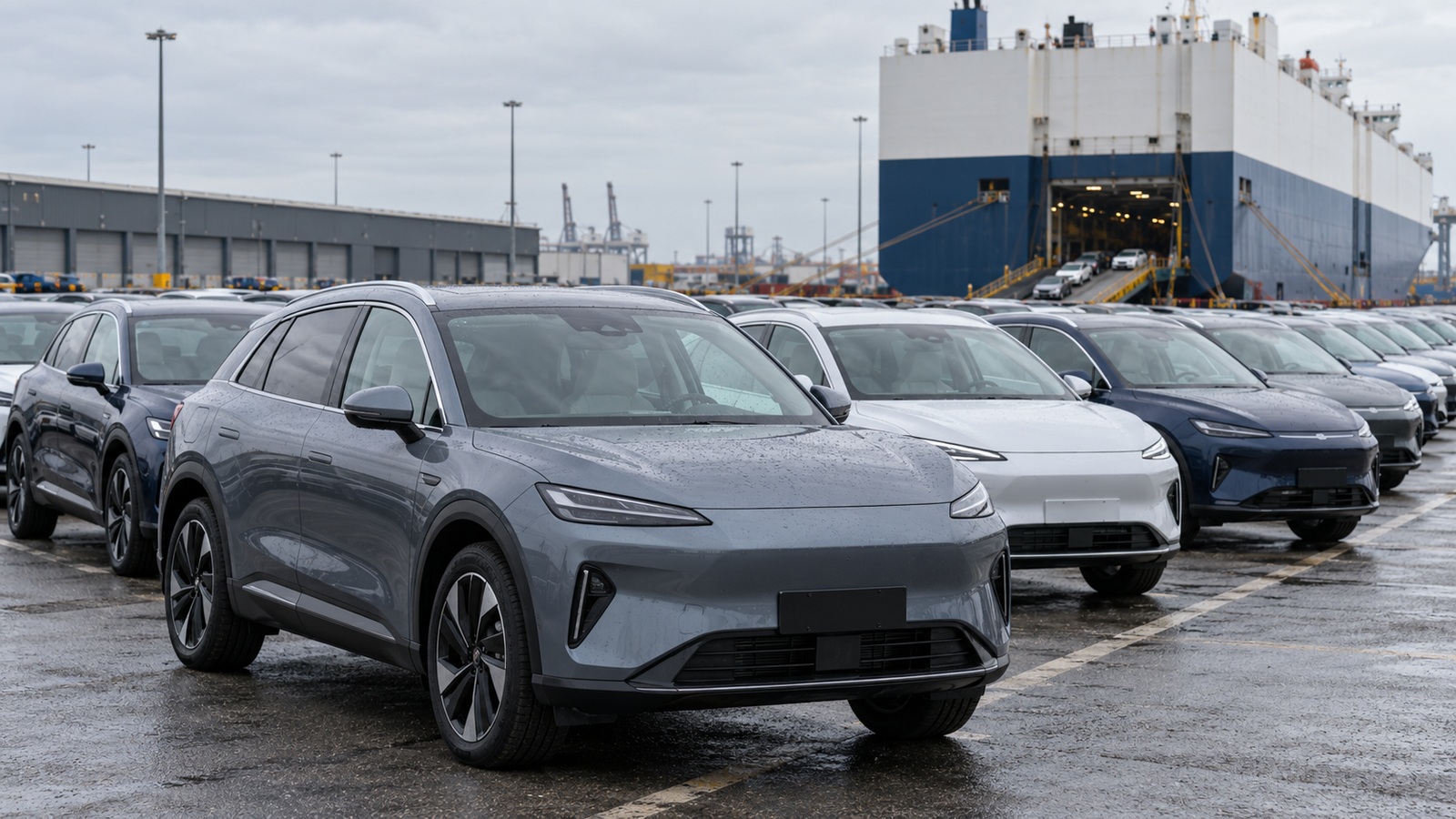
Pressure on manufacturers in China is driving their international expansion, while Brussels considers new measures to protect European industry. Spain already has Chinese brands penetration above the continental average.
Europe’s automotive industry faces a transformation that goes beyond electrification. Chinese manufacturers are expanding their presence across the continent at a pace that could see them control between 10% and 15% of the EU market by 2030, according to S&P projections cited in a recent industry analysis. Their growth coincides with a period of challenges in China, where competition among manufacturers, price wars, and excess production capacity are pushing companies to seek new opportunities beyond their borders.
Europe has become one of the main destinations for this expansion. The combination of a high-income market, growing demand for electrified vehicles, and less restrictive entry barriers than those in the United States offers opportunities for groups such as BYD, Chery, SAIC, and Geely. However, their foothold will increasingly depend on their ability to manufacture within the continent and adapt to the European Union’s new trade requirements.
The figures cited in the S&P analysis reflect the speed of this process. During the first half of 2026, Chinese brands reached an 8.4% share of the European market, while in Spain they accounted for 11.8%, excluding Volvo Cars, which is owned by Geely. The gap places the Spanish market among the most receptive to these manufacturers and confirms that their growth is already reshaping the competitive automotive landscape.
Pressure in the Chinese market drives overseas expansion
The international growth of Chinese brands is largely a response to the challenges facing their domestic industry. For years, the country has built up enormous automobile manufacturing capacity, particularly for electric vehicles and plug-in hybrids, supported by substantial industrial investment and a supply chain spanning batteries to electronic components.
This expansion has created an exceptionally competitive market, with numerous manufacturers vying for buyers through discounts and continuous product launches. According to S&P data cited in the analysis, the Chinese automotive sector’s pretax margin stood at 3.8% during the first half of 2026, compared with 6.1% at the beginning of the decade. Lower profitability is forcing many companies to reassess their commercial strategies and seek markets where they can generate better returns.
The outlook does not point to an immediate recovery either. Forecasts attributed to the consultancy project a decline in passenger-car sales of between 2% and 5% in 2027, followed by a possible further contraction of between 5% and 7% in 2028, coinciding with the expiration of certain tax incentives for electric-vehicle purchases.
Internationalization is therefore taking on decisive importance. Some of China’s major manufacturers already sell a substantial share of their output outside the country, and Europe offers growth opportunities at a time when the U.S. market remains effectively closed to many of these brands. The pressure is particularly intense among manufacturers that have yet to establish a profitable position in China.
Manufacturing in Europe to overcome trade barriers
The next phase of Chinese expansion could increasingly take place within Europe’s own borders. Asian manufacturers are strengthening their industrial projects, sales networks, and after-sales services, aware that maintaining a stable presence on the continent requires more than importing competitively priced vehicles.
Brussels’ trade policy is accelerating this transformation. In October 2024, the European Commission imposed countervailing duties on imports of battery electric vehicles manufactured in China, following an investigation that concluded certain public subsidies threatened to harm EU industry. The measures remain in force and have prompted affected manufacturers to reconsider their production and distribution strategies.
In the central scenario of the S&P analysis, Chinese brands would gradually increase the share of European components and processes in their vehicles to between 40% and 50% local content by 2030, excluding battery cells. This shift would reduce reliance on imports and improve their ability to meet the market’s regulatory requirements.
The trend is already extending to the battery industry, one of the sectors in which China maintains a particularly strong position. Manufacturers such as CATL and BYD are developing international investments to bring production closer to their customers and reduce their exposure to trade restrictions. The availability of suppliers, industrial costs, and the profitability of these facilities will be decisive factors in establishing a European supply chain.
However, manufacturing in Europe does not guarantee exemption from all restrictions. Rules of origin, local-content requirements, and conditions that may be imposed to access certain public programs will be decisive in determining which investments are most competitive.
Brussels could alter the pace of growth
Forecasts for the expansion of Chinese manufacturers vary significantly depending on the evolution of European industrial policy. In the scenario most favorable to these brands, their market share could reach between 10% and 15% by the end of the decade. A more restrictive trade response would limit that growth to a range of 7% to 10%, according to the scenarios attributed to S&P.
One of the central issues in the debate is defining the requirements needed for an automobile to be considered manufactured in Europe. Proposals linked to EU industrial policy envisage strengthening the presence of European components in certain activities and public procurement, although the final scope of these requirements remains under discussion.
The issue also divides European manufacturers themselves. Companies heavily dependent on international supply chains must balance protecting their industrial capacity with the need to maintain competitive costs. At the same time, groups such as Volkswagen, Renault, and Stellantis are renewing their electric-vehicle lineups and developing more affordable models in response to the arrival of new competitors.
Competition will not be limited to the purchase price, either. The rollout of distribution networks, parts availability, warranties, vehicle residual values, and consumer confidence will be fundamental in determining which brands succeed in establishing themselves. The experience of Japanese and South Korean manufacturers shows that building a lasting presence in Europe requires sustained investment and constant adaptation to the characteristics of each market.
For Chinese groups, the challenge is to turn their rapid commercial expansion into a stable and profitable business. For Europe’s industry, the priority is to improve its technological and industrial competitiveness without losing production capacity in a sector that is strategic for employment and exports.
Spain occupies a relevant position in this process for two reasons. On the one hand, the share achieved by Chinese brands demonstrates the receptiveness of Spanish buyers