



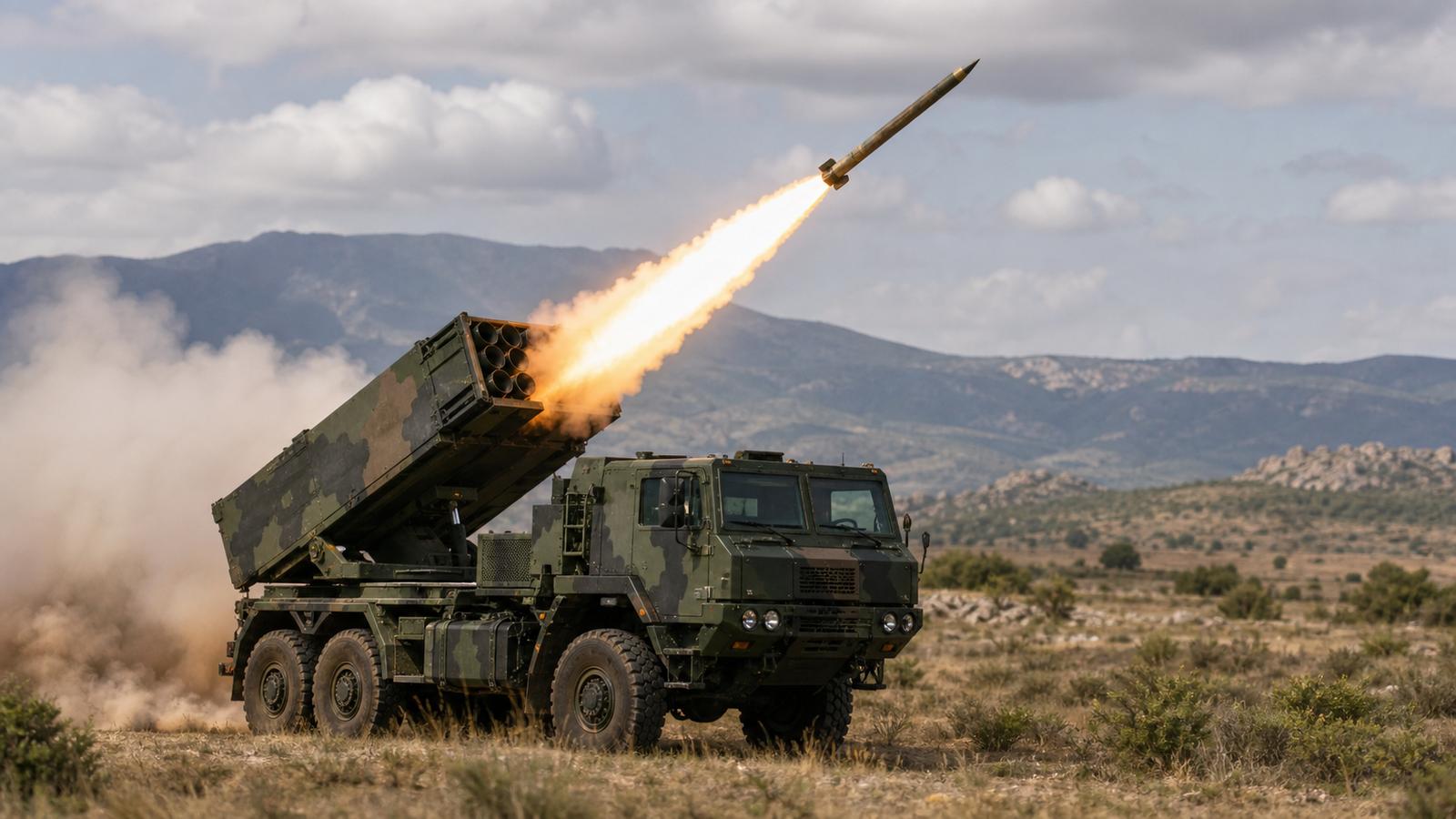
The program to restore the Spanish Army’s rocket artillery capability remains open following the cancellation of the High-Mobility Rocket Launcher System (Silam) contract. The award, valued at nearly €700 million, envisioned acquiring Israel’s PULS system through a joint venture formed by EM&E Group and Rheinmetall Expal Munitions, but the Ministry of Defense canceled it in September 2025 amid Spain’s technological and commercial disengagement from Israel.
The project was intended to restore a capability lost in 2011 with the retirement of the Teruel system. In addition to launchers and ammunition, it included support vehicles and technology transfer, meaning the choice of an alternative will affect both military capabilities and the degree of control Spanish industry can retain over design, manufacturing and maintenance.
Rheinmetall Expal Munitions and EM&E presented a domestic proposal in January 2026 to redefine Silam. The plan includes operational and test launchers, munitions, reconnaissance vehicles and command posts, as well as the development and qualification of training and guided rockets. A month later, EM&E and GMV formalized their collaboration on fire control, guided-projectile navigation and connectivity with Spanish artillery command-and-control systems.
The final solution has yet to be decided. The foreign platforms reviewed by Infodefensa serve as benchmarks for a potential procurement or industrial partnership, but there is no record of an official Defense Ministry assessment of all of them.
Roketsan expresses interest in the program
Turkish company Roketsan has told Infodefensa of its interest in Silam, although its executives said there is currently no firm agreement. Its MBRL system can accommodate 122mm, 230mm and 300mm munitions, as well as the 610mm KHAN tactical missile, and can be mounted on six- or eight-wheel trucks.
The configuration varies by munition: the launcher can carry 40 122mm rockets, 12 230mm rockets, four 300mm rockets or one KHAN missile. According to the manufacturer’s published specifications, the TRG-122 has a range of up to 28 kilometers; the TRG-230 and its laser-guided variant operate between 20 and 70 kilometers; and some versions of the TRG-300 reach up to 120 kilometers. The KHAN has a range of between 80 and 280 kilometers, according to Roketsan’s commercial specifications.
This range of options would make it possible to support artillery missions and conduct deeper strikes using the same launcher family. However, any potential proposal would need to specify export terms, ammunition availability, technology rights and the involvement of Spanish companies. Its integration with the Spanish Army’s communications, fire-control and target-acquisition systems would also need to be verified.
Options at different stages of industrial maturity
Alternatives include South Korean company Hanwha Aerospace’s K239 Chunmoo, capable of carrying up to 12 CGR-080 guided rockets with an 80-kilometer range or two tactical missiles with a range of up to 290 kilometers. Its deployment in Poland, where it has been integrated on Jelcz trucks and with the TOPAZ command system, provides a benchmark…
Lockheed Martin’s Himars offers operational experience and a broad user community, but Spain had already ruled it out when it selected PULS. According to available information, one reason was the U.S. refusal to transfer design authority. The launcher can use six GMLRS rockets, ER GMLRS munitions with a range of about 150 kilometers, or Atacms missiles with a range of around 300 kilometers, but it maintains dependence on the United States for projectile supply and development.
Rheinmetall and Lockheed Martin are also developing GMARS, mounted on an HX 8×8 vehicle and equipped with two pods. The companies say it can carry 12 GMLRS or ER GMLRS rockets, two Atacms missiles or four PrSM missiles. The system conducted its first live firing in August 2025, but it should not be confused with the domestic proposal from EM&E and Rheinmetall Expal: the announcement regarding the latter did not identify GMARS as the selected platform.
Brazilian company Avibras’ Astros II offers interchangeable modules for rockets of different calibers and includes the AV-TM 300 missile, advertised with a range of up to 300 kilometers. Spain’s NTGS and Avibras previously formed the Ibermisil consortium to explore production in Spain, although there is no indication of an active bid to replace Silam. The Brazilian manufacturer’s production situation would also require review following the October 2026 announcement that Globe Investimentos would acquire its assets.
France is working on the FLP-T program to field guided munitions with a range of about 150 kilometers. Proposals include Thundart, linked to MBDA and Safran, and ArianeGroup and Thales’ FLP-t 150 munition, whose first test firing was announced in May 2026. These remain developments that would need to complete integration into a system including launchers, support vehicles, fire control and logistics.
The comparison also includes EuroPULS, promoted by KNDS and Elbit Systems; India’s Pinaka, whose LRGR 120 munition has been tested at ranges of up to 120 kilometers; and Serbia’s Tamnava, with 122mm and 262mm rockets and a published maximum range of 70 kilometers. EuroPULS retains PULS’ core Israeli technology, while Pinaka and Tamnava differ in maturity and range from platforms that combine guided rockets and tactical missiles with ranges of several hundred kilometers.
The future decision will have to resolve three related issues: the required capabilities, the timetable for restoring the capability and industrial control. Procuring an available platform could shorten delivery times, but design authority, ammunition production, maintenance and integration with Spanish systems will depend on the terms negotiated with the manufacturer.
You can also follow international news at GoAragón France.
Read other Defense news here.