



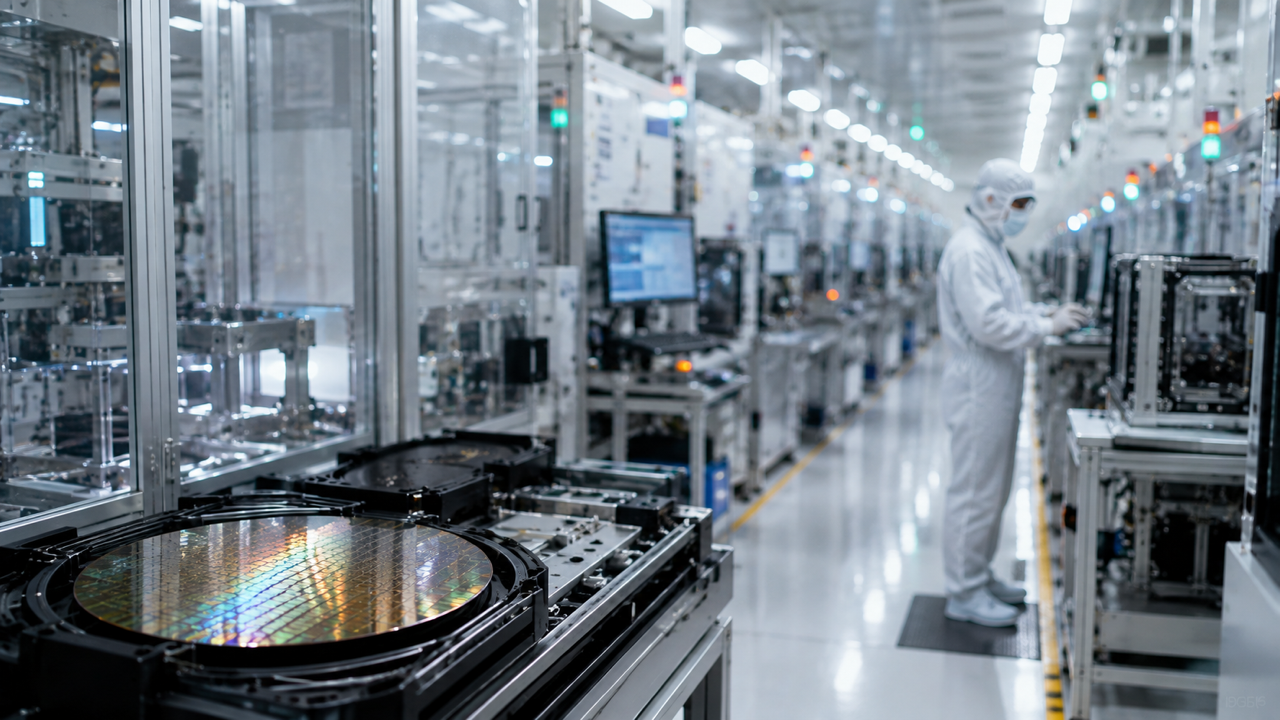
The names Nvidia, Intel, Samsung, and TSMC are familiar even outside the tech industry. YMTC, on the other hand, remains largely unknown to much of the Western public. However, its evolution deserves attention.
Yangtze Memory Technologies, known by the acronym YMTC, was founded in 2016 in Wuhan and specializes in a component we use constantly, though we rarely think about it: NAND Flash memories.
These are the chips responsible for permanently storing information in mobile phones, computers, SSDs, servers, and data centers. Unlike RAM, they retain data when the device is powered off.
A decade after its inception, YMTC has become the leading Chinese manufacturer of these types of memories and, according to documentation submitted for its IPO, achieved the third position globally in NAND in the first quarter of 2026, both in revenue and shipment volume.
Entering one of the toughest markets in the world
Manufacturing memory chips at scale requires facilities that cost billions, ongoing investments in research, and a tremendous capacity for precision-producing millions of components.
YMTC competes in a market populated by major players like Samsung, SK Hynix, Kioxia, SanDisk, and Micron. Its emergence is particularly significant because China has historically relied on foreign manufacturers to supply a substantial part of its massive electronics industry.
To compete, YMTC has developed its own architecture called Xtacking. Simplifying an extraordinarily complex process, this technology allows for the separate manufacturing of specific parts of the memory and its peripheral circuits, which are later integrated. The company unveiled the first generation in 2018 and has continued to evolve the system. YMTC: Xtacking technology
Its growth is also beginning to reflect in its financials. The documentation submitted for the IPO indicates that the company recorded 63.19 billion yuan in revenue in 2025 and returned to profitability in 2024.
A $4.9 billion IPO
The next step will be the capital markets.
YMTC’s parent company, CCSH Corporation, has submitted its application to list on the STAR Market of the Shanghai Stock Exchange, the market created to facilitate funding for Chinese tech companies.
The operation aims to raise 33 billion yuan, approximately $4.9 billion. If completed as proposed, the company’s valuation could be around $49 billion.
The purpose of the funds helps to understand the type of competition YMTC is engaged in. Approximately 20.8 billion yuan is earmarked for modernizing production lines, while another 12.2 billion will finance research and development in advanced storage technologies.
This is not just about producing more. In semiconductors, continuous investment is necessary to manufacture components that are smaller, faster, more efficient, and with greater capacity.
What does artificial intelligence have to do with it?
While we primarily think of artificial intelligence in terms of processors like Nvidia’s GPUs, AI systems also need to store vast amounts of information.
The growth of data centers is increasing storage demands. Model training, databases, cloud services, and enterprise applications require large infrastructures where processing and storage work together.
This is why the AI race is fueling different segments of the semiconductor industry, not just the most advanced processors.
For YMTC, this growth represents a significant potential market.
The United States’ restrictions
However, the story of YMTC is difficult to understand without considering the technological competition between the United States and China.
Washington added YMTC to its Entity List in 2022, subjecting the company to restrictions in accessing certain U.S. products and technologies. Subsequently, it was also included in a list of companies that the Department of Defense considers linked to China’s military sector.
These restrictions impact a fundamental issue: manufacturing semiconductors requires more than just having a factory.
The global supply chain relies on highly specialized machinery, materials, chemicals, software, and technological knowledge from various countries. The United States, Japan, and the Netherlands hold particularly relevant positions in some of these technologies.
In response, YMTC has increased its use of domestically produced equipment. Reuters reported this year that the company plans three new factories that could more than double its production capacity, with an increasing presence of domestic machinery.
A piece of a much larger strategy
Here lies the true significance of YMTC.
The company should not be viewed in isolation. It is part of a technological ecosystem that China has been trying to develop for years.
SMIC aims to advance semiconductor manufacturing; CXMT focuses primarily on DRAM memories; Huawei and its division HiSilicon develop their own chips and architectures, while YMTC seeks to gain ground in NAND memories.
These are different businesses, but they address the same industrial need: to enhance China’s capability to design and manufacture critical components within its own borders.
The Chinese government has also mobilized vast amounts of capital to develop this industry. In 2024, it established the third phase of the so-called Big Fund, the large state fund for semiconductors, with registered capital of 344 billion yuan.
YMTC’s IPO adds market-driven funding to that effort.
A company worth getting to know
Significant technological gaps still exist between China and international leaders in certain parts of the semiconductor supply chain. YMTC itself acknowledges in its documentation the risks arising from trade restrictions, technological evolution, and the cyclical nature of the memory market.
However, its trajectory allows us to observe how the industry is changing.
In just ten years, a company born in Wuhan has managed to enter a market historically dominated by large international manufacturers, develop proprietary technology, expand industrial capacity, and prepare for one of the largest recent IPOs in the Chinese tech sector.
For this reason, we will likely hear more about its four letters.
YMTC is not just another Chinese chip manufacturer. It is one of the companies that help measure how far China is advancing in its goal to build its own semiconductor industry and compete in one of the strategic sectors of the global economy.