



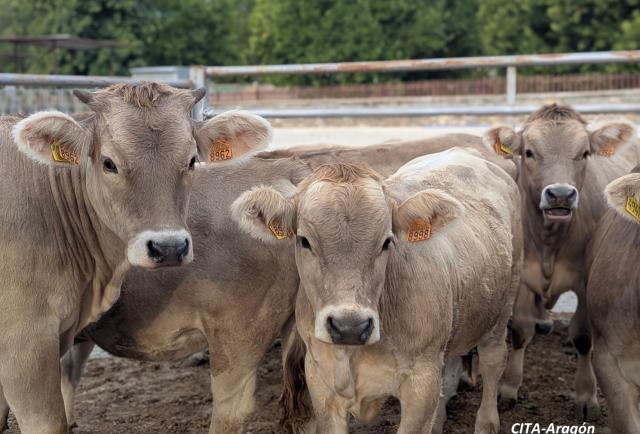
The BoviTECH Operational Group is advancing the development of tools in Aragon to improve the productivity, health, and welfare of beef cattle. The project is already collecting more than 400 records a week from participating farms to anticipate health risks and fine-tune feedlot management.
BoviTECH to present its first findings at the Cedrillas Fair
The Cedrillas Fair (Teruel) will host the event Experiences and tools to improve profitability and competitiveness in suckler-cow farms on September 30. The meeting will showcase BoviTECH’s initial findings and the solutions it is assessing for feedlot cattle management.
The initiative combines digital technologies, real-time monitoring, data analysis, and nutritional innovation. Its aim is to incorporate production, health, environmental, and management data into a system that helps farmers make decisions before problems affect animal growth or welfare.
The event will feature Ana Galeote and Leticia Riaguas of Oviaragón; Miguel Tainta, ASIGA’s technical director and a specialist in animal nutrition and pathology; and Isabel Casasús, a CITA researcher specializing in ruminant production. The event will also bring together livestock farmers from the region to share the group’s progress with the sector.
Data, sensors, and health monitoring for Aragon feedlots
BoviTECH was established in 2025 through the collaboration of livestock farmers, technicians, and researchers. Its work focuses on incorporating biometric parameters and monitoring systems into calf finishing operations to analyze how feeding affects animal health, welfare, and productive performance.
The project is coordinated by Oviaragón-Grupo Pastores, which since 2024 has managed the finishing of more than 2,500 calves at 14 feedlots in Aragon. Its partners include the Aragon Agrifood Research and Technology Center, the Huesca Higher Polytechnic School of the University of Zaragoza, and ASIGA.
The decision-support system planned by BoviTECH will integrate feed intake, production performance, environmental conditions, and health incidents. Sensors and weather records will complement farm-level monitoring to set alert thresholds and identify risk situations at an early stage.
Nutritional strategies aim to reduce veterinary treatments
The group is also comparing commercial feed formulations with different energy levels and presentation formats, including both meal and pelleted feeds. These strategies incorporate natural flavonoids for their intestinal anti-inflammatory effects and are being assessed for their impact on calf production performance.
The goal is to strengthen digestive health and minimize the need for veterinary treatments without sacrificing economic efficiency, under a One Health approach. In this area, ASIGA contributes its work on sustainable management and reducing medication use, while CITA and the Huesca Polytechnic School contribute expertise in animal production, digitalization, and monitoring.
BoviTECH is part of the European Innovation Partnership and is included in the National CAP Strategic Plan 2023-2027. The project is co-financed 80% by the European Agricultural Fund for Rural Development and 20% by the Ministry of Agriculture, Fisheries and Food under the 2025 call for proposals.