


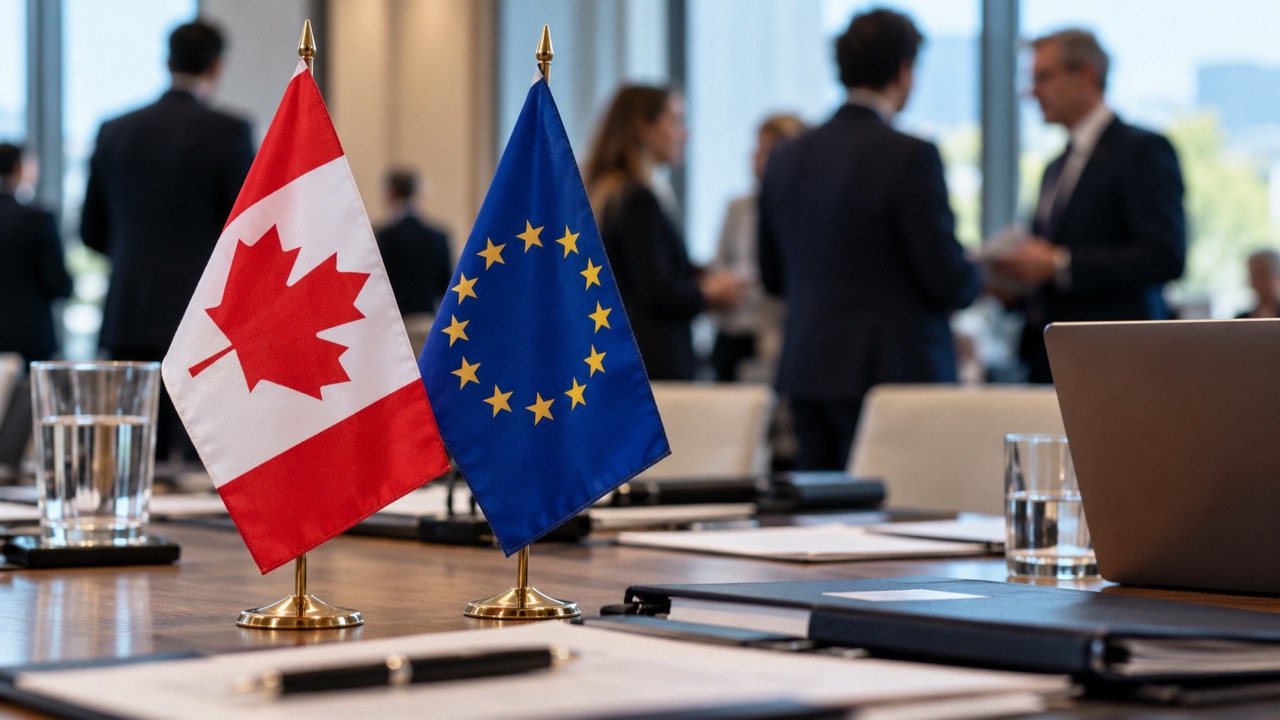
Canada and the European Union are exploring how to take their relationship beyond the trade framework built over the past decade. European Commission President Ursula von der Leyen has proposed moving from CETA toward a “Partnership for the Future,” with new ties spanning defense and energy to artificial intelligence, critical minerals, and the Arctic.
For now, the phrase represents a political aspiration rather than the creation of a new agreement between Canada and the EU. Canadian Prime Minister Mark Carney addressed the European Parliament the following day, also advocating closer ties between the two sides to reduce dependencies and strengthen their economic and strategic capacity. Von der Leyen added a more far-reaching proposal: working to pave the way for Canada to become the European Union’s first “associate member.” No agreement currently grants Ottawa that status, and the rights and obligations it would entail have yet to be defined. Any such development would require clarifying what that formula means legally and which areas it would cover.
From CETA to a broader agenda
The starting point is the Comprehensive Economic and Trade Agreement between Canada and the European Union, known as CETA, which has been provisionally applied since September 2017. According to von der Leyen, trade in goods between the two sides has risen by more than 75% since then.
On that basis, the proposal is to extend the shared agenda into sectors considered strategic, including advanced manufacturing, technology, defense industries, energy, critical minerals, batteries, artificial intelligence, quantum computing, and cybersecurity. The Arctic also features among the areas of shared interest.
Carney outlined some of the opportunities Canada sees in the process. His country has, he said, more than 34 critical minerals and sees scope to combine those resources with Europe’s processing and manufacturing capacity. He also mentioned liquefied natural gas and hydrogen in the energy sector, and proposed joint progress in artificial intelligence, computing capacity, quantum technologies, space, payment systems, and digital trade.
Education and research are also among the opportunities cited by Ottawa. Carney raised the prospect of Canadian participation in Erasmus+ and the next generation of Horizon, although both issues would need to be negotiated and do not constitute commitments already adopted.
Defense already offers a precedent
Canada-EU ties have taken a concrete step in defense. On June 15, the Council of the EU concluded an agreement setting out the conditions under which Canadian companies and products originating in Canada may participate in procurement supported by SAFE. Canada thus became the first non-European country to take part in the instrument.
This precedent shows that closer ties between Ottawa and Brussels have already translated into concrete mechanisms in certain sectors, although this does not imply Canada’s broad integration into EU structures.
Minerals, energy, and technology
Critical minerals are essential for activities ranging from battery and semiconductor manufacturing to energy technologies and certain defense capabilities. Canada has substantial resources and is seeking to expand their processing and marketing, while Europe is looking to diversify supplies and reduce certain external dependencies. Linking Canadian raw materials with European industrial capacity is one of the opportunities identified by both partners.
Carney pointed to the possibility of increasing Canadian exports of liquefied natural gas and hydrogen to Europe while jointly developing technologies related to the energy transition. Artificial intelligence opens another area for cooperation. Ottawa proposes sharing efforts with Europe on computing infrastructure, standards, and security, while also expanding ties in quantum technologies and digital connectivity. These fields are part of an agenda still taking shape, and their translation into specific agreements will depend on negotiations between Canada, the European Commission, and member states.
What “associate membership” would entail
Von der Leyen’s proposal for a possible “associate member” is politically novel but calls for caution. There is currently no EU “associate member” status of the kind envisaged for Canada. Its rights, obligations, and the mechanisms through which Ottawa might participate in certain European policies have therefore not been defined. Nor should this possibility be confused with Canada joining the European Union. The proposal points toward a formula allowing closer links in certain areas without turning the country into a member state.
Defense, raw materials, energy, technology, research, and academic mobility are emerging as possible areas for closer ties, but the degree of integration that could be achieved remains open.
Montreal, the next meeting
The next EU-Canada summit, scheduled for October 29 and 30 in Montreal, will provide an opportunity to see whether the ambition expressed in Strasbourg begins to translate into concrete proposals. For now, there is neither a new treaty nor a defined scope for any potential Canadian partnership with the EU. Brussels and Ottawa have made clear their intention to expand a relationship whose foundations have included trade into sectors that have gained growing importance on the international agenda: security, technology, energy, and raw materials.
CETA provides a solid economic foundation, and Canada’s participation in SAFE shows that there are avenues for progress in specific areas. Following the speeches by von der Leyen and Carney, it remains to be seen how far the process will go and what institutional form it could take.