



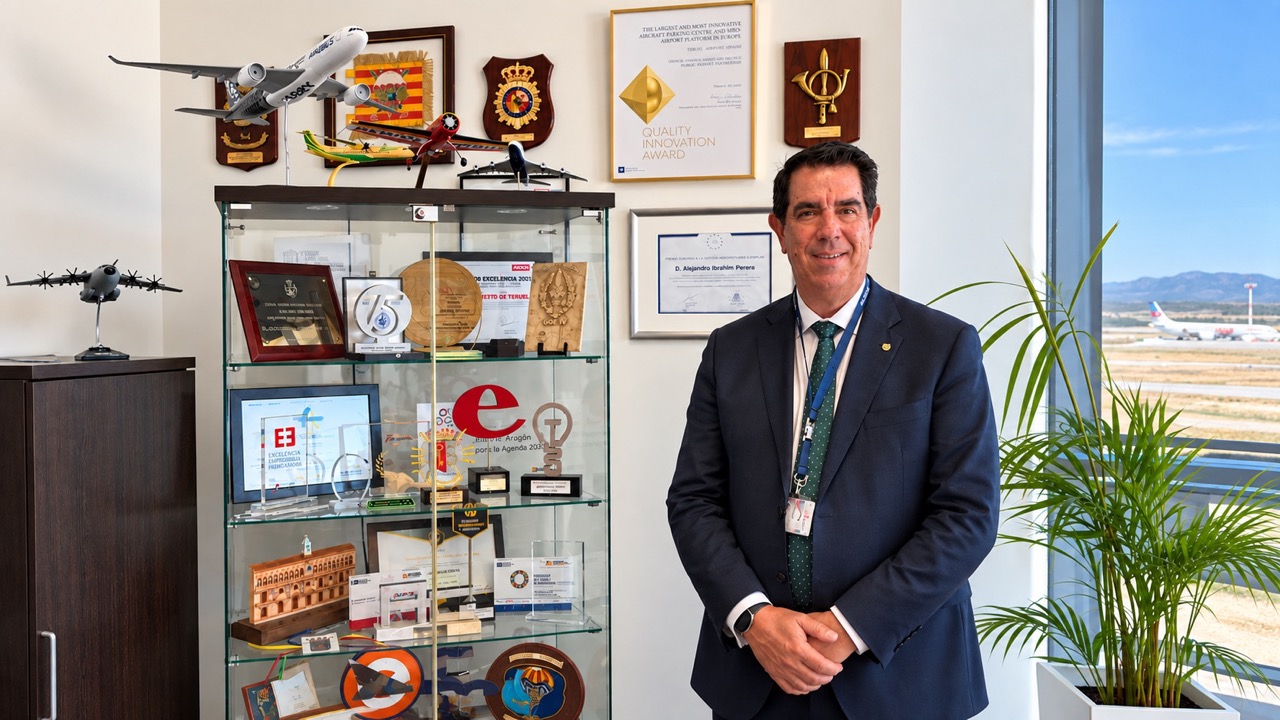
At the Teruel Airport, scale needs context. From the ground, a hangar may seem simply enormous until you learn it is designed to house two Airbus A380s; a structure under construction takes on a different dimension when you are told that stratospheric airships capable of flying at an altitude of around 20 kilometers will be manufactured and operated there; and an apparently empty expanse ceases to be so when you discover it is part of an expansion intended to continue accommodating aircraft, companies and activities that only a few years ago would have been difficult to associate with Teruel.
Alejandro Ibrahim has been here since September 2012 and, as we tour the facilities, speaks with the ease of someone who has watched all of it emerge where there was previously almost nothing.
When I arrived here, the main goal was to get an airport up and running from scratch.
At the time, the airport had not yet been certified, lacked the authorizations from the Ministry of Development, meaning aircraft could not fly there, and had no customers either, as the contract with Tarmac—the company that would become one of the pillars on which the industrial model began to be built—had not yet been signed. During the first few months, Ibrahim recalls, the work essentially involved ensuring that the site could become an airport, both administratively and operationally; then came the time to prove it could be something more.
—The next stage was to attract other customers that would give the airport more substance, to diversify. Farmers do this a lot here: rather than growing only wheat, they look for other options.
The comparison may seem straightforward, but it clearly explains a strategy that, 14 years later, is easier to understand than it was when many of the decisions had to be made. At the time, diversification meant backing activities whose viability had yet to be proven and, in some cases, listening to proposals that must have sounded rather unusual. One of them came from PLD Space.
—When I met them, they were 23 or 24, with a PowerPoint presentation, and they had come to ask whether there was any space to test a rocket.
The company that Ibrahim remembers arriving with little more than a presentation now has facilities at the airport to test its engines and continues to expand its presence. The anecdote is of interest not only because of PLD Space’s transformation, but also because it helps explain how the airport itself has grown: by embracing projects that may once have seemed unconventional and building an ecosystem around them that is now far more recognizable. Something similar is happening with the huge building rising at one end of the site which, viewed from a distance, appears isolated from everything else. Ibrahim notes that although the area now seems far away, the airport’s expansion will gradually fill the space separating it from the rest. It will be the future hangar and production facility for stratospheric aircraft, an infrastructure project already at a very advanced stage and scheduled for completion during 2027.
As we move through the airport, the scale repeatedly catches visitors off guard. There are wind turbine blades and components stored for months, aircraft parked on the aprons, maintenance and painting hangars, PLD Space facilities and a new area designed to significantly increase parking capacity. At some point, it becomes inevitable to ask whether the definition that made Teruel such a distinctive case is also beginning to feel too narrow.
—Is the label of industrial airport becoming too limiting?
Ibrahim does not reject it, but he already speaks of an evolution toward what he calls a smart airport: an airport that incorporates sustainability, energy self-sufficiency, batteries, artificial intelligence and new technologies capable of improving management into its industrial character. Nor is the transformation limited to the civilian sphere, as the Ministry of Defense has chosen Teruel to host the Centro Integral de Entrenamiento y Movilidad Aérea, or CIEMA, a project that will add a new dimension to facilities where the Air and Space Force has been carrying out occasional activities for years. The first phase will develop infrastructure for the training and instruction of pilots and personnel involved in air mobility operations, while a second phase includes the construction of an unpaved runway, specifically intended to replicate the conditions in which certain military aircraft must operate when missions take them to locations without a conventional airport.
—They have to go to places where there are no airports, so the ground has to be prepared. We are also going to build an unpaved runway, in addition to the asphalt runway we already have. The A400M, for example, can land in areas where there is only dirt, but of course pilots need to be trained.
Everything appears to be growing simultaneously, and that accumulation of activities helps explain wh…