



At the Teruel Airport, scale needs context. From the ground, a hangar may seem enormous—until you learn it is designed to house two Airbus A380s. A structure under construction makes more sense when you are told it will manufacture stratospheric airships capable of flying at an altitude of around 20 kilometers.
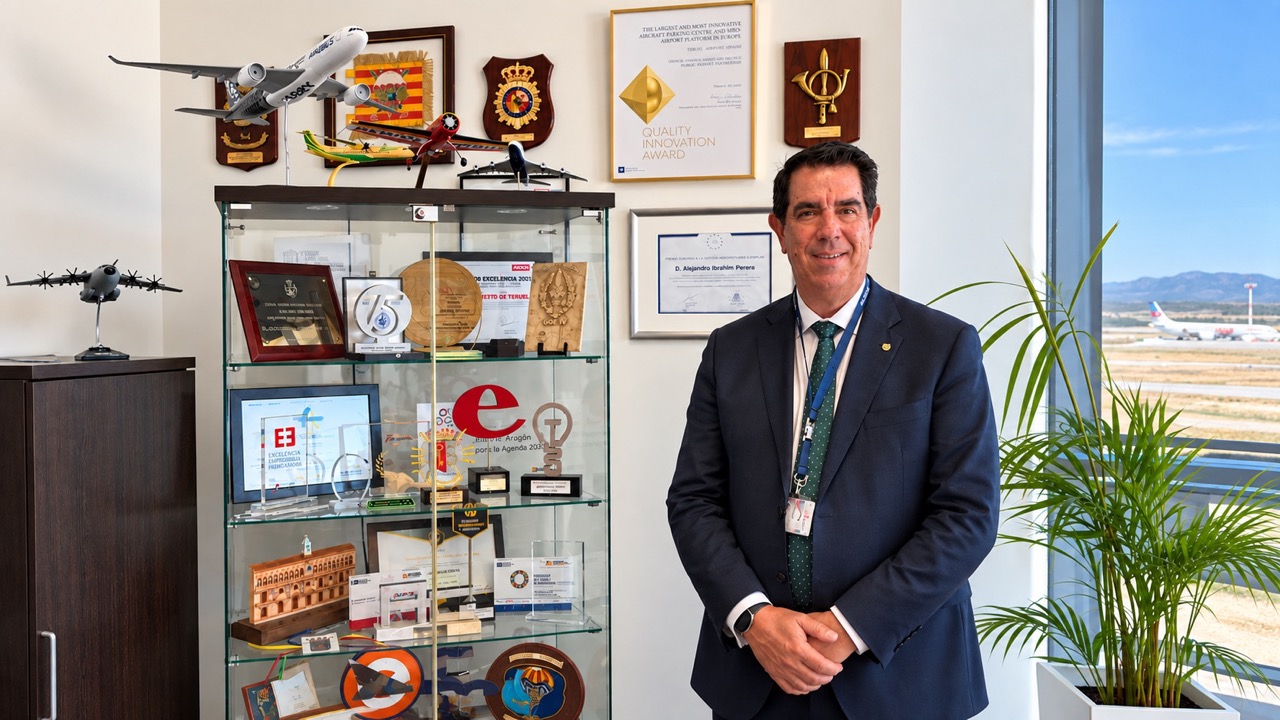
Alejandro Ibrahim has been here since September 2012 and, as we tour the facilities, he speaks with the ease of someone who has watched everything develop from the ground up.
When I arrived here, the goal was to get an airport up and running from scratch.
At the time, the airport was neither certified nor authorized by the Ministry of Public Works. Aircraft therefore could not operate there, and it had no customers because it lacked a contract with Tarmac. During the first few months, Ibrahim recalls, the work largely consisted of turning the site into an airport in both administrative and operational terms. Then came the time to prove it could be more.
—The next stage was to attract other customers and diversify. Farmers do this a lot here—not just growing wheat, but looking for other options.
The comparison may seem simple, but it clearly explains a strategy that, 14 years later, is easier to understand. One of the most unusual proposals came from PLD Space.
—When I met them, they were 23 or 24 years old and looking for somewhere to test a rocket.
Today, PLD Space has facilities at the airport for testing engines and continues to expand. This reflects how the airport has grown by embracing unconventional projects and building a distinctive ecosystem. Something similar is happening with the building rising at the edge of the site, intended for the hangar and production of stratospheric aircraft. The infrastructure is at an advanced stage, with completion scheduled for 2027.
The airport’s scale again catches visitors off guard. Wind-turbine components are stored for months, aircraft are parked, maintenance and paint hangars operate alongside PLD Space facilities, and an area is ready to expand parking capacity.
Ibrahim no longer confines himself to the industrial-airport label. He now believes they are evolving toward a smart airport, incorporating sustainability, artificial intelligence, and new technologies.
—They have to go to places without airports, so the ground has to be prepared. We are also going to build an unpaved runway, in addition to the asphalt one. The A400M, for example, can land in areas with only dirt runways, but pilots need training.
Everything appears to be growing at once, and this accumulation of activities helps explain the airport’s impact on Teruel. Ibrahim refers to “champagne problems”: jobs, a growing economy, and a housing shortage.
As Ibrahim explained, the airport generates a network of surrounding businesses: cleaning, security, maintenance, engineering, catering, and more. It has even worked with the university campus to train specialized professionals who did not previously exist.
—No one here used to paint aircraft; they normally painted walls.
Specialization requires years of training and specific qualifications. This is also reflected in the complex logistics of film shoots held at the airport.
—The priority is to serve customers, but if there is no conflict, the spaces can be used for other activities.
We are a public entity, and anything that can generate activity benefits the surrounding area.
The economic impact of film shoots is considerable. Productions such as ‘García y García’ have mobilized substantial resources in Teruel, far exceeding any fees the airport might collect.
Ultimately, its ability to generate activity around it explains why it is difficult to see the airport merely as hangars and aircraft. There are now rockets, airships, military personnel, mechanics, and film crews—a combination unimaginable in 2012.
Before wrapping up, Ibrahim recalls that Teruel was a pioneer in Spain in automating airport meteorological services. The airport houses one of the hangars capable of accommodating the world’s largest aircraft, such as the Airbus A380, and remains committed to innovation.
—Are we disruptive? Well, if we are doing things that are not being done anywhere else…