



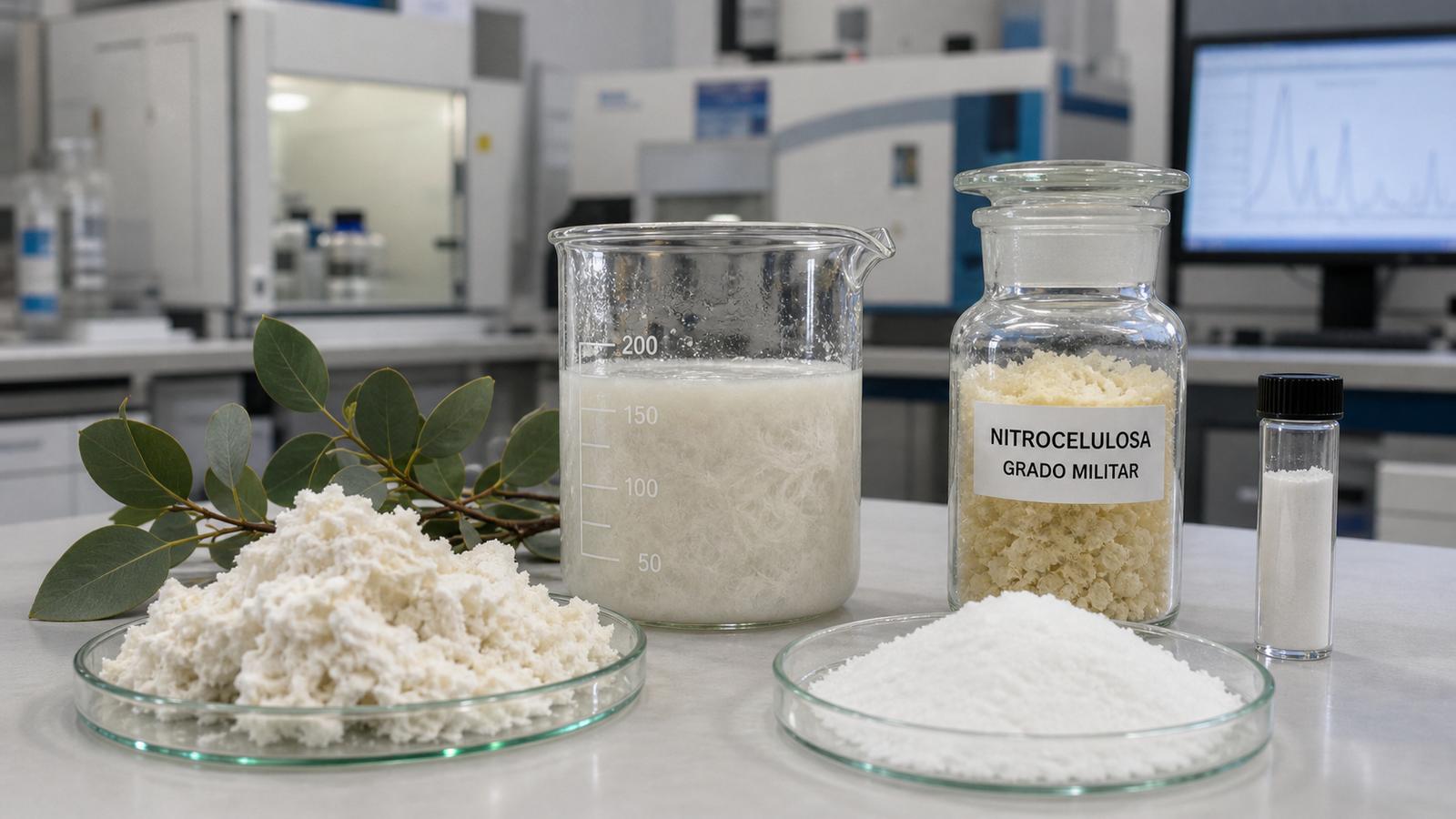
Spanish company Iberian Defence Propulsion Hub (IDPH) is developing a process to produce military-grade nitrocellulose from European eucalyptus pulp. The technology remains at an experimental stage, between Technology Readiness Levels (TRL) 3 and 4, and is undergoing testing under a research and development contract with Spain’s National Research Council (CSIC).
The project seeks to partially replace the cotton linters traditionally used to manufacture nitrocellulose, a component required for producing propellant and ammunition. More than 70% of this short cotton fiber is imported, with China among the leading suppliers, according to data compiled by Infodefensa. IDPH’s alternative draws on the availability of eucalyptus in northern Spain and the capacity of the country’s pulp industry.
The company, established in 2026 and based in Madrid, aims to develop a pre-industrial TRL 5 demonstrator. That stage would enable continuous assessment of the material’s performance and the process’s viability before qualification with European manufacturers and potential industrial-scale production.
A plant planned for Castile and León
IDPH plans to build a plant in Castile and León with capacity to produce approximately 5,000 metric tons per year of nitrocellulose, although the location has yet to be determined. The company expects to finalize a land agreement with the regional government of Castile and León in 2027, then launch a funding round aimed at securing public and NATO financing.
The company also has a partnership with Spanish firm Tecnesis to add another production line at the projectile-filling plant that Tecnesis plans to open in Valderas, in the province of León. IDPH expects those lines to begin operating in 2028, a timetable dependent on technological progress and the industrial projects announced.
Estimates compiled by Infodefensa put Europe’s nitrocellulose requirements at about 20,000 metric tons a year, compared with continental capacity of between 4,500 and 10,000 metric tons. The resulting shortfall is therefore estimated at between 10,000 and 15,000 metric tons annually, as the European Union seeks to increase its production capacity to 2 million projectiles a year.
A European consortium awaiting assessment
IDPH also leads Europulp, a consortium comprising six partners from five European Union member states. The initiative brings together the CSIC, research centers in Spain and Germany, and small and medium-sized technology companies from three other countries. Its proposal was submitted in September to the European Defence Fund’s 2026 call and will be assessed by the European Commission, whose decision is expected in 2027.
Europulp’s objective is to take the process from the laboratory to a continuous TRL 5 demonstrator. Álvaro Marín, IDPH’s founder, says the company has already achieved a favorable chemical result and that the findings have been certified under NATO standards. The company remains in contact with the ministries of Industry and Defense and says it has received interest from sector companies and several European countries, including Ukraine.
IDPH is part of the European Defence Agency’s CapTech group for Missiles and Ammunition. In its first meeting as a member, held Sept. 29 and 30 in Tomar, Portugal, it presented its work on producing nitrocellulose from wood pulp to representatives of European governments, industry, and research centers.