



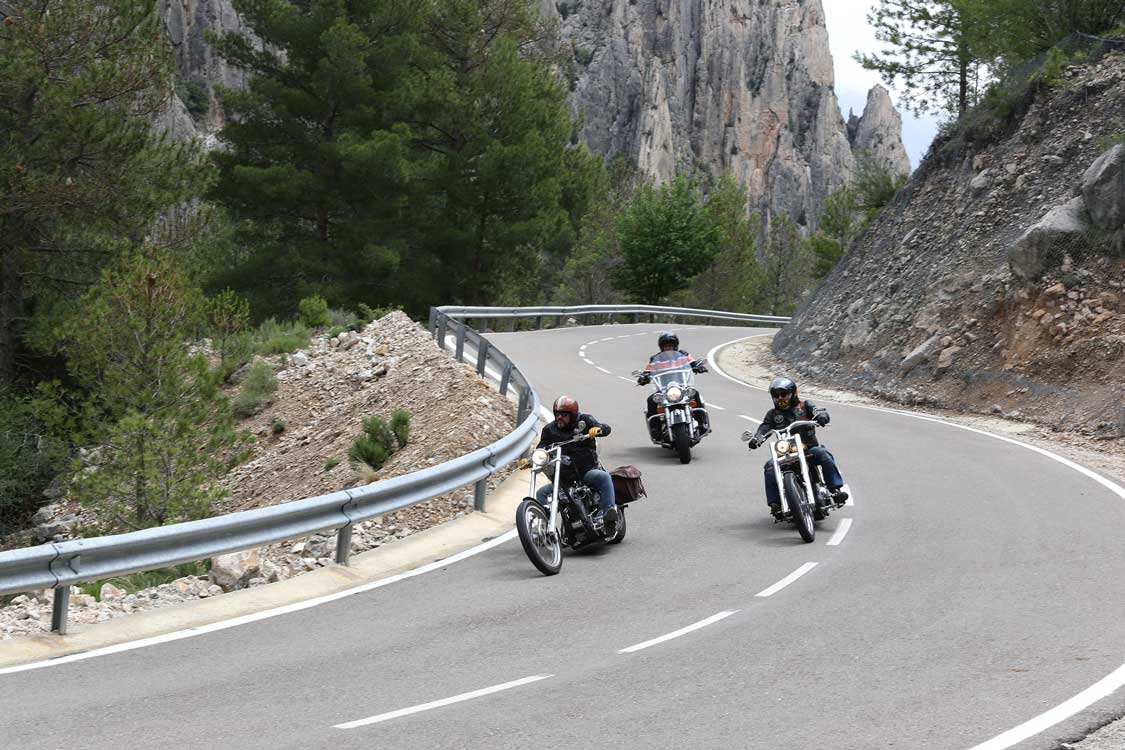
Traveling along the A-1702 from Alcorisa, Andorra, or Gargallo to Cantavieja, in the heart of Teruel’s Maestrazgo region, was always somewhat arduous. The route spans more than 60 kilometers of climbs and descents, bends, gorges, and mountain passes. In recent years, however, its reputation has changed completely.
Above all since 2022, when the route was named Spain’s Best National Motorcycle Touring Route. Since then, motorcyclists from across Spain and other European countries have come to ride The Silent Route, which has become a pilgrimage trail for bikers.
Teruel’s Silent Route should not be mistaken for an open-air racetrack. Quite the opposite. It is designed for relaxed riding. Indeed, the longer it takes to complete, the better the indication that it has been enjoyed to the fullest.
Typically, the journey takes between four and five hours, as stops at the various viewpoints set up to take in the scenery are frequent. It is also well worth strolling through the villages along the way, where there is always a bar that has become a small shrine to motorcyclists.
The route begins at Venta La Pintada in Gargallo. Once on the road, travelers encounter the welcome sign for The Silent Route. It is covered with stickers from motorcycle clubs and groups, another tradition alongside greeting fellow riders with a hand gesture.
That gesture is immortalized as a sculpture at one of the viewpoints. The Monumento al Saludo Motero features a gloved hand raised in a vertical victory sign. Another monument further along is dedicated to the Silencioso, the mountain goat that serves as the route’s emblem.
The views from here are magnificent, particularly over the traditional farmsteads around Ejulve. Those with time to spare can also walk to the Caleja del Huergo, an unexpected trail in this high plateau landscape.
Others may prefer to continue toward the most spectacular stretch of the route. The road narrows, while the pinnacles of the Montoro organ pipes—a geological formation designated a Natural Monument—dominate the landscape.
They are an impressive sight. A detour to Montoro de Mezquita is recommended, followed by a visit to the Valloré viewpoint. The route can be extended into a full weekend to explore more hiking trails, such as the source of the Pitarque River.
For those combining riding with hiking, staying overnight in the area is advisable. One option is Hotel de la Trucha, between Montoro de Mezquita and Pitarque, a former paper mill now converted into a hotel.
The hotel lies within the municipality of Villarluengo, a village whose houses seem to perch on the edge of a cliff. Much the same is true of Cañada de Benatanduz, reached through spectacular narrow gorges.
Near the end of the route, the Caimán viewpoint offers a rest area featuring a replica of the old bus that once linked Alcorisa and Cantavieja.
From here, the road climbs to the final pass of the journey: Cuarto Pelado, at 1,659 meters. The A-1702 ends here and, after joining the A-226, travelers reach Cantavieja, a historic town included among Spain’s Most Beautiful Villages.