



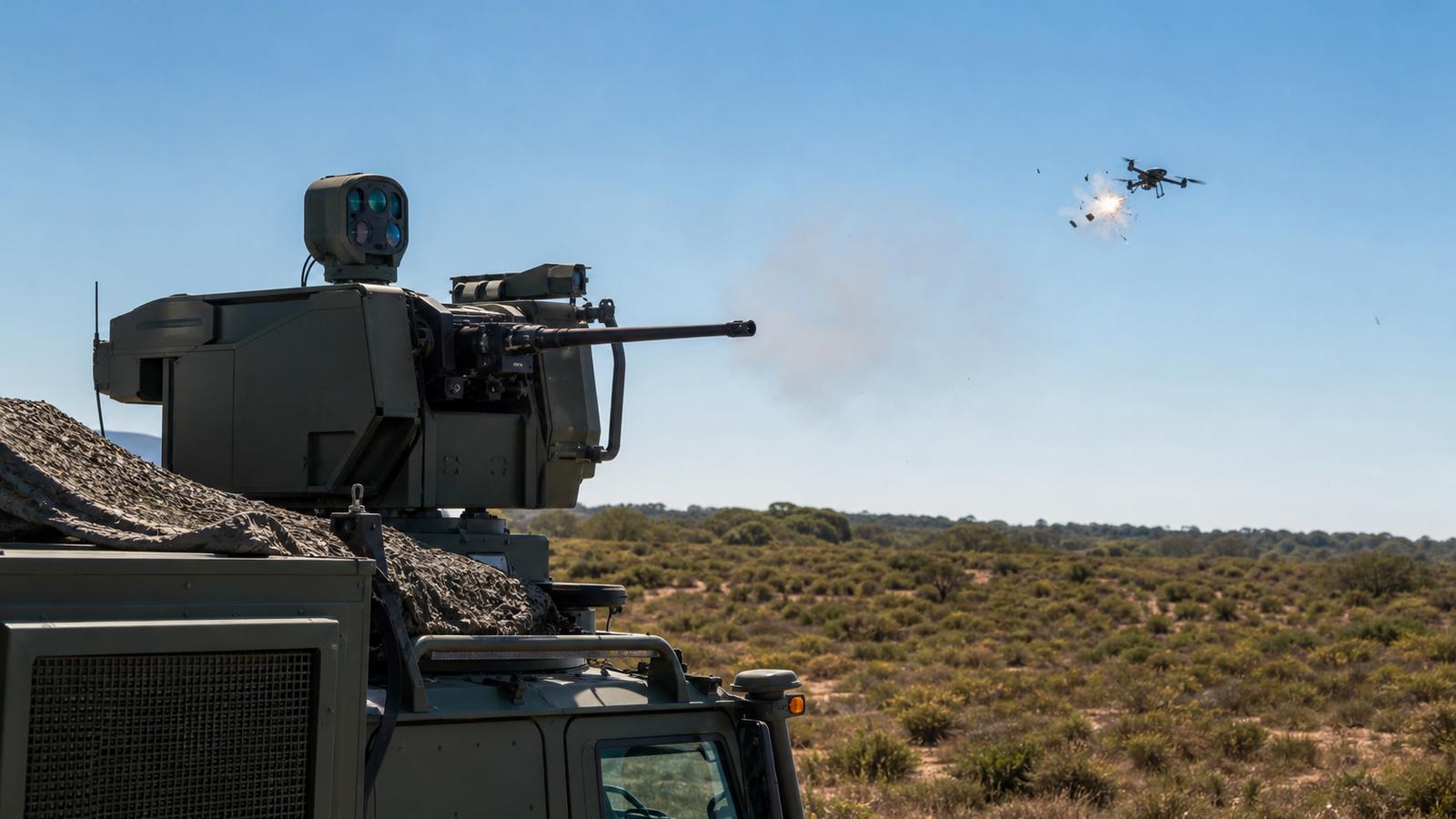
The Spanish Army’s Aracne counter-drone system has brought down drones through direct hits during the operational evaluation of its destructive neutralization capability, known as hard kill. The first live firings took place in Huelva during preparations for the Atlas 26 exercise.
The tests are part of a second evaluation phase. In the first, the Spanish Army validated its soft kill capability, designed to disable unmanned aircraft through electronic warfare systems without physically destroying them. Trials will continue during Atlas 26, involving Aracne systems from the Spanish Army, Navy, and Air and Space Force.
Aracne entered service in October 2026 with the 71st Antiaircraft Artillery Regiment. Developed by Indra and EM&E, it integrates sensors and electronic and kinetic response capabilities. Its mobile version distributes the equipment across two Vamtac ST5 vehicles: one houses the identification and electronic warfare systems, while the other carries the radar and weaponry.
A €30 million program with 14 systems
The program has a budget of €30 million and includes 14 systems in fixed and mobile configurations. The Spanish Army will receive 10 units—five of each type—and a simulator. The Navy and Air and Space Force will each receive one fixed and one mobile system.
The fixed configuration uses a shelter as its command-and-control center. In the mobile version, the Nemus radar provides 360-degree azimuth coverage and 90-degree elevation coverage. According to system data, it can detect targets with a radar cross-section of one square meter at distances of 12 to 15 kilometers, and mini-drones with a 0.01-square-meter cross-section at four kilometers.
The system also incorporates the SmartEar radio-frequency sensor, with a stated range of six kilometers, and the Oteos electro-optical sensor, developed by EM&E. For electronic neutralization, it uses the Brontes/EVO jammer, while its destructive response relies on the Guardian 2.0 remote weapon station, fitted for these tests with a 40-millimeter MK-19 grenade launcher.
The acquisition is focused particularly on drones known as LSS, short for Low-Slow-Small: small aircraft that fly slowly and at low altitude, characteristics that make them difficult to detect. The mobile version of Aracne had previously been evaluated by the Spanish Army in Slovakia during NATO trials.
Read more defense news here.








