



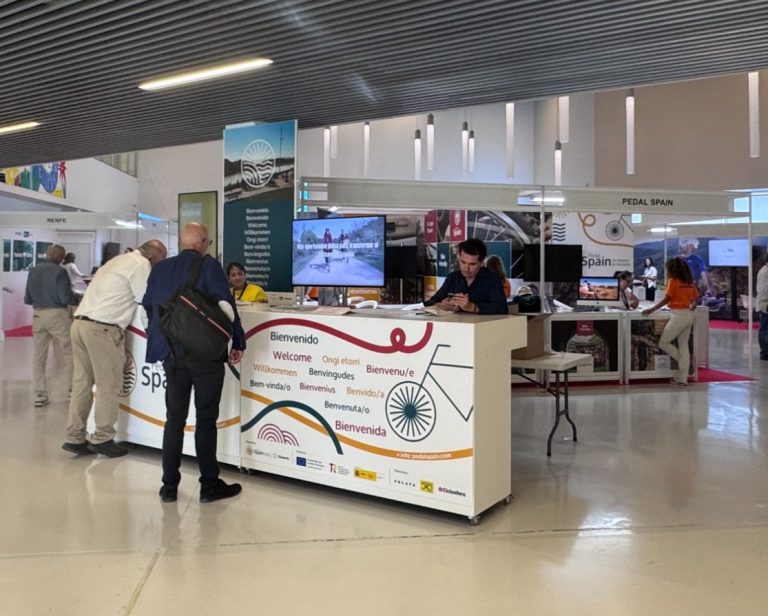
The second edition of the fair, held from November 6 to 8, brought together companies, tourist destinations, and international operators. Sponsored by the Zaragoza Provincial Council, the event focused on the opportunities bicycle tourism offers municipalities and rural areas.
From November 6 to 8, Zaragoza hosted the second edition of Pedal Spain, a bicycle tourism fair that brought together industry professionals, tourist destinations, and cycling travel enthusiasts. Held at the Auditorium’s Multi-Purpose Hall and sponsored by the Zaragoza Provincial Council, the event combined business activity with a public program showcasing routes, equipment, and experiences linked to two-wheel tourism.
The business dimension was one of the event’s central features. Organizers announced the participation of 68 organizations in its professional program and more than 500 pre-arranged business meetings, with tourism operators from markets including Sweden, the United Kingdom, and Romania. These meetings were intended to facilitate contacts between specialized companies, travel agencies, and destinations seeking to market their cycling tourism offerings.
The fair’s growth since its first edition prompted its move from Etopia to the Multi-Purpose Hall, a venue spanning more than 2,000 square meters. An exhibition area featuring nearly 50 companies and tourist destinations was set up there, while Miguel Merino Square hosted a bicycle test track.
Cristina Palacín, the Zaragoza Provincial Council’s delegate for Tourism, highlighted during the fair’s presentation the diversity of landscapes across Zaragoza province, which makes it possible to combine demanding mountain routes with more leisurely rides. She also pointed to the appeal of its historical and gastronomic heritage as a complement to cycling tourism experiences.
An opportunity for rural tourism in Aragon
One of Pedal Spain’s main objectives is to encourage the development and marketing of bicycle-related tourism products. In Aragon, the activity includes initiatives that make use of rural roads, former rail lines, natural landscapes, and routes of cultural interest.
Projects linked to this offering include the Garnacha Route in Campo de Borja; the cycling tourism initiatives in Campo de Belchite; and routes such as the Camino del Cid and the Santander-Mediterranean Greenway Nature Trail. Specialized gravel initiatives were also represented, a discipline that combines trails and unpaved roads with lightly traveled paved roads.
Arturo Sancho, coordinator of Pedal Spain, said in remarks reported by Onda Cero on November 9 that bicycle tourism has experienced notable growth in Aragon since the pandemic, aided by the emergence of new routes and projects. According to Sancho, these initiatives can help extend the tourist season, as spring and fall offer suitable conditions for bicycle travel.
This potential is of particular interest to small municipalities seeking to attract visitors outside peak periods. Bicycle tourism makes it possible to design routes incorporating rural accommodations, restaurants, heritage visits, and activities connected to the natural environment, although its specific economic impact depends on each destination’s ability to turn these proposals into marketable products.
The event also addressed one of the sector’s challenges: its business fragmentation. The Pedal Spain Association aims to facilitate coordination among small businesses and tourism operators in order to improve the joint promotion of Spain as a cycling tourism destination, particularly in international markets.
Gravel and travel experiences take center stage
Pedal Spain’s program devoted special attention to gravel, with project presentations and discussions on its use in developing new routes and attracting visitors to rural areas. Aragonese initiatives included Grava Fayonera, Pedaleando por el Maestrazgo, La Corraliza, and Destino 41.
Over the weekend, attendees could take part in activities including the Social Gravel Ride, bicycle travel mechanics workshops, and a biomechanics lab involving Universidad San Jorge. The program also included destination presentations, travelers’ experiences, and family activities, with free admission.
The fair brought together offerings from different Spanish regions and international destinations. The experiences presented included cycling trips in Iceland, while specialized operators showcased routes across Spain and other European countries.
With this second edition, Pedal Spain has consolidated its position on Zaragoza’s tourism calendar. The holding of international business meetings and the participation of Aragonese projects reinforce the city’s role as a venue for professional exchange in a sector seeking to improve its organization and expand the marketing of bicycle tourism experiences.








