



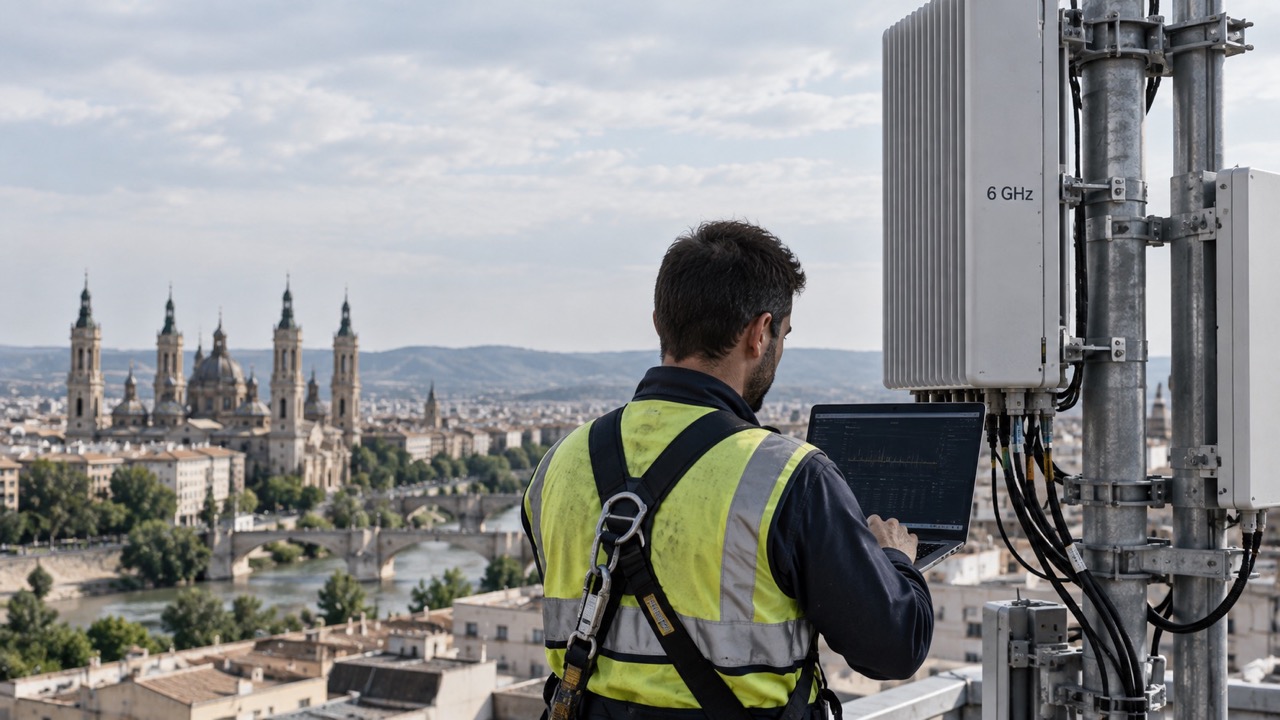
Embou, MasOrange, and Ericsson have conducted mobile network trials in the 6 GHz band, a spectrum identified as strategic for the future rollout of 6G in Spain. The technology is not expected to reach the market until 2030, but operators are already validating the infrastructure needed to accommodate rising data traffic and new digital services.
The 6 GHz band builds capacity for future 6G networks
The 6 GHz band combines coverage, capacity, and energy efficiency—three factors the industry considers essential for developing next-generation mobile networks. Its role in 6G is comparable to that played by the 3.5 GHz band in the expansion of 5G.
Although this spectrum has not yet been licensed in Spain, MasOrange has carried out the technical validation with Ericsson as part of its strategy to anticipate future connectivity needs. The trials are intended to prepare networks for an era marked by the intensive use of artificial intelligence, advanced automation, quantum computing, and immersive digital experiences.
Embou CEO and MasOrange regional director for Aragon, Jorge Blasco, describes the 6 GHz band as a resource that will make it possible to multiply mobile network capacity amid growing data traffic. He says it will be a significant technological enabler for operators seeking to compete over the next decade.
256TR antennas and beamforming to multiply mobile network efficiency
The validation included advanced active antenna architectures that evolve from current configurations of 64 transmitters and receivers to 256TR systems. This leap has the potential to quadruple the number of radiating elements available in radio equipment.
MasOrange and Ericsson also tested beamforming techniques, which dynamically direct the data signal toward the location and needs of each user. This technology makes more efficient use of spectrum, increases network capacity, and serves more users with the same radio resource.
According to the trials, the combination of the new band, active antennas, and precise signal steering will make it possible to quadruple the capacity of each mobile node. The goal is to improve service in high-demand settings and move toward more programmable, open, efficient, and sustainable networks.
6G opens the door to networks that communicate and perceive their surroundings
Future 6G aims to natively integrate communications, intelligence, automation, and the ability to interpret the surrounding environment. In this context, ISAC technologies—Integrated Sensing and Communication—are gaining relevance, combining communications and sensing through the same radio signals.
These capabilities could make it possible to detect people or vehicles without cameras, track assets in ports, factories, or airports, monitor industrial activity, and identify obstacles for autonomous mobility systems. They also include the real-time creation of digital twins of cities, roads, and infrastructure.
For Embou, MasOrange’s telecommunications brand in Aragon, these trials add to its work in advanced connectivity. The company has a hybrid fiber and radio network reaching 99% of Aragon, while MasOrange exceeds 93% 5G coverage and connects around 5,250 municipalities in Spain.