



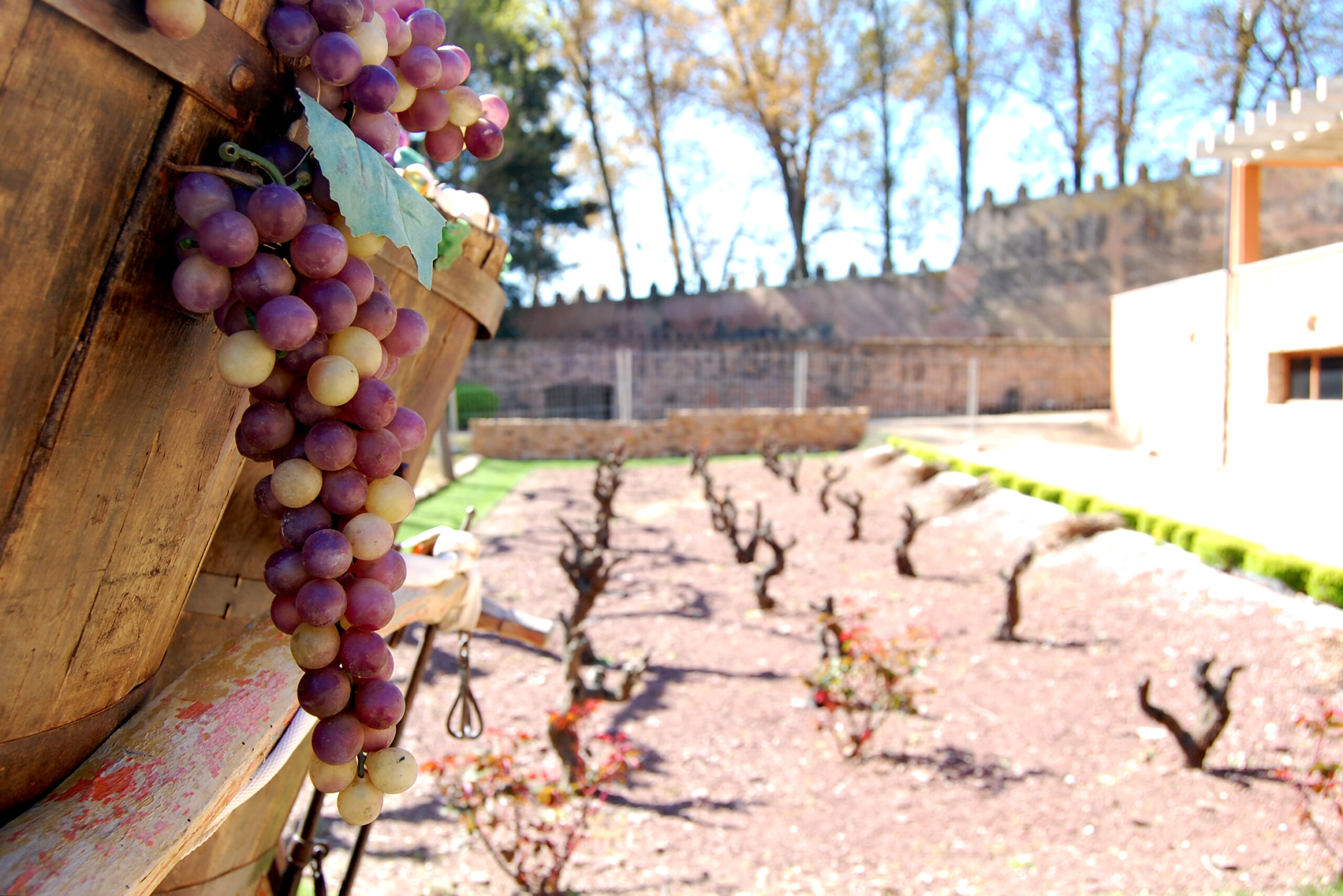
There are many ways to explore the province of Zaragoza, and one of the most compelling is to follow the landscapes of its vineyards. South of the regional capital, Cariñena has been linked to vine-growing for centuries, while to the northwest, Campo de Borja has made Garnacha one of its defining hallmarks. These are two regions with distinct identities, separated by more than just a few miles, offering travelers the chance to visit wineries, discover villages and gain insight into an activity that has left its mark on both history and the landscape.
Autumn is an especially appealing time to visit. Once the harvest is over, vine leaves turn shades of yellow, ocher and red before falling, giving the vineyards a very different appearance from the summer months. It is also an ideal time to explore the towns at a leisurely pace, visit a winery and enjoy the local cuisine.
Cariñena, a history written among the vineyards
About 50 kilometers from Zaragoza, Cariñena is one of the great names in Aragonese wine. Its winemaking tradition dates back centuries and has shaped both the local economy and the customs of its residents. A walk through its streets is enough to find references to an activity that is part of the town’s identity.
A good way to begin a visit is at the Wine Museum, housed in the former Casa de la Viña y el Vino, where visitors can learn about the evolution of viticulture and winemaking methods. It is then worth strolling through the historic center, stopping at the Church of Nuestra Señora de la Asunción and discovering the Fuente de la Mora, one of the town’s best-known spots. Each year, during the Grape Harvest Festival, this fountain takes center stage in a celebration where wine naturally holds a prominent place.
But understanding Cariñena also means heading into its surrounding countryside. Vineyards stretch across plains and gently rolling terrain, with the Algairén mountain range serving as a defining feature of the landscape. Towns such as Aguarón, Paniza and Longares maintain close ties to vine-growing and offer a glimpse of a less-visited part of the region.
The Campo de Cariñena Wine Route provides access to this world through winery visits, tastings and culinary experiences. Some wineries allow visitors to tour their production and aging facilities, learn about the differences among grape varieties and see how traditional processes have evolved. Booking ahead is advisable, as visiting conditions and schedules vary by winery.
Those who would rather enjoy a tasting without worrying about driving can check departures for the Wine Bus, an initiative offering excursions from Zaragoza that combine winery visits with other attractions across the region.
Campo de Borja and the land of Garnacha
Leaving Cariñena behind and heading northwest across the province, the wine landscape takes on different nuances. Campo de Borja extends across an area shaped by the presence of Moncayo, whose climatic influence helps define the growing conditions of its vineyards.
Here, Garnacha is the undisputed star, a grape variety deeply rooted in the region. Its vines grow on land with widely varying characteristics, from relatively flat areas to higher-altitude plots, and some estates preserve old vineyards that form part of the area’s agricultural heritage.
Borja can serve as the starting point for the trip. Its historic center brings together churches, palaces and streets that recall the town’s importance over the centuries. From there, it is easy to reach Ainzón, Magallón or Fuendejalón, three municipalities where winemaking remains a major activity.
The Garnacha Route offers different ways to explore the area, with wineries open to visitors, dining establishments and wine-related activities. Visits offer an opportunity to discover how Garnacha is cultivated, the importance of vine age and soil characteristics, and why the same variety can produce different results depending on where it is grown.
For photography enthusiasts, the areas surrounding these towns also offer striking vineyard landscapes, particularly during the final weeks of autumn. The plots trace lines across the hillsides and, when the sky is clear, the silhouette of Moncayo appears in the background of many panoramic views.
Veruela, an essential stop
A trip through Campo de Borja warrants setting aside a few hours to visit Veruela Monastery, located beside Vera de Moncayo. Founded in the 12th century, it is one of Aragon’s most important Cistercian complexes and retains monumental architecture that reveals much of its history.
The monastery also has close ties to the region’s winemaking tradition. Its premises house the Campo de Borja Designation of Origin Wine Museum, which explains the evolution of vine-growing, the varieties used and the changes wineries have undergone over time.
The visit also offers the chance to explore the cloister, abbey church and the various spaces within the monastic complex. Its setting, with Moncayo close by, makes it possible to extend the day into the surrounding villages or continue to Tarazona, one of the province’s most interesting historic cities.
It is easy to understand why the site also attracted brothers Gustavo Adolfo and Valeriano Bécquer, who spent time in Veruela during the 19th century. The poet’s stay inspired his well-known Letters from My Cell, in which he recorded his impressions of the monastery and the surrounding landscapes.
Two getaways to discover another side of Zaragoza
Although Cariñena and Campo de Borja can be visited on the same multiday trip, it is best to devote at least one full day to each area. The distances between wineries, villages and major landmarks make it advisable to choose visits selectively and allow enough time to enjoy them.
In Cariñena, a good itinerary is to begin in town, visit a winery and continue to one of the municipalities near the Algairén mountain range. In Campo de Borja, the day can be divided among a wine visit, a stroll through Borja and Veruela Monastery. Those with a full weekend may find it worthwhile to spend a night in the area and take the opportunity to explore its cuisine.
Spring and autumn are particularly pleasant seasons for exploring these landscapes, although each time of year reveals a different stage of vineyard work. During the harvest, from late summer to early fall, winery activity reaches one of its busiest periods, making it advisable to check visiting options in advance.
Cariñena and Campo de Borja offer a view of a province of Zaragoza where wine remains part of daily life in many towns. Visiting their wineries, traveling through their vineyards and pausing at their historic sites is an excellent way to discover the area, while leaving enough time to enjoy what emerges along the way.