



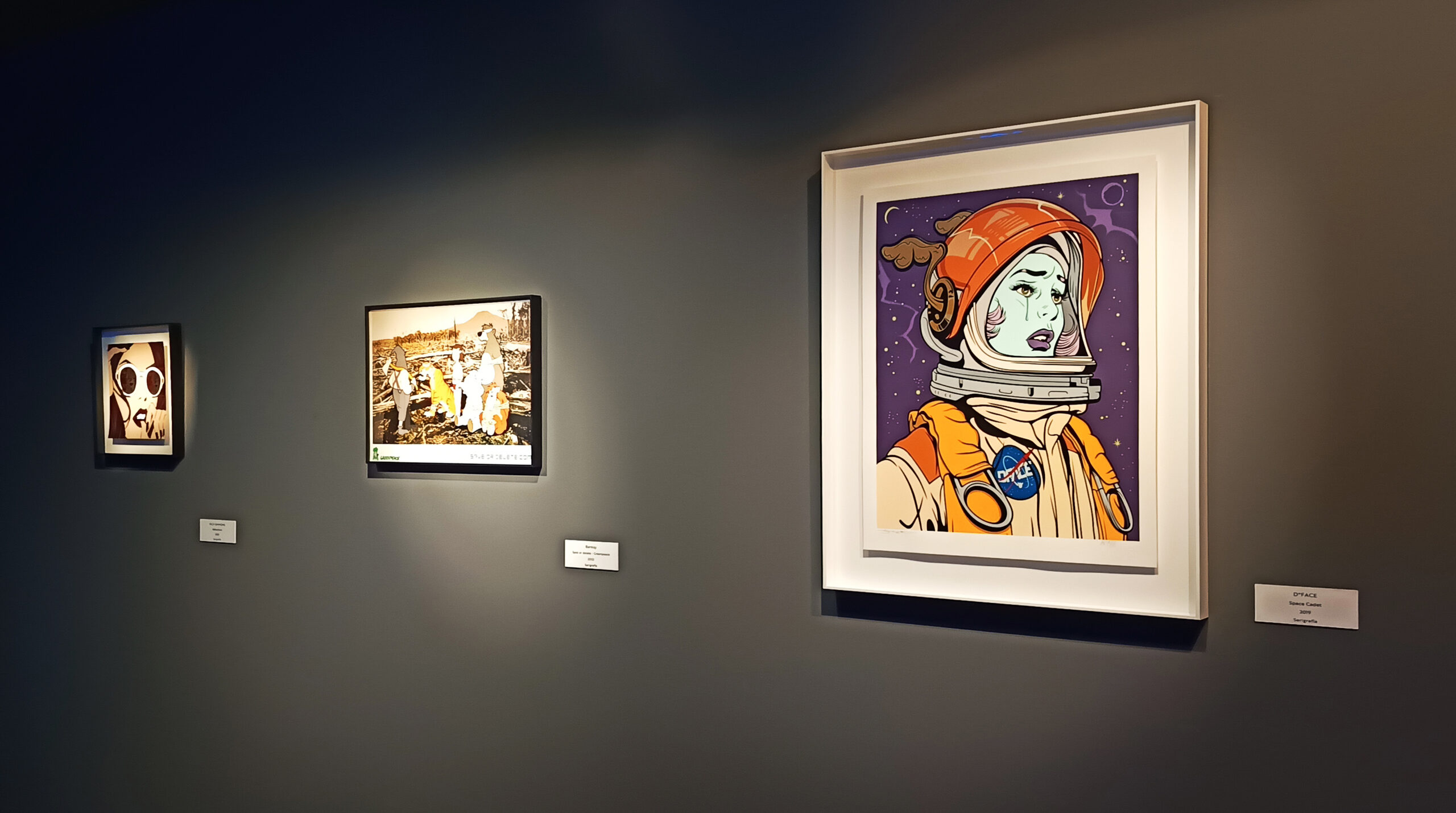
The first floor of the Centro de Historias in San Agustín Square, Zaragoza, hosts one of the most interesting exhibitions scheduled in the city this year, running until August 23. Titled «Comic in Contemporary Art: Icons, Myth, and Narrative,» it reveals how popular comic strips have influenced contemporary art creators across various disciplines, styles, and origins since the mid-20th century to the present day.
Some of the exhibited works are signed by artists such as Andy Warhol, Roy Lichtenstein, Eduardo Arroyo, and the enigmatic Banksy. Through these pieces, the exhibition takes a journey across several decades in which comics have evolved from mere entertainment and a means of storytelling to sources of aesthetic, thematic, and conceptual inspiration for some of the most significant artists of our time.
This influence has never been concealed, as is clear from the first artworks in the exhibition, where we see iconic comic characters reimagined in other formats. For instance, there is the sculptor, painter, and cartoonist Claes Oldenburg, whose famous Geometric Mouse features Mickey Mouse transformed into geometric shapes while still being recognizable, highlighting the power of this mass culture icon. Similarly, we recognize Spider-Man in the piece titled What Have I Become by street artist D*Face, who presents the superhero sitting on the edge of a cliff, almost defeated and holding a broom. In other words, depicting a moment that is far from heroic, showcasing vulnerability rather than strength.
Following this initial contact, the exhibition quickly reaches one of its high points, as several works by the great representatives of Pop Art hang on the walls of the Centro de Historias. This includes Andy Warhol, who adeptly adapted the more industrial and repetitive concept of comics into series like his Campbell’s Soup. Likewise, Roy Lichtenstein took the idea of the comic strip and materialized it on an enormous scale, turning it into something monumental yet devoid of narrative power.
While this was happening in the United States, various figurative movements were developing in Europe that confronted the prevailing abstraction in contemporary art. Some artists began painting figures and depicting recognizable scenes. The exhibition features the work of the French artist Hervé Télémaque, the Italian Valerio Adami, as well as Eduardo Arroyo and the Equipo Crónica from Spain.
These Pop Art and New Figuration movements laid the foundations for comic forms and characters to appear in many subsequent creations of 20th-century contemporary art. Indeed, by the end of the century, many postmodern artists, with varying perspectives and purposes, kept the influence of comics alive, as can be observed in the exhibited works of Riiko Sakkinen, Judas Arrieta, Ai Weiwei, and the ever-intense Damien Hirst.
So far, we see primarily the impact of comics on American and European art, but we cannot forget that at one point, manga and Japanese animation burst onto the scene with unprecedented force. This obviously has repercussions in other artistic disciplines, particularly painting. In fact, this chapter of the exhibition is one of the most interesting. Artists like Takashi Murakami, his disciple Mr., and Yoshitomo Nara bring the seemingly naive forms of manga and their extraordinarily bright colors to canvases and prints. It may seem that they are merely replicating the aesthetics, but they go further, inviting reflection on issues such as consumption, desire, and the traumas of their society and time.
To conclude the journey through the exhibition, the most musical chapter arises. We all know that comics, both their characters and stories, have long jumped onto screens. In fact, they currently enjoy a thriving period in this regard. Not to mention their presence on television for decades. It is also evident that comics, now regarded as the ninth art, even participate in literature, with many publications being referred to as graphic novels. Likewise, there is perhaps an unexpected mark of the comic in music, which can be traced in the album covers of some records.
The cover of Goo by Sonic Youth is evidently almost an expanded comic strip. The same can be said for the cover of The New Abnormal by The Strokes, created by another great artist of the late 20th century, the late Jean Michel Basquiat, who designed an image for the New York rockers that reflects the typical fragmentation of the genre. In a completely different style, but inspired by the clarity and silhouettes typical of comics, Julian Opie created portraits of the Brit-pop group Blur. Meanwhile, Jamie Hewlett turned the musicians of the band Gorillaz into characters within a comic. Although the comic influence on an album was not a new concept, as Warhol did it long before with The Velvet Underground.
In summary, the exhibition «Comic in Contemporary Art: Icons, Myth, and Narrative» at the Centro de Historias showcases up to 70 works by more than thirty world-renowned artists. It is a highly recommended (and free) exhibition that will run until August 23, 2026.