



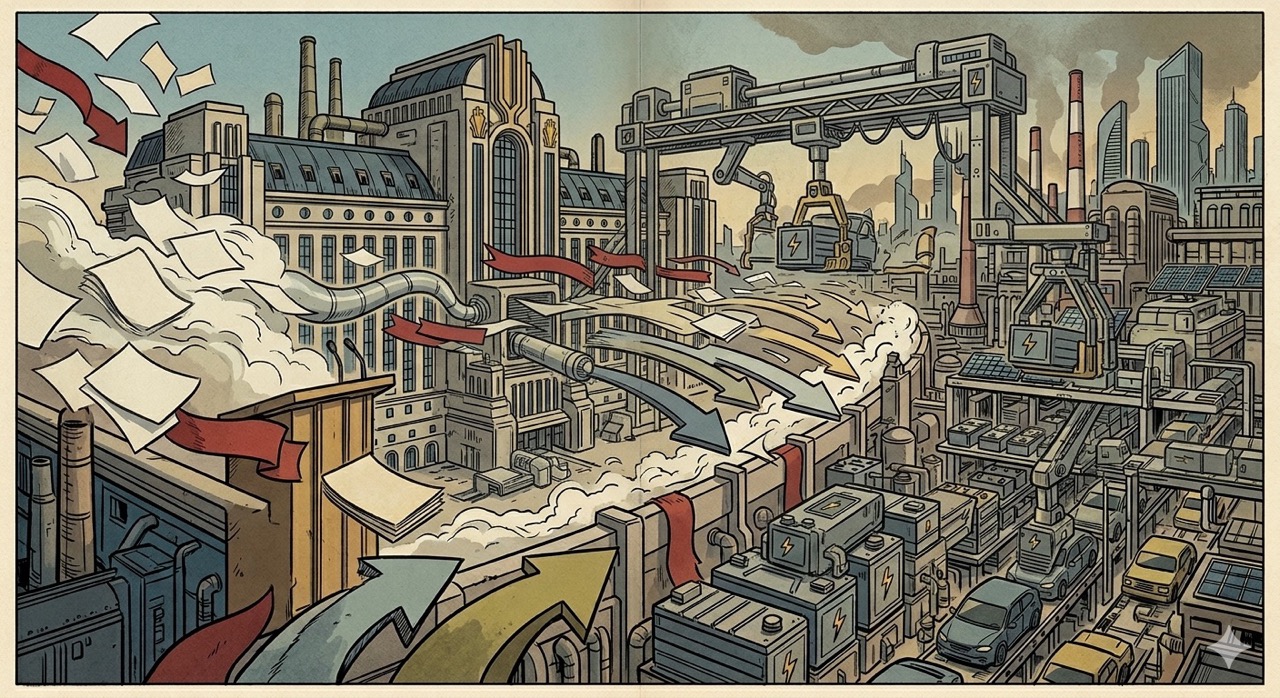
The European Union’s decision to restrict the participation of Chinese investors and limit access to batteries manufactured in China for certain strategic programs has provoked an immediate and strong response from Beijing. What until a few years ago seemed to be a relationship based on industrial interdependence and commercial complementarity is progressively transforming into an open geoeconomic dispute over control of the value chains of the energy transition.
The Chinese reaction was swift. The Beijing government labeled the new European measures as «discriminatory» and accused Brussels of violating fundamental principles of free trade and international competition. pv-magazine.es
Beyond the usual diplomatic tone, the episode reflects something deeper: Europe is entering a new phase of defensive industrial policy.
For years, the community strategy regarding China was marked by an ambiguous combination of trade openness and strategic concern. However, Europe’s dependence on sectors considered critical—batteries, rare minerals, solar panels, semiconductors, or technological components—has altered the political balance in Brussels. The war in Ukraine, tensions between the United States and China, and fears regarding industrial vulnerabilities have accelerated a paradigm shift.
The new European regulation aims to limit the access of companies linked to countries considered «high strategic risk» to public community funding or to participate in certain sensitive projects related to clean technologies and energy storage. pv-magazine.es
In practice, this move directly affects one of the major industrial pillars of China: the global production of batteries.
China currently dominates a large part of the global supply chain related to electric vehicles and energy storage. From the refining of strategic minerals to the manufacturing of cells, the Asian country has built an extremely difficult industrial position to replicate in the short term over the past two decades. Companies like CATL, BYD, and EVE Energy have become central players in the new global energy landscape.
Europe knows this. And that is precisely where the complexity of the situation lies.
Because while Brussels tries to reduce strategic dependencies, the European industry continues to require Chinese technology, scale, and productive capacity to sustain a good part of its electrification and decarbonization objectives. The risk for the EU consists of trying to partially decouple from a supplier on which it still relies structurally.
The tension is especially visible in the European automotive sector. German, French, and Spanish manufacturers are accelerating investments in gigafactories and local supply chains, but many of those facilities still depend on technological agreements or equity participation from Chinese groups. The continent wants industrial autonomy, although it still lacks a fully integrated supply chain capable of competing on costs and volume with Asia.
Beijing’s response precisely addresses this contradiction. The Chinese government warned that the European restrictions could deteriorate the investment climate and affect future business decisions related to Europe. pv-magazine.es
Behind the diplomatic language lies an implicit threat: China retains enormous industrial leverage over strategic European sectors.
It is not only about finished batteries. It also concerns refined lithium, graphite, rare earth elements, and intermediary components where European production capacity remains limited. Any sustained trade escalation could tighten prices, delay industrial projects, and increase costs for European manufacturers amid the energy transition.
At the same time, Brussels faces growing political pressure to protect local industry against what many European governments consider imbalanced competition. Chinese industrial overcapacity, backed by massive state subsidies and preferential financing, raises particular concerns in green sectors where Europe fears repeating the mistake made two decades ago with solar energy.
The precedent is very much present in European industrial memory.
In the early 2000s, Europe had significant panel manufacturers. In just over a decade, Chinese capacity completely transformed the global market, drastically reducing costs but displacing a large part of European production. Today, the EU seeks to prevent the same phenomenon from occurring in batteries and electric mobility.
However, the European strategy contains its own risks. Excessive protection could slow the energy transition, raise industrial prices, and generate tensions with key trading partners. Moreover, Europe’s ability to build real technological autonomy will depend not only on defensive regulation but also on massive investment, innovation, and the speed of industrial execution.
Here emerges the central question: if Europe intends to seriously compete in strategic technologies, it will have to decide how much it is willing to bear the economic costs of that autonomy.
Because the energy transition no longer functions solely as a climate agenda. It has also become an industrial policy, economic security, and geopolitical competition.
The Chinese reaction to the new European restrictions is, in reality, a signal that this competition has entered a new stage. A stage where batteries, critical minerals, and supply chains weigh as much as tariffs or traditional diplomacy.
And where the big question for European companies is no longer just how to decarbonize, but who they will depend on to do so.