



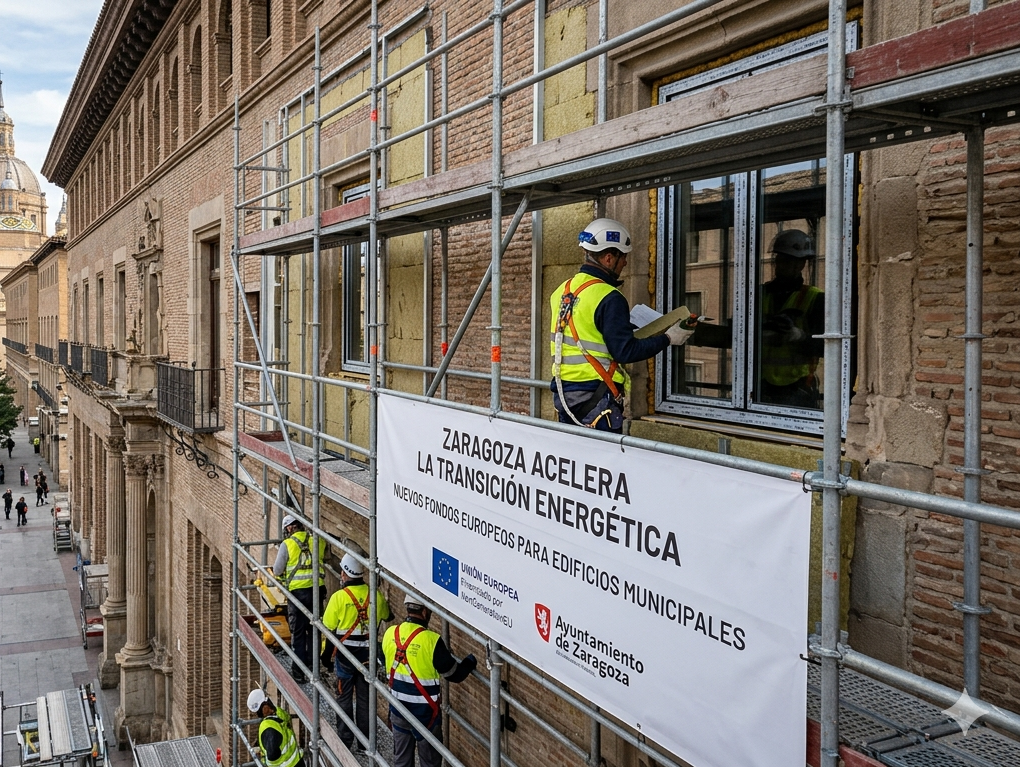
The race to secure European funding for energy transformation has become one of the major indicators of the management capacity of Spanish public administrations. In a context of increasing pressure on energy costs, European climate requirements, and the need to modernize infrastructure, municipalities are no longer competing solely for traditional urban investments but also positioning themselves within the new funding landscape linked to sustainability and decarbonization.
In this scenario, the Zaragoza City Council has successfully obtained nearly 400,000 euros from NextGenerationEU funds aimed at improving the energy efficiency of several municipal buildings, as part of the Recovery, Transformation, and Resilience Plan (PRTR).
This initiative will mobilize a total investment of 907,326 euros and will allow for the renovation of thermal systems in four municipal facilities: the Zaragoza Joven building in La Azucarera, the La Piraña Early Childhood School, the offices of Roadway and Water of Zone 5, and the Miralbueno Municipal Board. The European funds will cover approximately 44% of the total budget planned.
Beyond the immediate economic dimension, the project reflects an increasingly visible trend in European urban management: energy transition has ceased to be solely an environmental issue and has become a strategy for modernizing public infrastructure and optimizing resources.
Local administrations today face a dual challenge. On the one hand, they must reduce energy consumption and emissions in aging public buildings that are often inefficient. On the other hand, they need to accomplish this within a budgetary context where European funding has become a decisive tool to accelerate investments that would otherwise progress much more slowly.
The Councilor for Finance and European Funds of the Zaragoza City Council, Blanca Solans, framed the project within the municipal strategy of energy transition and public equipment modernization. According to the council, these actions will allow for the replacement of fossil fuel-based systems with more efficient electric solutions aligned with European climate objectives.
In technical terms, the interventions will entail a total installed capacity of 665.60 kW, aimed at improving energy performance and reducing dependence on conventional fuels.
The largest investment will be concentrated at the La Piraña Early Childhood School, with over 526,000 euros planned for the renovation of facilities. The Zaragoza Joven building in La Azucarera will absorb a little over 301,000 euros, while actions at Zone 5 Water and Roadway and the Miralbueno Municipal Board will involve a smaller amount, though still focused on modernizing thermal systems and improving energy efficiency.
The project is also integrated into a broader municipal strategy linked to urban sustainability, energy self-consumption, and the progressive decarbonization of public infrastructure. Zaragoza has been promoting initiatives related to energy communities, photovoltaic installations, and efficiency projects related to both municipal facilities and industrial parks and residential neighborhoods for several years.
In this regard, the attraction of new European funds reinforces a dynamic that is redefining the relationship between local administrations and community financing. The NextGenerationEU funds have not only enabled the acceleration of investments but have also increased the strategic weight of specialized technical areas in managing, executing, and supervising complex projects.
The Zaragoza City Council maintains that it has already executed more than 102 million euros of the 125 million collected through competitive bidding within the PRTR, achieving an execution rate of over 82%. This is particularly relevant considering that one of the main challenges associated with European funds in Spain has been the administrative capacity to transform approved funding into projects that are effectively executed.
This issue is not insignificant. Brussels has progressively tightened control and oversight mechanisms over programs funded with European resources, especially in areas related to energy transition and sustainability. The speed of execution is beginning to become as important a political and economic factor as the acquisition of resources itself.
At the same time, urban energy transition is consolidating as an area of increasing activity for companies involved in engineering, energy rehabilitation, construction, technical maintenance, and technological solutions applied to public infrastructure. A significant portion of the funds mobilized by European programs ends up acting as an indirect stimulus on the local and regional business fabric.
The deadline for completing the actions is set for December 2028, within the timetable established by the European recovery programs. By then, the question will likely no longer be solely about how many public buildings have improved their energy efficiency, but rather which cities have managed to turn the climate transition into a genuine urban competitive advantage.
Because the new competition among European cities is no longer measured solely by infrastructure or logistical capacity. It is also evaluated in terms of sustainability, efficiency, and the ability to adapt to an increasingly electrified and decarbonized economy.