



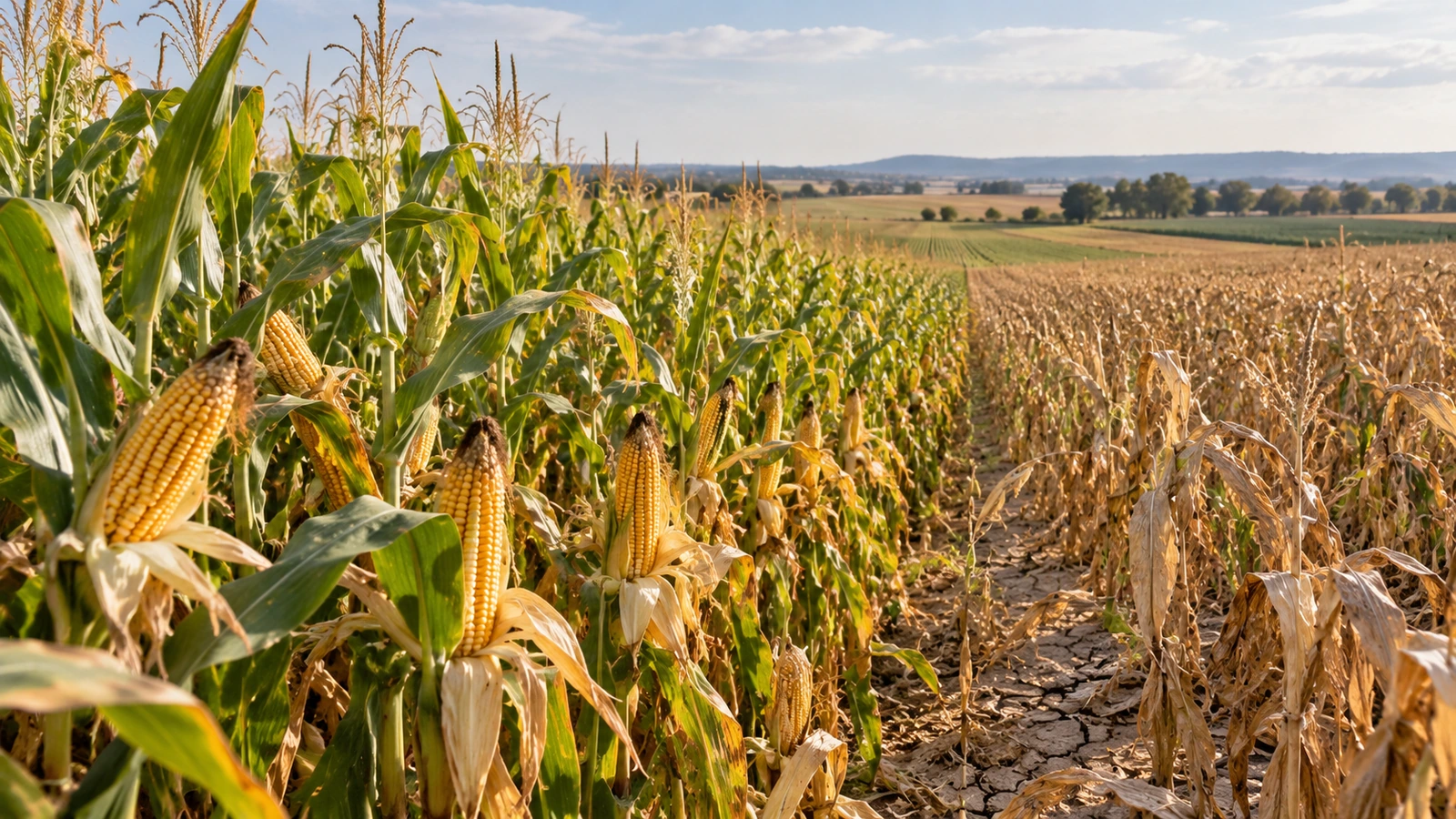
Global corn production will reach 1.309 billion metric tons in 2026, according to the latest forecasts from the United Nations Food and Agriculture Organization (FAO). Output remains high, but the figure represents a 0.6% downward revision from estimates published in June and reflects worsening harvest conditions in some of Europe’s main producing regions.
The cut is concentrated particularly in the European Union. Heat and lack of rainfall over the summer have affected crops in countries including France and Poland, pushing expected yields below the average of the past five years. The FAO has also slightly lowered its forecasts for India and Paraguay.
The trend has been different in South America. Argentina and Brazil are reporting better yields than initially expected, and upward revisions for both countries have partially offset anticipated losses in other regions.
Corn is also one of the main reasons the FAO has lowered its global forecast for total cereal production. The agency now expects worldwide output of 2.980 billion metric tons in 2026, 61.1 million metric tons less than the previous year. The 2% decline would be the largest recorded since 2018, although total output would still represent the second-largest global harvest on record.
Europe will need to import more corn
Lower European production will have consequences for international trade flows. The FAO expects the European Union’s import needs to increase to offset weaker harvests, while the United States will strengthen its position as the world’s leading exporter.
Argentina will also expand its international presence. Forecasts point to exports of as much as 39 million metric tons, a volume that would bring its overseas sales close to those of Brazil.
Market performance will also depend on developments in the Black Sea. Russia and Ukraine will remain major grain suppliers, but maritime shipping conditions, logistical risks, and limitations on alternative routes are sustaining uncertainty over the reliability of supplies.
This situation is prompting some importing countries to seek greater supplier diversification and improving export prospects for other major producers.
Stock forecasts have also been revised. In the United States, the FAO has lowered its projection for ending corn stocks because of the strong pace of exports. It also expects lower inventories in the European Union and Paraguay as a result of less favorable production prospects.
Global demand continues to grow
The lower forecasts follow an exceptional season. According to data compiled by El Economista from FIRA’s Panorama agroalimentario maíz 2026 report, global production is estimated to have reached about 1.327 billion metric tons during the 2025/2026 marketing year, a record high and 7.6% above the previous season.
Consumption has followed a similar path. Over the past five marketing years, global corn demand grew at an average annual rate of 2.4%, reaching approximately 1.300 billion metric tons. The main driver has been animal feed, where consumption increased at an average annual rate of 2.7%, while food and industrial uses grew by around 2%.
The scale of the market is also explained by its high concentration. The United States produced about 432 million metric tons in the 2025/2026 season, roughly one-third of the global total. China ranked second with just over 301 million metric tons, followed by Brazil with 141 million metric tons.
Forecasts for the following season keep the United States at the forefront of global production, albeit with a lower volume, while countries such as Argentina and Brazil continue to increase their weight in international markets.
Despite the revised harvest forecasts and trade tensions, the FAO does not yet foresee a global cereal shortage. The agency estimates that the stocks-to-use ratio will stand at 31.6% at the end of the 2026/2027 seasons, slightly below the previous 31.9%, but still at a level it considers relatively comfortable by historical standards.
The figure is relevant for Europe and for regions with significant agricultural and livestock activity, such as Aragon. International developments in corn affect both grain producers and livestock operations and the animal-feed industry, all of which depend on this raw material. A smaller European harvest, coupled with greater import needs, once again puts weather, costs, and the security of international supplies among the variables likely to shape the market in the coming months.