



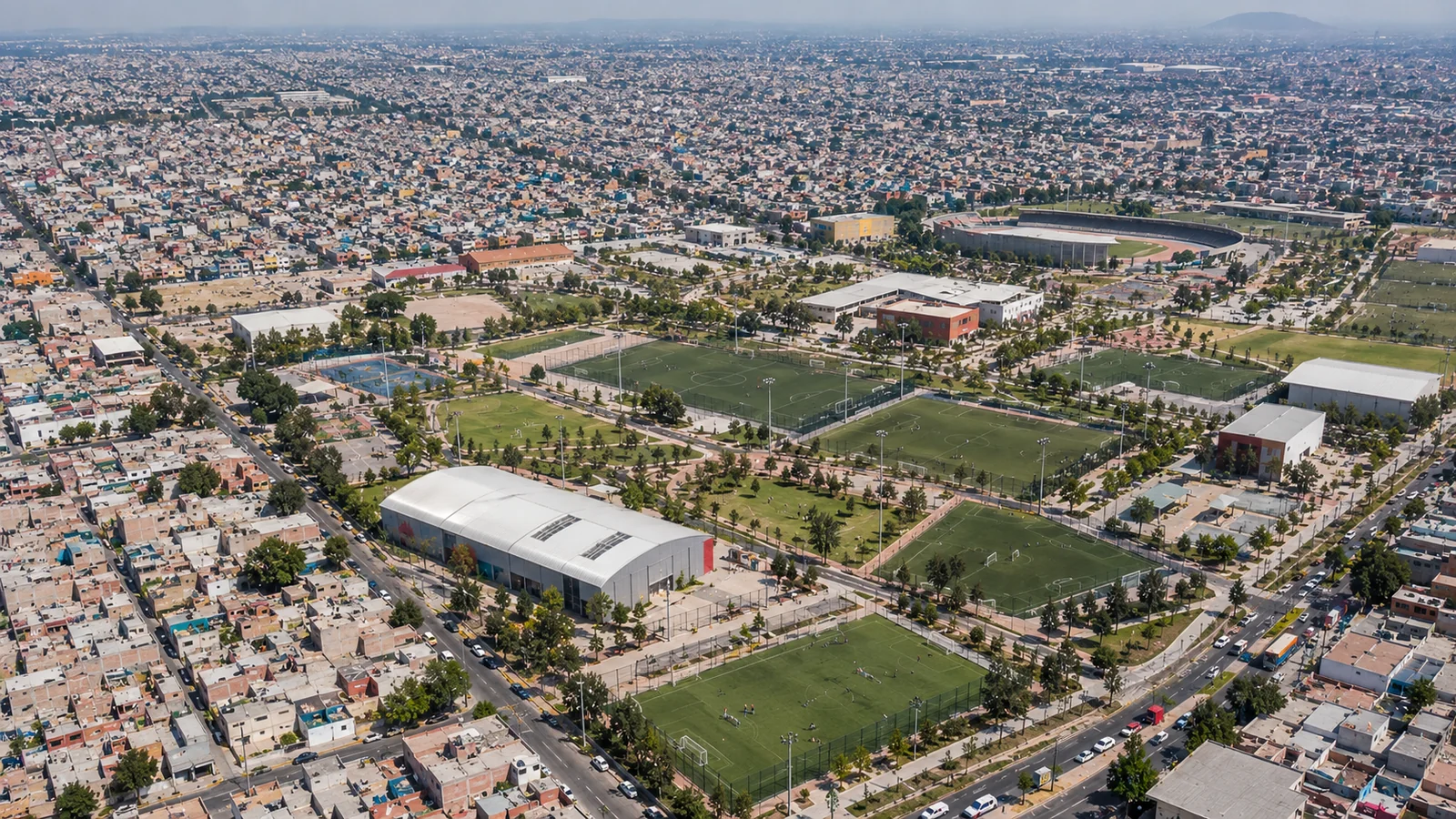
For more than three decades, Bordo de Xochiaca was one of the largest open-air landfills in the Mexico City metropolitan area. Between 10 million and 12 million tons of waste accumulated on the Nezahualcóyotl site, while about 1,200 tons of garbage entered the facility each day. Where pollution, leachate, gases, and vast piles of waste once stood, there is now an urban development encompassing commercial, health care, educational, and sports activities.
Ciudad Jardín Bicentenario is the result of that transformation. The project, involving companies linked to Carlos Slim alongside public authorities and other stakeholders, turned the former landfill into a mixed-use development that now covers about 150 hectares. The process illustrates how the restoration of severely degraded land can combine environmental regeneration, corporate investment, and new services for a densely populated urban area.
The Nezahualcóyotl 1 and 2 dumps were closed in 2006 after reaching levels of saturation that made their continued operation unsustainable. Their closure, however, left a substantial challenge unresolved: what to do with millions of tons of waste accumulated over more than 30 years, and how to restore land that represented a major environmental liability.
The solution required stabilizing the ground, compacting and sealing the waste, and establishing systems to manage leachate and the biogas generated by the decomposition of organic matter. Ciudad Jardín Bicentenario was subsequently built on that land.
From environmental problem to urban development
Carlos Slim and his companies became involved after authorities in the State of Mexico, the municipal government of Nezahualcóyotl, and developer Gucahe proposed restoring the site. According to information published by Expansión, the group initially acquired 46 hectares from the Government of the State of Mexico for about 250 million pesos, funds that contributed to the remediation process.
Constructora IDEAL and Promotora Sanborns subsequently provided about 70% of the project’s private investment, estimated at roughly $200 million. Information published by Expansión in 2009, while the complex was being developed, put projected total investment at approximately 3 billion pesos.
The result was far broader than a conventional real estate development. The former landfill gradually became home to a shopping center, sports facilities, universities, a hospital, a children’s rehabilitation center, and a range of public and private services.
Plaza Ciudad Jardín began operating in late 2008. The commercial complex covers about 17.5 hectares and includes big-box stores, restaurants, entertainment venues, and service businesses. A year later, Hospital Star Médica Ciudad Jardín opened, with 82 rooms and 32 consultation offices.
The project’s social and sports dimension arrived with the Centro Deportivo Ciudad Jardín TELMEX Bicentenario, inaugurated in May 2009. The facility covers more than 60 hectares and includes dozens of sports courts, a 3,650-seat stadium, a cycling track, and gyms. The development also added university campuses, educational facilities, and a Teletón Children’s Rehabilitation Center.
Making use of what remained underground
One of the project’s defining features lies directly beneath its new buildings and green spaces. The millions of tons of waste did not disappear: they were stabilized and remain beneath the reclaimed land.
The decomposition of that material continues to produce biogas. Rather than releasing it directly into the atmosphere, the project incorporated facilities to capture and use it for energy. Documentation from the Carlos Slim Foundation indicates that biogas from the former landfill could generate up to four megawatts of electricity.
The redevelopment also included about 350,000 square meters of grassed areas and rainwater collection systems capable of recovering up to 5 million liters. The Carlos Slim Foundation estimates that the various environmental measures associated with the project avoid 93,000 tons of CO₂ emissions annually.
A model combining business and regeneration
Ciudad Jardín Bicentenario also has a business dimension that helps explain its development. Environmental remediation made it possible to bring previously unusable land to market and develop commercial, health care, and service assets capable of generating economic activity for decades.
Inmuebles Carso participated in developing the shopping center, while other companies linked to the group were involved in different parts of the project. That combination of land restoration and the subsequent operation of the assets turned urban regeneration into an undertaking with long-term economic returns.
The Nezahualcóyotl experience therefore raises an issue that extends beyond Mexico. Many large metropolitan areas retain former industrial sites, landfills, and degraded land whose restoration requires investments that are difficult for the public sector alone to bear. Ciudad Jardín offers a model based on collaboration between public authorities and private capital, although replicating it necessarily depends on the urban planning, environmental, and economic conditions of each location.
Nearly two decades after the landfill closed, the contrast remains the clearest way to convey the scale of the change. Where hundreds of trucks loaded with waste arrived every day for more than 30 years, there are now stores, a hospital, universities, and sports facilities. The waste remains stabilized beneath the ground, but the space it once occupied now serves an entirely different function within the city.