


What was once a degraded barrier is now transforming into the largest European urban integration project along a riverbank: 32 million euros in investment, 80,000 square meters of public space, 2.5 km of renovated riverbed, 8 river parks, pedestrian-priority streets, and 190,000 trees and shrubs. ZARAGOZA.- The Huerva River has been a discreet, almost invisible presence in the daily life of Zaragoza. Constricted, partially covered by asphalt, and degraded by urban growth in the 20th century, this tributary of the Ebro went from being a central axis of agricultural and social life to becoming an urban scar. Today, the Huerva seems to be gradually reemerging and beginning a second life. With an investment exceeding 31.9 million euros, funded through the European Next Generation EU funds, Zaragoza is undertaking one of the most ambitious river regeneration projects in southern Europe. It is a hydraulic work as well as a landscaping project, a structural transformation between the city and its natural environment.
A river with history… and outstanding debt
Born in the Sierra de Cucalón in Teruel, the Huerva flows nearly 128 kilometers before it merges with the Ebro. Over the centuries, it has served as an agricultural engine, a water supplier, and a silent witness to the passage of Romans, Muslims, and farmers from the Zaragoza plain. Its name, possibly linked to the root «ur» —water—, reveals its ancestral significance. This role changed drastically between 1925 and 1928, when a significant portion of the riverbed was covered under the current Gran Vía and the Paseo de la Constitución. That decision, now regarded as an urban planning error, relegated the Huerva to a secondary role: hidden, channeled, and treated more as a sewage system than as a natural resource. The city grew with its back turned to it.
The Huerva River Regeneration Project was conceived to correct this historical fracture. Driven by the Zaragoza City Council, the Government of Aragon, and the Biodiversity Foundation of the Ministry for Ecological Transition, the plan approaches the river from a comprehensive perspective: environmental, urban, and social.
Such initiatives respond to a new model of European city: greener, more resilient, and more livable, as highlighted by analysis from media specializing in urban sustainability. Zaragoza thus joins the trend already followed by cities like Vitoria, Paris, and Copenhagen in recovering their river corridors.
2025 and 2026, two phases for profound transformation
The intervention is structured into two main phases. The first, already completed in the summer of 2025, has established the technical foundations of the project with an investment of 8.85 million euros. It has involved renewing sanitation networks, constructing an anti-pollution storm tank, and preparing the ground for subsequent actions.
The second phase, ongoing until late 2026, focuses on the bulk of the urban and landscaping transformation. With over 23 million euros, work is being done on 2.5 kilometers of riverbed, the river is being widened to reduce flooding risk, and 190,000 native trees and shrubs are being planted, a figure that will turn the Huerva into a new green lung for the city.
Víctor Serrano, Councilor for Urban Development: «It’s not just going to change the city; it will change the relationship of Zaragoza residents with a forgotten river: this is the most important green infrastructure regeneration project in Europe.»
Eight parks and an ecological corridor
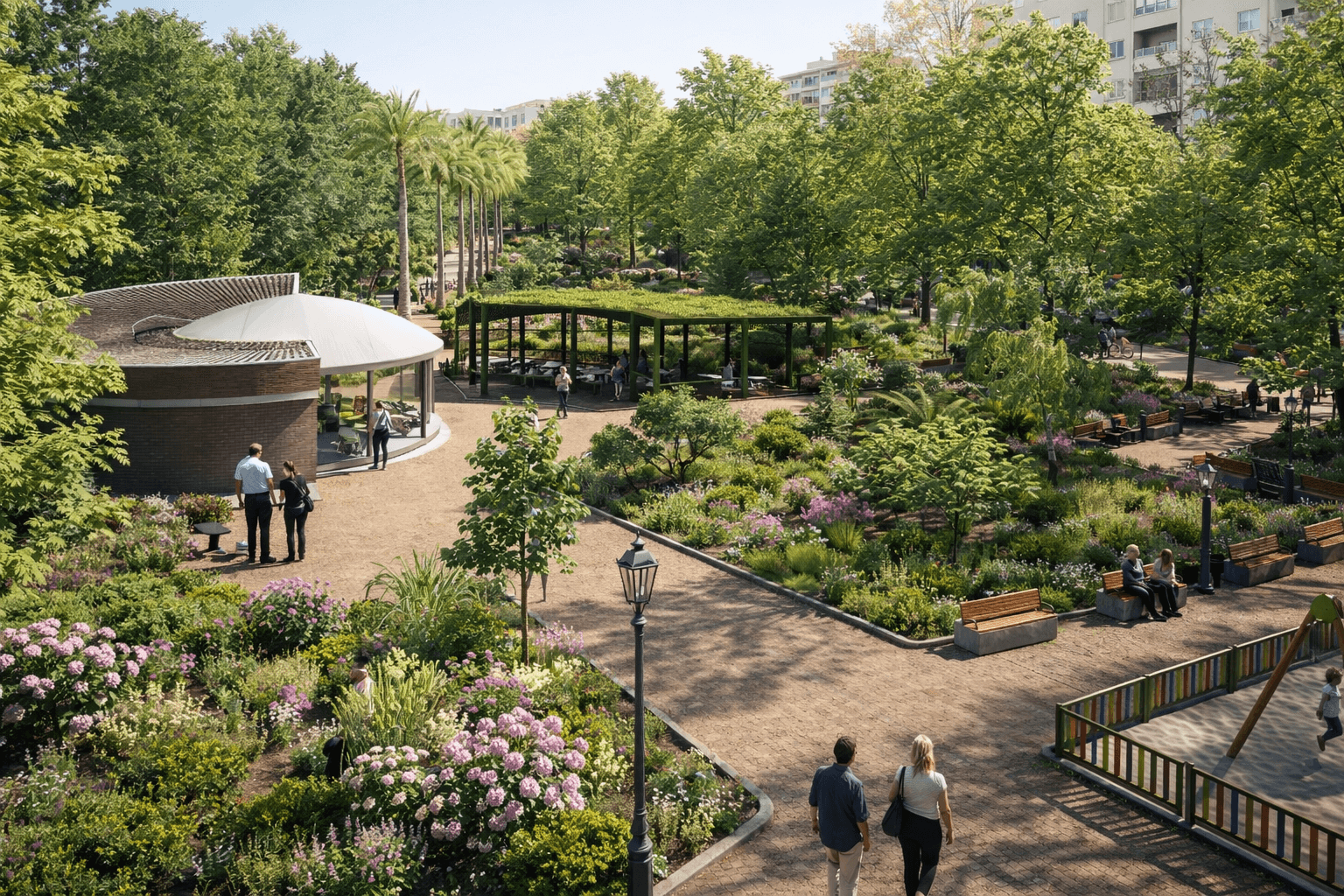
One of the most visible elements of the project will be the creation of eight river parks. Five of them are entirely new and together add more than 12,400 square meters in the first stretch of the river. Spaces like Sopesens, Bruno Solano, and Emperador are designed as green areas, meeting places, playgrounds, and resting spots, integrated into the urban fabric.
In the second stretch, historic parks such as Villafeliche, the Linear Park of Huerva, or the riverbank of Parque Bruil are set to be renewed to enhance accessibility, safety, and connection with the river. The idea is for the Huerva to cease being a boundary and become a unifying axis.
More than a project, an urban philosophy
Beyond aesthetics, recreational space, and street adaptations for people, the Huerva River Project represents a strategic response to climate change, according to the promoting administrations. The widening of the riverbed, floodable parks, and the restoration of the riverside forest will enhance the river’s capacity to absorb episodes of heavy rainfall and improve biodiversity in the urban environment, they assert.
When the works conclude, Zaragoza will have recovered a river and something more: a part of its collective memory and a new green space. All indications point to it becoming an ecological corridor, a unifying axis that allows people to once again look at the Huerva River, recognize it, enjoy it, and care for it. Transforming what was an urban planning mistake of the past into an example of sustainability for the future.