



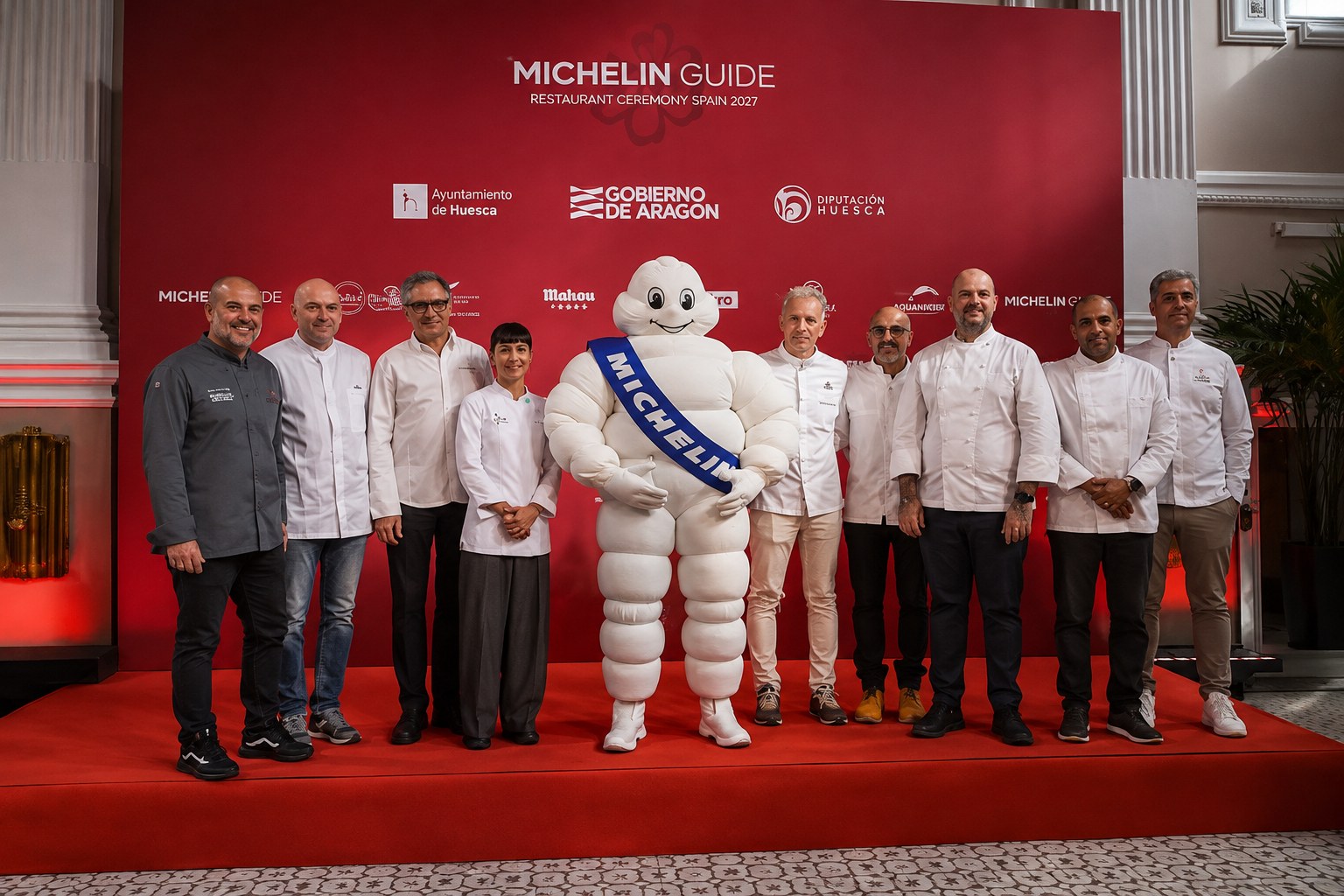
Some regions tell the story of their cuisine through their landscapes, and Huesca is undoubtedly one of them. From the forests of the Pyrenees to the grain fields of Los Monegros and the vineyards of Somontano, the province has developed a culinary tradition rooted in its local products, the seasons, and a heritage that has turned humble ingredients into dishes with a distinctive character. Today, that legacy finds one of its most acclaimed expressions in fine dining. Eight restaurants in the province hold a Michelin star, an accolade of particular significance this year as the city of Huesca prepares to host the Michelin Guide Spain and Andorra 2027 launch gala in December. The event will bring together some of Spanish gastronomy’s leading names, with Carmelo Bosque, chef at Lillas Pastia and one of Aragonese cuisine’s foremost figures, serving as culinary coordinator.
Eight stars and eight approaches to cooking
Upper Aragon’s cuisine is rooted in farming and livestock raising, two activities that shaped the lives of its people for centuries. Shepherd’s breadcrumbs, lamb stews, chiretas, and legume casseroles are part of a culinary repertoire born from the need to make the most of the land’s produce. They are complemented by products such as Graus sausage and a rich pastry-making tradition, with signature specialties including Almudévar braid pastry, Russian cake, and pumpkin empanadicos. One distinctive feature of Huesca’s food scene is that its most acclaimed restaurants are not concentrated in the provincial capital. Of the eight Michelin-starred establishments, two are located in the city of Huesca, while the other six are spread across small villages in and around the Pyrenees.
In the capital, Lillas Pastia, led by Carmelo Bosque, is one of the enduring classics of Aragonese fine dining. It has retained its star since 1998 and has made black truffle one of its hallmarks. Also in Huesca, Tatau, headed by Tonino Valiente, offers creative cuisine in a more casual setting, demonstrating that fine dining need not always follow traditional formats. In Aínsa, Callizo, run by Josetxo Souto and Ramón Aso, offers an innovative take on Pyrenean cuisine. Canfranc Express, led by Eduardo Salanova, delivers a markedly different experience in a former train car at the historic Canfranc station, where Aragonese flavors are blended with French influences. The Benasque Valley is home to two further acclaimed restaurants. Ansils, in Anciles, is led by siblings Iris and Bruno Jordán, who have revitalized the family business by reclaiming mountain recipes and ingredients. In Villanova, Casa Arcas, with Víctor Manuel Ovalles at the helm of its kitchen, rounds out the Michelin-starred presence in this Pyrenean valley. The list continues in Sardas, where La Era de los Nogales, run by Toño Rodríguez, has turned a small village in Alto Gállego into a culinary destination. It extends as far as Hospital de Tella, where Casa Rubén, led by Rubén Coronas and Cristina Romero, earned its first star in the 2026 edition.
These eight restaurants offer markedly different concepts, yet share one common element: each is committed to cuisine connected to the place where it operates.
Fine dining thrives in villages, too
The presence of Michelin-starred restaurants in small communities is one of the most compelling aspects of this phenomenon. These establishments draw visitors, create jobs, and help raise the profile of villages that might otherwise struggle to appear on the itineraries of serious food enthusiasts. Iris Jordán, chef at Ansils, recently spoke in an interview of “a paradigm shift.” The chef championed a cuisine built around humble ingredients and traditional recipes—a style of cooking that finds an opportunity for innovation precisely in its roots. Her own restaurant is a strong example. According to Jordán, Ansils has grown from five to 11 employees since receiving its Michelin star and is beginning to attract international visitors even outside the usual tourist seasons.
In Sardas, Toño Rodríguez has also expanded his activity beyond La Era de los Nogales, launching new projects linked to pastry-making and local products. In a recent interview, the chef highlighted the pride felt by the province’s culinary professionals at Michelin’s decision to hold its gala in Huesca. These initiatives show that fine dining can also represent an opportunity for rural areas, both through their ability to attract visitors and through their contribution to keeping traditional products, recipes, and crafts alive.
The result of many generations
The recognition enjoyed by Huesca’s cuisine today did not emerge overnight. Behind the eight stars lie decades of work and several generations of chefs who have paved the way. Eduardo Salanova, chef at Canfranc Express, recently recalled this in public remarks. He believes today’s success is the result of many years of dedication, during which younger professionals have taken up the baton from those who first began promoting the province’s fine-dining scene. Carmelo Bosque, one of the leading figures in that evolution, has also stressed that the recognition extends far beyond the award-winning restaurants.
Next December, the chefs from all eight Michelin-starred restaurants will take part in the Michelin gala dinner, coordinated by Bosque. It will be an excellent opportunity to showcase to the world the talent of a province that has made gastronomy one of its defining hallmarks.








