



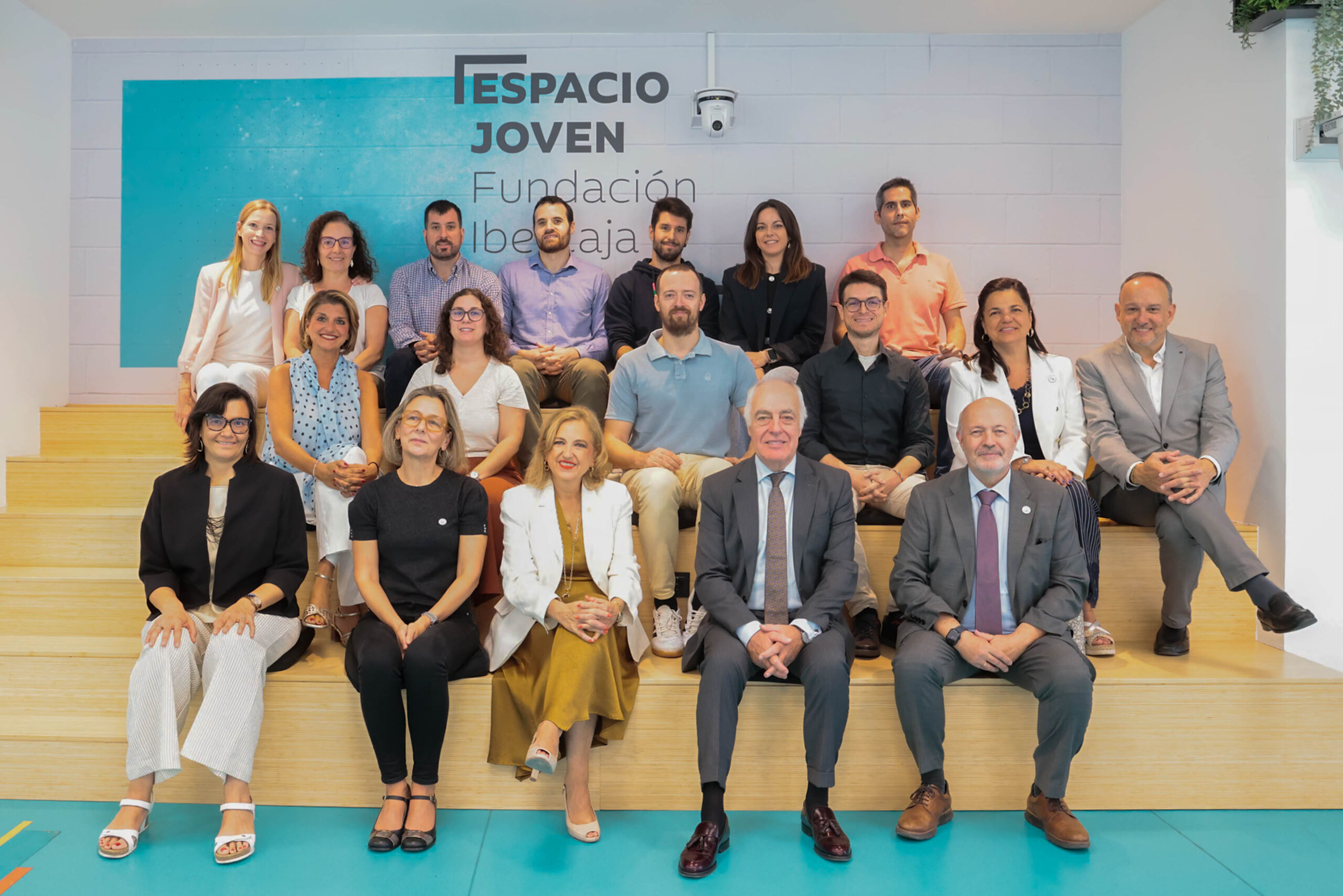
Fundación Ibercaja and the University of Zaragoza have renewed their collaboration agreement to fund research, R&D&I employment, university entrepreneurship, and science and technology career development. The agreement, signed at Fundación Ibercaja’s Espacio Joven, focuses on early-career researchers, rural projects, Parkinson’s diagnosis, and promoting engineering in schools.
The partnership will fund five early-career research projects in 2026
The IMPULSA Talento Joven call will once again be one of the agreement’s main pillars. Aimed at early-career researchers, it seeks to support research and innovation projects and help consolidate independent lines of work across different fields of knowledge.
The 2026 edition introduces a funding model that concentrates support on a smaller number of proposals. The five selected projects range from metabolic health and nutrition to cybersecurity, functional materials, university mental health, and renewable energy systems.
Luis Vicente Herrera Marcos will develop Deep-Lipidomics, a more accessible and affordable lipid-analysis platform, with potential applications in metabolic health, personalized nutrition, and healthy foods. Meanwhile, Manuel Pedrón Laserna will work on the computational design of boron- and nitrogen-based functional materials for potential photonic, optoelectronic, and energy applications.
Also selected were Javier Carrillo Mondéjar, who will investigate vulnerabilities in connected devices through code analysis and artificial intelligence; Verónica Vidal-Arenas, who will use machine-learning models to study suicidal ideation among university students; and Eduardo Antonio Pina, who will develop DESIGN+ to improve the design and evaluation of renewable energy systems.
The agreement continues research into early Parkinson’s diagnosis
The agreement also renews support for Parkinson’s disease research being conducted by a team at the Institute of Biocomputation and Physics of Complex Systems (BIFI) at the University of Zaragoza, led by Dr. Nunilo Cremades.
The project studies biomarkers found in biological samples, specifically alpha-synuclein oligomers, small protein clusters associated with the development of the disease. The team has completed the protocol for isolating these biomarkers and developed two methods to measure and quantify them.
The research includes clinical collaboration with Dr. Juan Marín Lahoz of the Miguel Servet University Hospital, enabling the analysis of blood samples and nasal swabs from Parkinson’s patients and their comparison with those of healthy individuals. In its current phase, the team is using advanced artificial-intelligence models alongside Dr. David Yllanes and the company Kampal to identify patterns that can help distinguish between the two groups.
Rural entrepreneurship and engineering workshops for more than 3,200 schoolchildren
The renewal also continues Impulsa tu territorio, a rural university entrepreneurship program developed within the UNITA – Universitas Montium alliance. The initiative will bring together multidisciplinary teams of students from the University of Zaragoza and other universities in the network to develop solutions to challenges facing the Aragon region.
The program will fund feasibility studies, advisory services, and mentoring, as well as cash prizes for selected projects. Its four strategic areas are rural digitalization, the energy transition, global health, and building a more inclusive society. The schedule includes an Ideathon on October 2 and a Hackathon on November 6 and 7.
Since 2026, Fundación Ibercaja has also supported Una ingeniera en cada cole, an initiative promoted by the University of Zaragoza and AMIT-Aragón. The latest edition involved more than 120 volunteers, visited 34 schools, and reached 3,220 schoolchildren. Over its previous 11 editions, the project had involved more than 24,500 students.
The partnership between the two institutions thus brings together support for early-career research, knowledge transfer, rural entrepreneurship, and science outreach, with initiatives designed to connect university talent with the region’s social and economic needs.